Epalpus signifer
Early Tachinid Fly
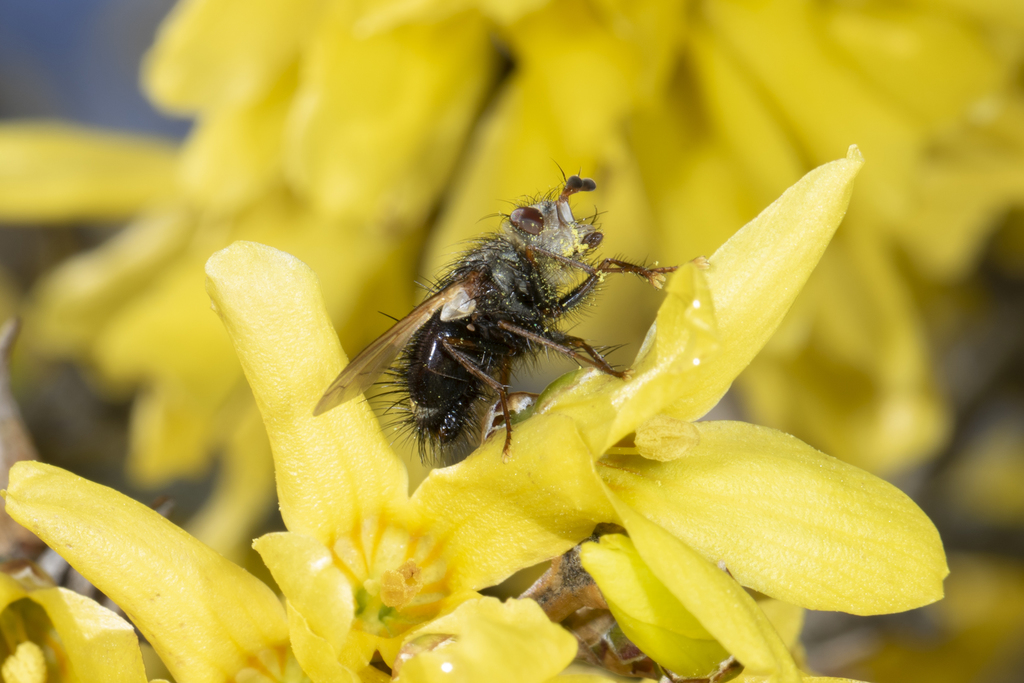
no rights reserved · CC0
Family: Tachinidae · Class: Insecta · Order: Diptera
Epalpus signifer (Early Tachinid Fly) is a California animal in the Tachinidae family.
The Early Tachinid Fly (Epalpus signifer) is a member of the diverse family Tachinidae, parasitoid flies that play important ecological roles as natural biocontrol agents. Like other tachinid flies, this species exhibits the characteristic bristled appearance typical of the family, with adults displaying the robust body structure and prominent bristles that distinguish tachinids from other dipteran families. Adult tachinid flies generally measure 3-15 mm in length, though specific morphometric data for E. signifer has not been well documented in the available literature. The distribution and range of Epalpus signifer within California and North America requires further documentation. According to NatureServe, the species has a global conservation rank of G4 (Apparently Secure), suggesting stable populations across its range, though specific locality records and population assessments remain limited in the scientific literature. The species belongs to the subfamily Tachininae and tribe Tachinini, placing it within a large group of tachinid flies that includes over 120 species across 16 genera in North America. Habitat requirements for E. signifer have not been thoroughly studied, but tachinid flies typically inhabit diverse environments where their host species occur. Many tachinids are associated with areas containing flowering plants that provide nectar sources for adults, as these flies require carbohydrate resources for flight and reproduction. The species likely occurs in habitats supporting its specific arthropod hosts, though these host associations remain undocumented for this particular species. As a parasitoid, E. signifer follows the typical tachinid life cycle where larvae develop within or on arthropod hosts, ultimately killing them during development. Adult females locate appropriate hosts and deposit eggs either directly on the host, near the host, or in some cases, eggs are ingested by hosts feeding on contaminated plant material. The larval stage is the parasitic phase, with larvae consuming host tissues and eventually pupating either within the host remains or in nearby soil. Adults emerge to mate and continue the cycle, with timing likely corresponding to host availability. Adult tachinids commonly feed on nectar from flowers, particularly those with accessible nectaries such as yarrow and other composite flowers that attract beneficial insects with smaller mouthparts. Conservation status information for Epalpus signifer is limited. The NatureServe ranking of G4 suggests the species is not currently of conservation concern, though this assessment may be based on limited survey data. No federal or state listing status has been assigned to this species as of December 2025. Like many specialized parasitoids, tachinid flies can be sensitive to habitat modifications that affect their host species or eliminate flowering plants that provide adult nutrition. The ecological value of tachinid flies as natural biocontrol agents makes them important components of integrated pest management systems and natural ecosystem function. Further research is needed to document the specific host relationships, distribution, and habitat requirements of E. signifer to better understand its ecological role and conservation needs.
Classification
Class: Insecta · Order: Diptera · Family: Tachinidae
Frequently asked questions
How is Epalpus signifer classified?
Epalpus signifer belongs to class Insecta, order Diptera, family Tachinidae.
What family does Epalpus signifer belong to?
Epalpus signifer is in the Tachinidae family.
What is Epalpus signifer?
The Early Tachinid Fly (Epalpus signifer) is a member of the diverse family Tachinidae, parasitoid flies that play important ecological roles as natural biocontrol agents.
Is Epalpus signifer found in California?
Yes. Epalpus signifer is recorded in California in The California Species Project's catalogue.
Related species
Other California species in the same genus, family, or bioregion.
Data from The California Species Project — 14,000+ California species with verified data from CNPS, CDFW, USFWS, and more.