Epargyreus exadeus
Broken Silverdrop
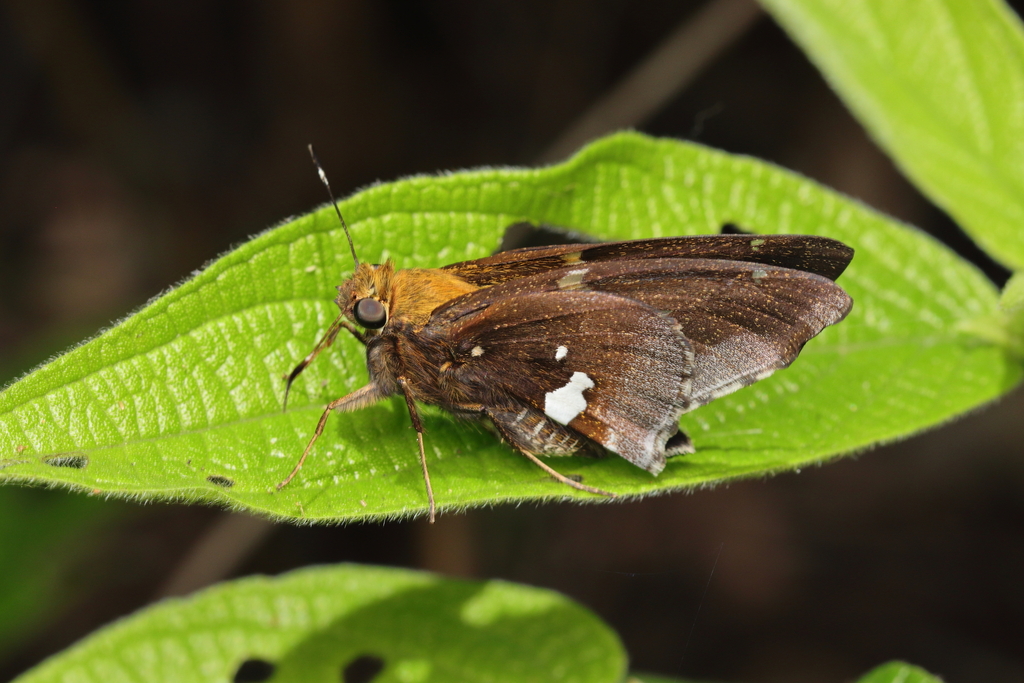
(c) Carlos Alexandre Mattos Raposo, some rights reserved (CC BY-SA) · licence
Family: Hesperiidae · Class: Insecta · Order: Lepidoptera
Epargyreus exadeus (Broken Silverdrop) is a California animal in the Hesperiidae family.
Epargyreus exadeus, commonly known as the Broken Silverdrop, is a large skipper butterfly in the family Hesperiidae. Adults have a wingspan ranging from 45 to 60 mm (1.8 to 2.4 inches). The forewings are dark brown to blackish with distinctive white translucent spots that create a broken pattern across the wing surface. The hindwings are similarly dark with white spotting, though typically less pronounced than on the forewings. The underside of the hindwings displays a characteristic silvery-white patch with irregular dark markings that gives this species its common name. Males possess a prominent stigma, a dark scent patch on the forewings used in courtship displays. The Broken Silverdrop has an extensive range from Argentina north through Central America to Mexico. In the United States, it occurs as a rare stray reaching South Texas, southern Arizona, and southern California. These northernmost records represent vagrant individuals rather than established breeding populations. The species is primarily tropical and subtropical, with its core range encompassing much of Mexico and extending south through Guatemala, Belize, Honduras, El Salvador, Nicaragua, Costa Rica, Panama, and into South America. This skipper inhabits tropical and subtropical regions with abundant leguminous vegetation. In its native range, it occurs in lowland areas, forest edges, gardens, and disturbed habitats where host plants are present. Elevational preferences range from sea level to approximately 1,500 meters (4,900 feet) in mountainous regions. The species favors areas with partial shade and access to nectar sources for adults. Adult Broken Silverdrops are strong, fast fliers that visit flowers for nectar, particularly favoring white and pale-colored blooms. Males establish territories and engage in rapid, erratic flight patterns during courtship. The species utilizes various legumes as larval host plants, including members of the genera Cassia and Phaseolus. Females deposit eggs singly on host plant leaves, and larvae construct leaf shelters by folding or rolling leaves together with silk. Development from egg to adult typically requires 6 to 8 weeks under favorable conditions. In tropical regions, the species likely maintains continuous broods throughout the year, while populations in more seasonal areas may have distinct flight periods. As a rare vagrant to the United States, the Broken Silverdrop has no formal conservation status in North America. Occasional sightings in South Texas, southern Arizona, and southern California likely represent individuals carried northward by weather systems or natural dispersal events. These vagrant occurrences provide no indication of population trends, as the species does not maintain breeding populations in the United States. In its native range, population status appears stable, though specific monitoring data are limited. The species benefits from its use of common leguminous plants and its ability to utilize various habitat types, including human-modified environments.
Classification
Class: Insecta · Order: Lepidoptera · Family: Hesperiidae
Frequently asked questions
How is Epargyreus exadeus classified?
Epargyreus exadeus belongs to class Insecta, order Lepidoptera, family Hesperiidae.
What family does Epargyreus exadeus belong to?
Epargyreus exadeus is in the Hesperiidae family.
What is Epargyreus exadeus?
Epargyreus exadeus, commonly known as the Broken Silverdrop, is a large skipper butterfly in the family Hesperiidae.
Is Epargyreus exadeus found in California?
Yes. Epargyreus exadeus is recorded in California in The California Species Project's catalogue.
Related species
Other California species in the same genus, family, or bioregion.
Data from The California Species Project — 14,000+ California species with verified data from CNPS, CDFW, USFWS, and more.