Epinotia subviridis
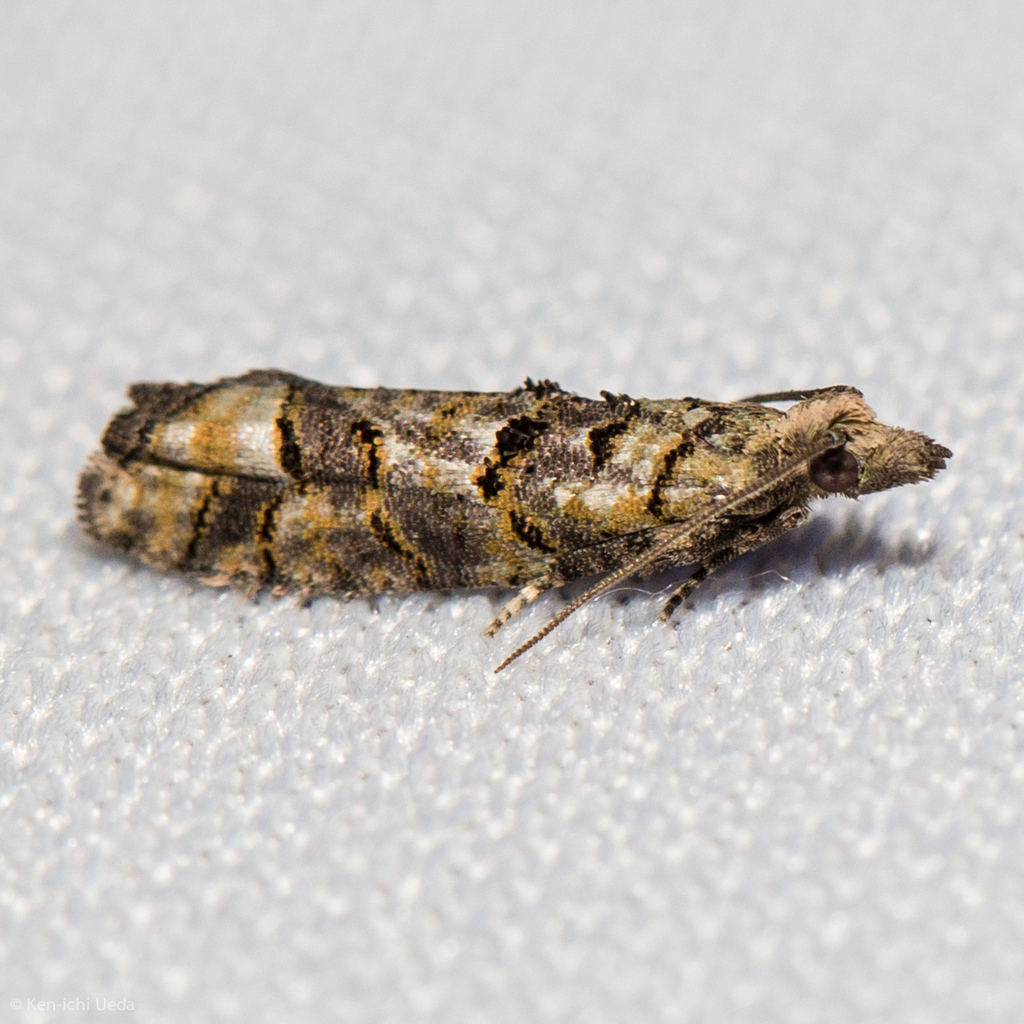
(c) Ken-ichi Ueda, some rights reserved (CC BY) · licence
Family: Tortricidae · Class: Insecta · Order: Lepidoptera
Epinotia subviridis is a California animal in the Tortricidae family.
Epinotia subviridis is a small moth species belonging to the family Tortricidae, commonly known as leafroller moths. This species represents one of numerous tortricid moths native to western North America, distinguished by its specialized feeding relationship with coniferous hosts. Adult moths typically measure 8 to 12 mm in forewing length, displaying the characteristic bell-shaped wing profile when at rest that defines the tortricid family. The forewings are generally brownish-gray with subtle darker markings and pale streaking, while the hindwings are lighter gray to whitish. Males possess feathery antennae, while females have thread-like antennae. The distribution of E. subviridis encompasses western North America, with documented occurrences across coniferous forest regions. The species has been recorded from British Columbia south through the Pacific Northwest and into California, primarily associated with montane and subalpine coniferous ecosystems. Specific distributional records within California remain limited, reflecting both the species' potentially restricted range and the general under-documentation of microlepidoptera in the region. Epinotia subviridis inhabits coniferous forests dominated by junipers, cedars, and other coniferous trees that serve as larval host plants. The species occurs in mixed conifer forests, juniper woodlands, and areas where arborvitae and related conifers are present. Elevation ranges likely span from mid-elevation zones to higher montane environments, corresponding to the distribution of suitable host plants. The moth appears to favor mature forest stands where host conifers are well-established. Larvae of E. subviridis feed specifically on junipers, cedars, arborvitae, and other conifers, exhibiting the typical tortricid feeding behavior of creating silk shelters while consuming foliage, buds, or developing shoots. The larvae likely construct webbed feeding sites by tying together needles or small branches of their coniferous hosts. Development from egg to adult typically requires one year, with overwintering occurring in the larval stage within protective shelters on the host plant. Adults are presumed to emerge during late spring to early summer months, coinciding with optimal conditions for mating and oviposition. Females deposit eggs singly or in small clusters on host plant surfaces, particularly on young growth or needle clusters. The conservation status of Epinotia subviridis has not been formally evaluated by state or federal agencies, and the species lacks specific protection status. Population trends remain undocumented, reflecting the limited research attention given to most microlepidoptera species. Potential threats may include habitat loss through logging, wildfire management practices, and climate change impacts on coniferous forest ecosystems. The species' dependence on specific coniferous hosts makes it potentially vulnerable to forest management practices that alter the composition or structure of montane conifer communities. Further taxonomic and ecological research is needed to better understand the species' distribution, population status, and conservation needs within California's diverse coniferous ecosystems.
Classification
Class: Insecta · Order: Lepidoptera · Family: Tortricidae
Frequently asked questions
How is Epinotia subviridis classified?
Epinotia subviridis belongs to class Insecta, order Lepidoptera, family Tortricidae.
What family does Epinotia subviridis belong to?
Epinotia subviridis is in the Tortricidae family.
What is Epinotia subviridis?
Epinotia subviridis is a small moth species belonging to the family Tortricidae, commonly known as leafroller moths.
Is Epinotia subviridis found in California?
Yes. Epinotia subviridis is recorded in California in The California Species Project's catalogue.
Related species
Other California species in the same genus, family, or bioregion.
Data from The California Species Project — 14,000+ California species with verified data from CNPS, CDFW, USFWS, and more.