Eptesicus fuscus
Big Brown Bat
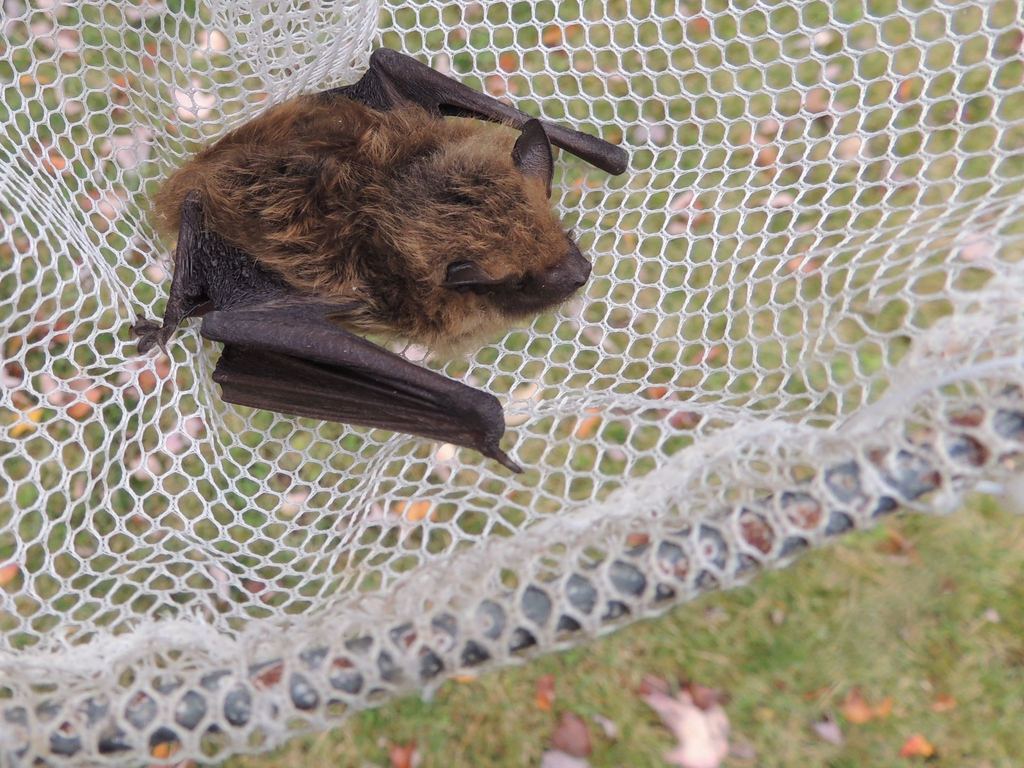
no rights reserved · CC0
Family: Vespertilionidae · Class: Mammalia · Order: Chiroptera
Eptesicus fuscus (Big Brown Bat) is a California animal in the Vespertilionidae family.
The big brown bat is a medium to large North American bat species with robust build and broad wings. Adults measure 106 to 127 mm (4.2 to 5.0 inches) in total length with a wingspan of 325 to 350 mm (12.8 to 13.8 inches). Body mass ranges from 14 to 25 grams (0.5 to 0.9 ounces). The pelage is glossy brown to dark brown dorsally, with slightly paler brown ventral coloration. The ears are relatively short and rounded, and the tragus is broad and blunt. Wing membranes and tail membrane are dark brown to black. Sexual dimorphism is present, with females typically larger than males. Big brown bats occur throughout most of North America, ranging from southern Canada to northern South America. In California, the species is widely distributed across the state, occurring in nearly all counties from sea level to elevations exceeding 2,000 meters (6,600 feet). The species is found throughout the Sierra Nevada, Coast Ranges, Central Valley, and desert regions. Populations are year-round residents in most of California, though some northern populations may migrate seasonally. The species occupies diverse habitats including urban areas, agricultural lands, forests, grasslands, and desert environments. Big brown bats commonly roost in buildings, utilizing attics, wall spaces, and other structures. Natural roost sites include tree cavities, rock crevices, caves, and cliff faces. Summer maternity colonies typically form in warm locations such as building attics, while males often roost solitarily. Winter hibernation sites include caves, mines, buildings, and other protected locations with stable temperatures. Big brown bats are insectivorous, feeding primarily on beetles, which comprise up to 50 percent of their diet. Other prey includes moths, flies, flying ants, and other flying insects. Foraging typically occurs within 1.6 km (1 mile) of roost sites, with hunting flights following regular patterns along forest edges, over water, and around streetlights. The species uses echolocation calls of 25 to 50 kHz for navigation and prey detection. Mating occurs in fall, with delayed fertilization resulting in births the following late spring or early summer. Gestation lasts approximately 60 days. Females typically give birth to twins, though litter size ranges from one to four young. Lactation continues for 4 to 5 weeks, with juveniles achieving flight capability at 3 to 4 weeks of age. Big brown bats are not federally or state listed as threatened or endangered. The species is considered secure throughout most of its range, with stable populations in California. However, local populations face threats including habitat loss due to urban development, building modifications that eliminate roost sites, and pesticide use that reduces insect prey availability. White-nose syndrome, caused by the fungus Pseudogymnoascus destructans, poses a potential threat, though big brown bats appear more resistant than other species. Climate change may affect hibernation patterns and prey availability, particularly in montane regions.
Classification
Class: Mammalia · Order: Chiroptera · Family: Vespertilionidae
Frequently asked questions
How is Eptesicus fuscus classified?
Eptesicus fuscus belongs to class Mammalia, order Chiroptera, family Vespertilionidae.
What family does Eptesicus fuscus belong to?
Eptesicus fuscus is in the Vespertilionidae family.
What is Eptesicus fuscus?
The big brown bat is a medium to large North American bat species with robust build and broad wings.
Is Eptesicus fuscus found in California?
Yes. Eptesicus fuscus is recorded in California in The California Species Project's catalogue.
Related species
Other California species in the same genus, family, or bioregion.
Data from The California Species Project — 14,000+ California species with verified data from CNPS, CDFW, USFWS, and more.