Eremarionta rowelli bakerensis
Baker's Desertsnail
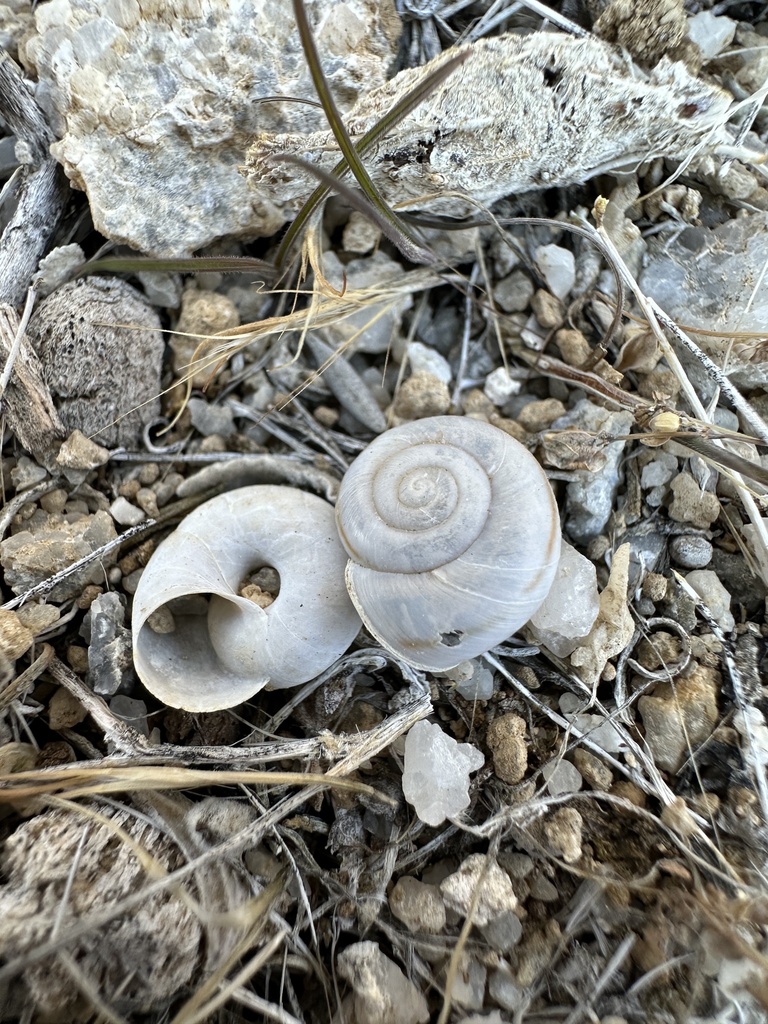
(c) Matt Berger, some rights reserved (CC BY) · licence
Family: Helminthoglyptidae · Class: Gastropoda · Order: Stylommatophora
Conservation status: G3G4T1 S1
Eremarionta rowelli bakerensis (Baker's Desertsnail) is a California animal in the Helminthoglyptidae family.
Baker's desertsnail is a terrestrial gastropod endemic to California, representing a subspecies of Eremarionta rowelli. This small desert snail exhibits the characteristic coiled shell morphology typical of the family Helminthoglyptidae, with specific morphological features that distinguish it from other subspecies within the E. rowelli complex. The shell typically displays a pale coloration adapted to desert environments, though detailed morphometric studies of this subspecies remain limited. Baker's desertsnail occurs in a restricted range within California's desert regions. The species' distribution is highly localized, contributing to its conservation concern. Current range data indicate the subspecies occupies a limited geographic area, though specific locality information requires verification through systematic surveys. The subspecies name suggests a connection to the Baker area of San Bernardino County, though comprehensive distribution mapping has not been completed. This desert-adapted mollusk inhabits arid environments characteristic of California's Mojave Desert region. The species likely occupies rocky outcrops, desert scrub communities, and areas with suitable microhabitat conditions that provide shelter from extreme temperatures and desiccation. Like other desert snails, Baker's desertsnail probably seeks refuge in rock crevices, under shrubs, or in soil during unfavorable conditions. Elevation range and specific vegetation associations have not been well documented for this subspecies. Baker's desertsnail exhibits behavioral adaptations common to desert gastropods, including estivation during periods of extreme heat and drought. The species likely emerges during cooler periods and following precipitation events to feed on organic matter, lichens, and decaying plant material. Reproductive biology remains poorly studied, though desert snails typically reproduce during favorable moisture conditions. Population dynamics and seasonal activity patterns require further investigation to understand the subspecies' ecological requirements. The subspecies holds a Global/State Rank of G3G4T1 S1, indicating it is critically imperiled at both the taxonomic and state levels. The T1 ranking signifies that this subspecies faces an extremely high risk of extinction, with very few populations or occurrences documented. The S1 state ranking reflects similar concern within California, where the subspecies appears to maintain only one to five occurrences or very few remaining individuals. Primary threats likely include habitat modification, urban development, off-road vehicle activity, and climate change impacts on desert ecosystems. The limited distribution makes the subspecies particularly vulnerable to localized disturbances. No federal listing status has been assigned as of December 2025, though the critical state and global rankings suggest conservation attention may be warranted. Systematic surveys to determine current population status and habitat requirements are needed to develop appropriate conservation strategies for this endemic California subspecies.
Classification
Class: Gastropoda · Order: Stylommatophora · Family: Helminthoglyptidae
Conservation status
G3G4T1 S1
Frequently asked questions
How is Eremarionta rowelli bakerensis classified?
Eremarionta rowelli bakerensis belongs to class Gastropoda, order Stylommatophora, family Helminthoglyptidae.
What family does Eremarionta rowelli bakerensis belong to?
Eremarionta rowelli bakerensis is in the Helminthoglyptidae family.
Is Eremarionta rowelli bakerensis protected or of conservation concern?
Eremarionta rowelli bakerensis carries the following status: G3G4T1 S1.
What is Eremarionta rowelli bakerensis?
Baker's desertsnail is a terrestrial gastropod endemic to California, representing a subspecies of Eremarionta rowelli.
Is Eremarionta rowelli bakerensis found in California?
Yes. Eremarionta rowelli bakerensis is recorded in California in The California Species Project's catalogue.
Related species
Other California species in the same genus, family, or bioregion.
Data from The California Species Project — 14,000+ California species with verified data from CNPS, CDFW, USFWS, and more.