Eremophila alpestris
Horned Lark
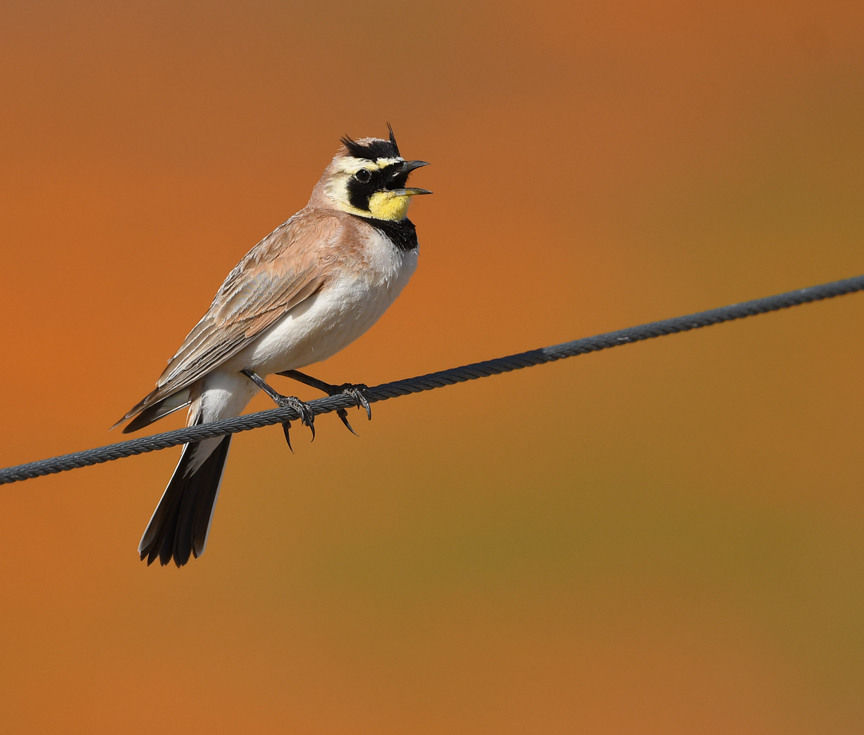
(c) Pat Farris, some rights reserved (CC BY) · licence
Family: Alaudidae · Class: Aves · Order: Passeriformes
Eremophila alpestris (Horned Lark) is a California animal in the Alaudidae family.
The Horned Lark is a small songbird measuring 17 to 20 cm (6.7 to 7.9 inches) in length with a wingspan of 30 to 35 cm (11.8 to 13.8 inches). Adults weigh 28 to 48 grams (1.0 to 1.7 ounces). Males display distinctive black facial markings forming a mask across the eyes and cheeks, with prominent black "horns" - elongated feather tufts extending from the crown. The throat is bright yellow, contrasting with a black breast band. The back is brown with darker streaking, while the underparts are white to pale yellow. Females show similar but more subdued patterns with less distinct facial markings and smaller horn tufts. Both sexes have dark tails with white outer feathers visible in flight. The Horned Lark has one of the most extensive breeding ranges of any North American bird, occurring across Alaska, Canada, and much of the continental United States. In California, the species breeds in suitable habitat throughout the state, from sea level to elevations exceeding 4,000 meters (13,100 feet) in the Sierra Nevada. Multiple subspecies occur in California, with coastal populations, Central Valley birds, and high-elevation montane forms showing variation in size and coloration. Horned Larks inhabit open, sparsely vegetated terrain including prairies, agricultural fields, airports, beaches, alpine tundra, and desert flats. The species requires areas with bare ground or very short vegetation for foraging and nesting. In California, they occupy coastal dunes, agricultural lands in the Central Valley, high-elevation meadows above treeline, and desert regions of the Mojave and Sonoran deserts. During winter, birds concentrate in lowland agricultural areas and coastal plains. The species feeds primarily on seeds, particularly from grasses and forbs, supplementing the diet with insects during breeding season. Horned Larks are ground nesters, with females constructing cup-shaped nests in shallow depressions lined with fine grasses and plant fibers. Breeding occurs from February through August, varying with elevation and latitude. Females typically lay 2 to 5 eggs, with incubation lasting 11 to 12 days. Multiple broods per season are common in favorable conditions. Males perform elaborate flight displays during courtship, ascending to heights of 200 to 800 feet before diving toward the ground while singing. The Horned Lark is not federally or state listed and maintains stable populations across most of its range. However, some subspecies face conservation concerns. The streaked horned lark (E. a. strigata) of the Pacific Northwest is listed as threatened under the Endangered Species Act due to habitat loss from urban development and agricultural intensification. In California, breeding bird survey data indicate stable to slightly declining trends over the past several decades, primarily attributed to conversion of grasslands and agricultural intensification. Climate change may affect high-elevation populations by altering alpine habitat conditions.
Classification
Class: Aves · Order: Passeriformes · Family: Alaudidae
Frequently asked questions
How is Eremophila alpestris classified?
Eremophila alpestris belongs to class Aves, order Passeriformes, family Alaudidae.
What family does Eremophila alpestris belong to?
Eremophila alpestris is in the Alaudidae family.
What is Eremophila alpestris?
The Horned Lark is a small songbird measuring 17 to 20 cm (6.7 to 7.9 inches) in length with a wingspan of 30 to 35 cm (11.8 to 13.8 inches).
Is Eremophila alpestris found in California?
Yes. Eremophila alpestris is recorded in California in The California Species Project's catalogue.
Related species
Other California species in the same genus, family, or bioregion.
Data from The California Species Project — 14,000+ California species with verified data from CNPS, CDFW, USFWS, and more.