Eremophila alpestris actia
California Horned Lark
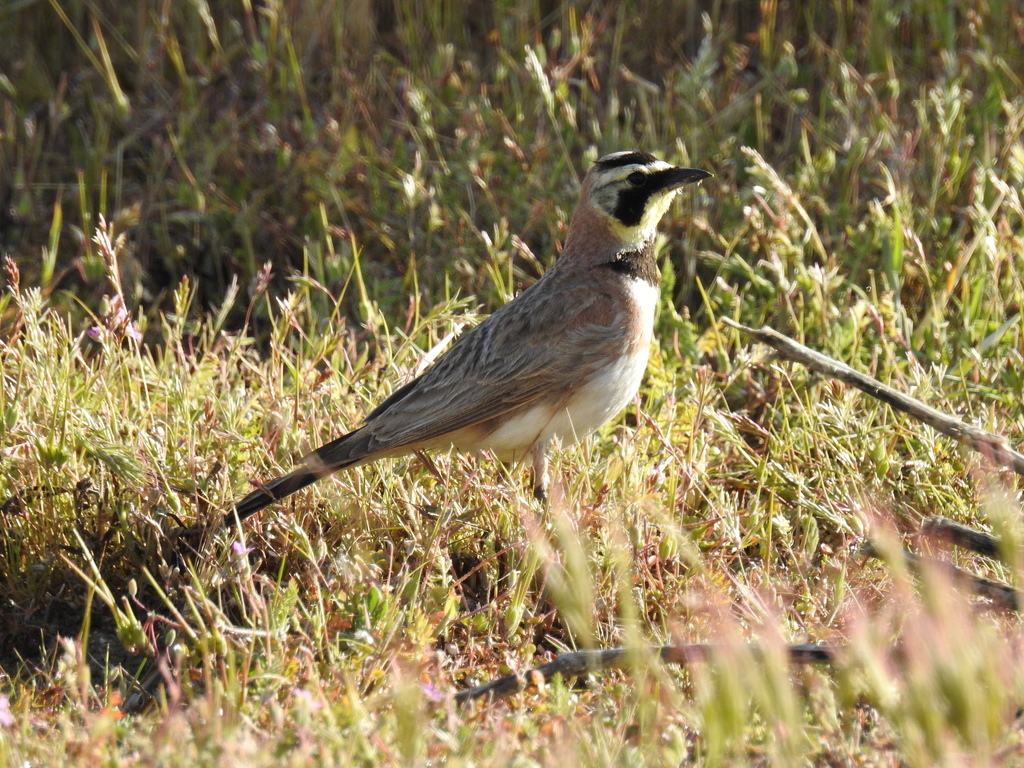
(c) P Holroyd, some rights reserved (CC BY) · licence
Family: Alaudidae · Class: Aves · Order: Passeriformes
Conservation status: WL · G5T4Q S4
Eremophila alpestris actia (California Horned Lark) is a California animal in the Alaudidae family.
The California Horned Lark (Eremophila alpestris actia) is a subspecies of the widespread Horned Lark, the only member of the family Alaudidae native to North America. Adults measure 17 to 20 centimeters (6.7 to 7.9 inches) in length with a wingspan of 30 to 34 centimeters (11.8 to 13.4 inches). Males display distinctive black "horns" or feather tufts above the eyes, along with a black facial mask and throat patch that contrasts with yellow facial coloring. The back and wings are brown with darker streaking, while the underparts are pale yellow to white. Females show similar but more subdued markings with less pronounced facial patterns. This subspecies is endemic to California, occurring primarily in the Central Valley and adjacent foothills. Historical records indicate distribution throughout much of the state's interior valleys and grasslands. The California Horned Lark inhabits open, sparsely vegetated areas including short-grass prairies, agricultural fields, pastures, and disturbed lands. According to Birds of the World, Horned Larks prefer areas with minimal vegetation cover, avoiding dense grasslands and shrublands (Beason 2020). The species favors flat to gently rolling terrain at elevations from sea level to approximately 1,500 meters (4,900 feet). Prime habitat consists of areas with 25 percent or less vegetation cover, including grazed grasslands, fallow agricultural fields, and recently burned areas. The subspecies has adapted to human-modified landscapes, utilizing crop stubble, dirt roads, and airport grasslands. California Horned Larks are primarily ground-dwelling birds that walk and run rather than hop. Males perform elaborate courtship flights, ascending 200 to 800 meters (650 to 2,600 feet) while singing before diving toward the ground. The breeding season extends from February through July, with peak activity occurring from March to May. Females construct cup-shaped nests on the ground, often in slight depressions or against small objects. Clutches typically contain 2 to 5 eggs, with an average of 3 to 4. Incubation lasts 11 to 12 days, and young fledge after 9 to 12 days. Pairs may produce multiple broods annually under favorable conditions. The diet consists primarily of seeds from grasses and forbs during non-breeding periods, with adults consuming seeds from plants such as chickweed, knotweed, and various grass species. During breeding season, parents feed insects including beetles, moths, caterpillars, and flies to nestlings, providing essential protein for growth. The California Horned Lark has a NatureServe global rank of G5T4Q, indicating the subspecies is apparently secure but with some uncertainty regarding taxonomic classification. However, populations have experienced significant declines due to habitat loss from urbanization, intensive agriculture, and invasive plant species that create unsuitable dense vegetation. The conversion of native grasslands to urban development and changes in agricultural practices have reduced available breeding habitat throughout the Central Valley.
Classification
Class: Aves · Order: Passeriformes · Family: Alaudidae
Conservation status
WL · G5T4Q S4
Frequently asked questions
How is Eremophila alpestris actia classified?
Eremophila alpestris actia belongs to class Aves, order Passeriformes, family Alaudidae.
What family does Eremophila alpestris actia belong to?
Eremophila alpestris actia is in the Alaudidae family.
Is Eremophila alpestris actia protected or of conservation concern?
Eremophila alpestris actia carries the following status: WL · G5T4Q S4.
What is Eremophila alpestris actia?
The California Horned Lark (Eremophila alpestris actia) is a subspecies of the widespread Horned Lark, the only member of the family Alaudidae native to North America.
Is Eremophila alpestris actia found in California?
Yes. Eremophila alpestris actia is recorded in California in The California Species Project's catalogue.
Related species
Other California species in the same genus, family, or bioregion.
Data from The California Species Project — 14,000+ California species with verified data from CNPS, CDFW, USFWS, and more.