Eremophila alpestris strigata
Streaked Horned lark
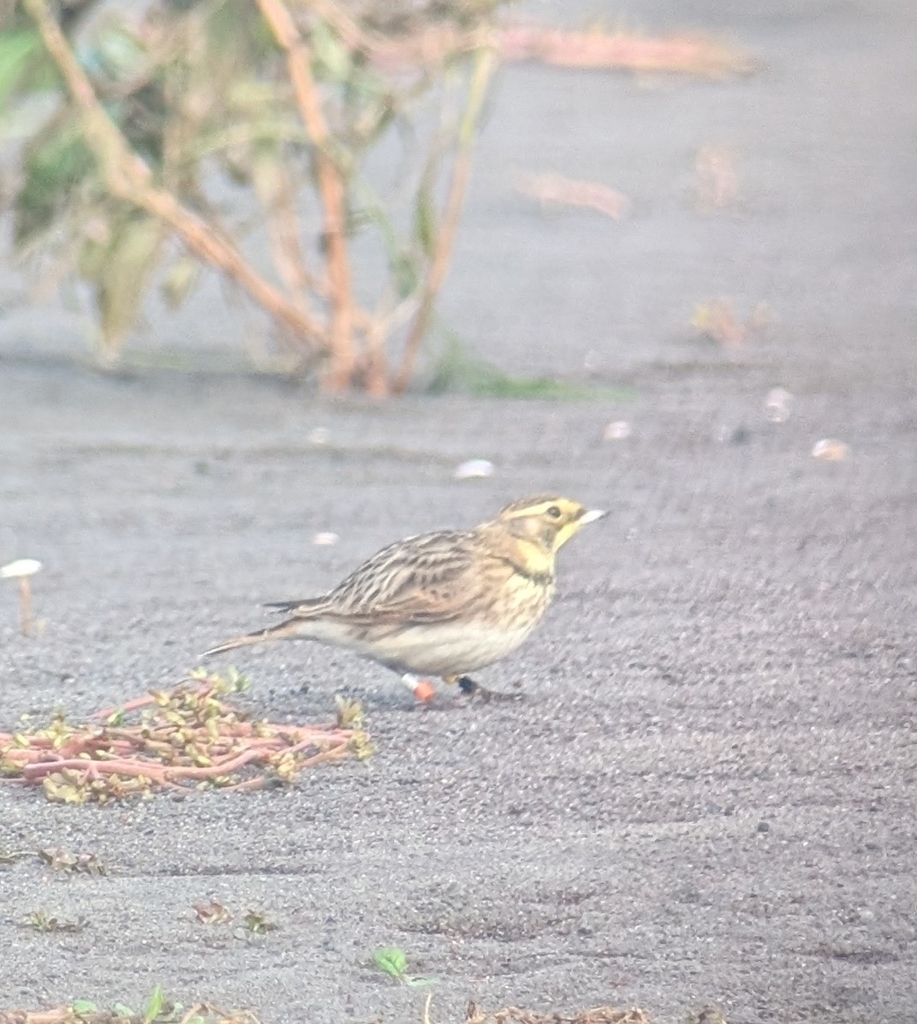
(c) Brodie Cass Talbott, some rights reserved (CC BY) · licence
Family: Alaudidae · Class: Aves · Order: Passeriformes
Conservation status: Threatened
Eremophila alpestris strigata (Streaked Horned lark) is a California animal in the Alaudidae family.
The Streaked Horned Lark is a subspecies of Horned Lark distinguished by its streaked breast patterns and coastal habitat preferences. Adults are small, long-bodied songbirds measuring approximately 17-20 cm (6.7-7.9 inches) in length with a horizontal posture. They possess the characteristic black facial markings and small horn-like feather tufts of all Horned Larks, but the streaked subspecies displays more pronounced streaking on the breast and less crisply defined patterns compared to other subspecies. The bill is short and thin, adapted for ground foraging, with a rounded head and short neck typical of the species. Historically, the Streaked Horned Lark ranged along the Pacific Coast from southern British Columbia through western Washington and Oregon to northern California. Current populations are severely restricted, with breeding documented primarily in Washington's Puget Sound region, the Columbia River estuary, and coastal Oregon. The subspecies has experienced dramatic range contraction, with many historical breeding areas no longer supporting viable populations. Streaked Horned Larks inhabit coastal prairies, grasslands, and open areas characterized by flat terrain with substantial bare ground and sparse, low-stature vegetation. They select habitats with short grass and forb communities, often in areas maintained by grazing, mowing, or natural disturbance. Airport grasslands have become important refugia, as they provide the open, short-vegetation habitat structure required by the subspecies. Coastal dunes, agricultural fields, and managed grasslands also serve as breeding and foraging habitat when appropriate vegetation structure is maintained. The species exhibits typical Horned Lark behavior, foraging on the ground for seeds, insects, and plant material. Breeding occurs from April through July, with females constructing ground nests in shallow depressions lined with grass and plant fibers. Clutches typically contain 2-4 eggs, and pairs may attempt multiple broods per season under favorable conditions. Males perform aerial territorial displays and song flights during breeding season. The subspecies is partially migratory, with some populations moving to lower elevations or more southern latitudes during winter months. The U.S. Fish and Wildlife Service listed the Streaked Horned Lark as threatened under the Endangered Species Act on October 3, 2013, with critical habitat designated covering approximately 9,735 acres across Washington and Oregon. Population estimates indicate fewer than 1,000 breeding pairs remain, representing a severe decline from historical levels (USFWS Species Profile). Primary threats include habitat loss due to urban development, agricultural intensification, and invasion by non-native vegetation that alters the open grassland structure essential for the subspecies. Succession of grasslands to shrublands and forests also eliminates suitable habitat. The Service reaffirmed the threatened status in 2022 following a comprehensive review, emphasizing the ongoing need for habitat conservation and management. Recovery efforts focus on habitat restoration, management of existing grasslands to maintain appropriate vegetation structure, and partnerships with airport authorities and agricultural landowners to preserve suitable habitat on working landscapes.
Classification
Class: Aves · Order: Passeriformes · Family: Alaudidae
Conservation status
Threatened
Frequently asked questions
How is Eremophila alpestris strigata classified?
Eremophila alpestris strigata belongs to class Aves, order Passeriformes, family Alaudidae.
What family does Eremophila alpestris strigata belong to?
Eremophila alpestris strigata is in the Alaudidae family.
Is Eremophila alpestris strigata protected or of conservation concern?
Eremophila alpestris strigata carries the following status: Threatened.
What is Eremophila alpestris strigata?
The Streaked Horned Lark is a subspecies of Horned Lark distinguished by its streaked breast patterns and coastal habitat preferences.
Is Eremophila alpestris strigata found in California?
Yes. Eremophila alpestris strigata is recorded in California in The California Species Project's catalogue.
Related species
Other California species in the same genus, family, or bioregion.
Data from The California Species Project — 14,000+ California species with verified data from CNPS, CDFW, USFWS, and more.