Eretmochelys imbricata
Hawksbill Sea Turtle
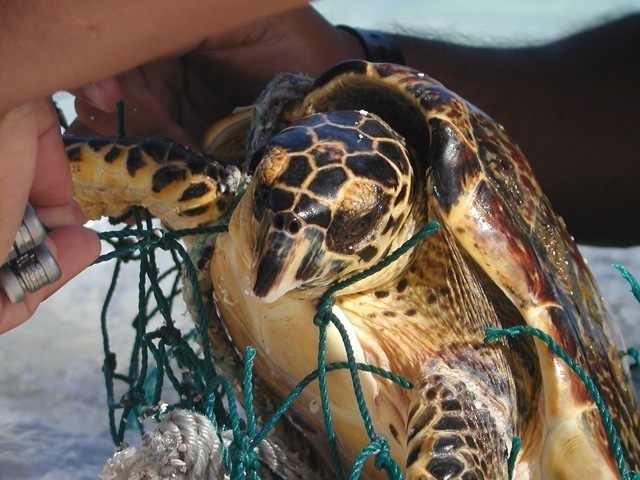
(c) Kyle Van Houtan, some rights reserved (CC BY) · licence
Family: Cheloniidae · Class: Reptilia · Order: Testudines
Eretmochelys imbricata (Hawksbill Sea Turtle) is a California animal in the Cheloniidae family.
The hawksbill sea turtle is a medium-sized marine reptile measuring 60 to 90 centimeters (24 to 35 inches) in straight carapace length and weighing 40 to 85 kilograms (88 to 187 pounds). The species is distinguished by its narrow, pointed beak and overlapping scutes on the carapace, which display a distinctive amber and brown tortoiseshell pattern with radiating streaks. The carapace has a pronounced serrated posterior margin, and the head features two pairs of prefrontal scales. Flippers are equipped with two claws, except for the rear flippers which may have one or two. Historically, hawksbill sea turtles were documented along the entire California coast, but current occurrences are extremely rare. The species is now considered extirpated from California waters as a regular resident, with only occasional vagrant individuals reported. Most Pacific hawksbill populations inhabit tropical and subtropical waters from Baja California, Mexico southward to Peru, with nesting beaches primarily in Mexico, Costa Rica, and other Central American locations. Hawksbill sea turtles inhabit coral reef ecosystems, rocky coastlines, and shallow coastal waters. Adults demonstrate strong fidelity to foraging areas around coral reefs and rocky outcroppings where sponges are abundant. Juveniles occupy pelagic environments, associating with floating sargassum and other drift algae. The species typically forages in waters less than 20 meters deep but can dive to depths exceeding 70 meters. Hawksbills are primarily spongivorous, with sponges comprising 70 to 95 percent of their diet in many regions. Their narrow beak allows them to extract sponges from crevices in coral reefs. They also consume algae, cnidarians, and other invertebrates. Females reach sexual maturity between 20 and 40 years of age and exhibit natal philopatry, returning to natal beaches to nest every two to five years. Nesting occurs at night on sandy beaches, with females depositing 130 to 160 spherical eggs per clutch. Incubation lasts 55 to 75 days, with hatchlings emerging at night and immediately moving toward the ocean. The hawksbill sea turtle is listed as Endangered under the U.S. Endangered Species Act since 1970. The species is also listed as Critically Endangered by the IUCN as of December 2025. Global populations have declined by more than 80 percent over the past three generations due to exploitation for tortoiseshell, egg collection, habitat loss, and incidental capture in fishing gear. Climate change poses additional threats through sea level rise affecting nesting beaches and coral bleaching reducing food resources. Recovery efforts include nest protection programs, fishing gear modifications, and international trade regulations under CITES Appendix I.
Classification
Class: Reptilia · Order: Testudines · Family: Cheloniidae
Frequently asked questions
How is Eretmochelys imbricata classified?
Eretmochelys imbricata belongs to class Reptilia, order Testudines, family Cheloniidae.
What family does Eretmochelys imbricata belong to?
Eretmochelys imbricata is in the Cheloniidae family.
What is Eretmochelys imbricata?
The hawksbill sea turtle is a medium-sized marine reptile measuring 60 to 90 centimeters (24 to 35 inches) in straight carapace length and weighing 40 to 85 kilograms (88 to 187 pounds).
Is Eretmochelys imbricata found in California?
Yes. Eretmochelys imbricata is recorded in California in The California Species Project's catalogue.
Related species
Other California species in the same genus, family, or bioregion.
Data from The California Species Project — 14,000+ California species with verified data from CNPS, CDFW, USFWS, and more.