Erinnyis crameri
Cramer's sphinx
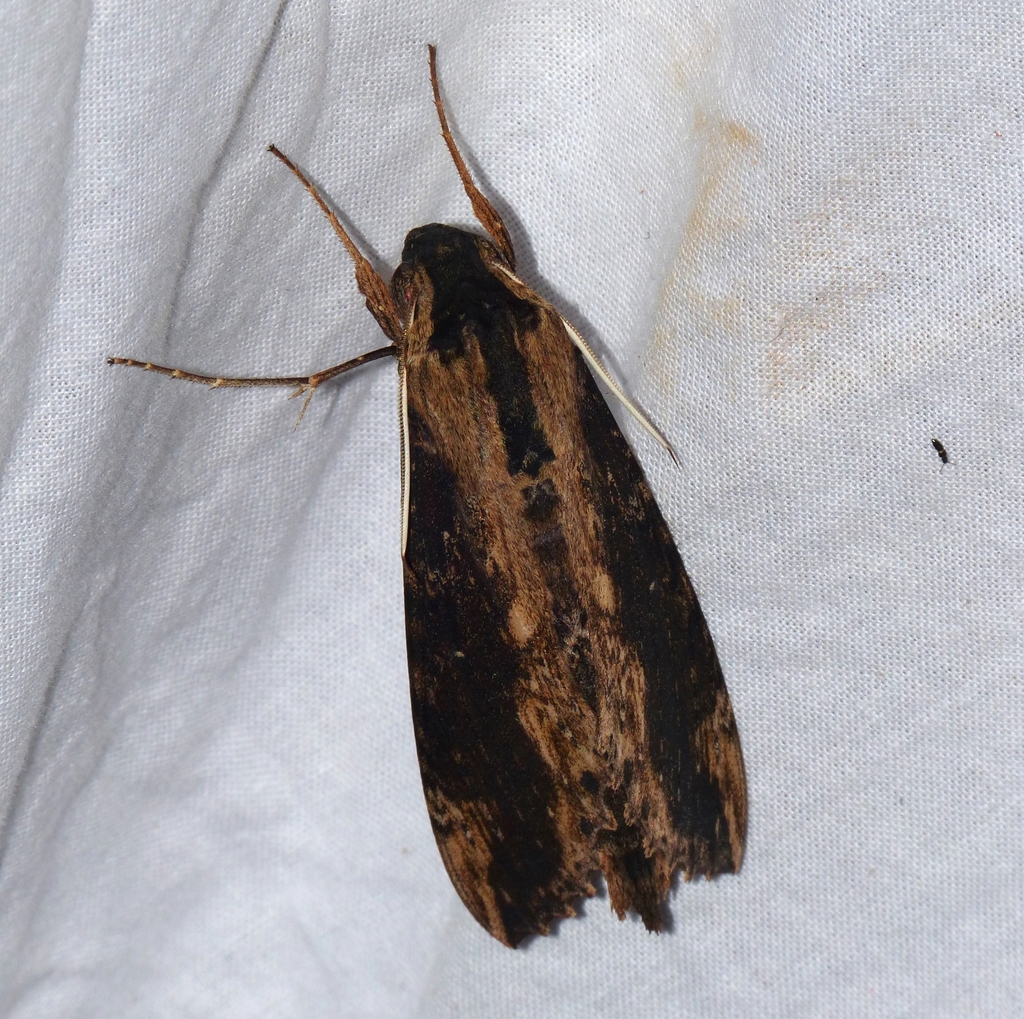
(c) Bernard DUPONT, some rights reserved (CC BY) · licence
Family: Sphingidae · Class: Insecta · Order: Lepidoptera
Erinnyis crameri (Cramer's sphinx) is a California animal in the Sphingidae family.
Cramer's sphinx (Erinnyis crameri) is a large hawkmoth in the family Sphingidae with a wingspan typically ranging from 95 to 120 millimeters (3.7 to 4.7 inches). The forewings are narrow and elongated, displaying a mottled pattern of brown, gray, and tan coloration with darker cross-lines and a distinctive pale stripe running from the wing base to the apex. The hindwings are smaller and typically brownish-pink to coral in color with darker borders. The robust body is covered in dense scales matching the wing coloration, and the antennae are thick and slightly clubbed, characteristic of sphinx moths. Adults possess a long proboscis adapted for feeding on nectar from deep-throated flowers. Cramer's sphinx has a broad neotropical distribution, ranging from Paraguay north through Central America, Mexico, and the West Indies. The species regularly strays north into the southern United States, including south Florida, South Texas, Arizona, and southern California. In California, records are primarily from the southern counties, with sightings most frequent during late summer and fall months when adults disperse northward from breeding populations in Mexico. The species inhabits tropical and subtropical regions, favoring areas with abundant flowering plants and suitable host vegetation. In its native range, it occurs from sea level to elevations of approximately 1,500 meters (4,900 feet). Adults are attracted to gardens, parks, and natural areas where nectar sources are available. The species shows particular affinity for warm, humid environments but can tolerate drier conditions during dispersal flights. Cramer's sphinx exhibits crepuscular and nocturnal activity patterns, with adults most active during evening and nighttime hours. Males are attracted to artificial lights and pheromone sources. The species feeds on nectar from various flowering plants, with adults showing preference for tubular flowers that accommodate their long proboscis. Larvae develop on various plants in the dogbane family (Apocynaceae), including species of Plumeria, Allamanda, and other ornamental and native apocynaceous plants. Females deposit eggs singly on host plant leaves, and larvae undergo five instars before pupating in soil chambers. In tropical regions, the species can produce multiple generations per year, while northern populations are typically sustained by continuous immigration from southern breeding areas. Cramer's sphinx is not federally or state-listed and appears to maintain stable populations throughout much of its range. The species benefits from the widespread cultivation of ornamental apocynaceous plants in urban and suburban environments. Climate change may be facilitating range expansion northward, with increasing frequency of records in border states. Primary conservation considerations include maintaining diverse flowering plant communities for adult nectar sources and preserving host plant availability. The species' broad host plant range and adaptability to human-modified environments suggest it is not currently facing significant conservation threats, though habitat loss in core tropical breeding areas could impact long-term population stability.
Classification
Class: Insecta · Order: Lepidoptera · Family: Sphingidae
Frequently asked questions
How is Erinnyis crameri classified?
Erinnyis crameri belongs to class Insecta, order Lepidoptera, family Sphingidae.
What family does Erinnyis crameri belong to?
Erinnyis crameri is in the Sphingidae family.
What is Erinnyis crameri?
Cramer's sphinx (Erinnyis crameri) is a large hawkmoth in the family Sphingidae with a wingspan typically ranging from 95 to 120 millimeters (3.7 to 4.7 inches).
Is Erinnyis crameri found in California?
Yes. Erinnyis crameri is recorded in California in The California Species Project's catalogue.
Related species
Other California species in the same genus, family, or bioregion.
Data from The California Species Project — 14,000+ California species with verified data from CNPS, CDFW, USFWS, and more.