Erinnyis ello
Ello sphinx
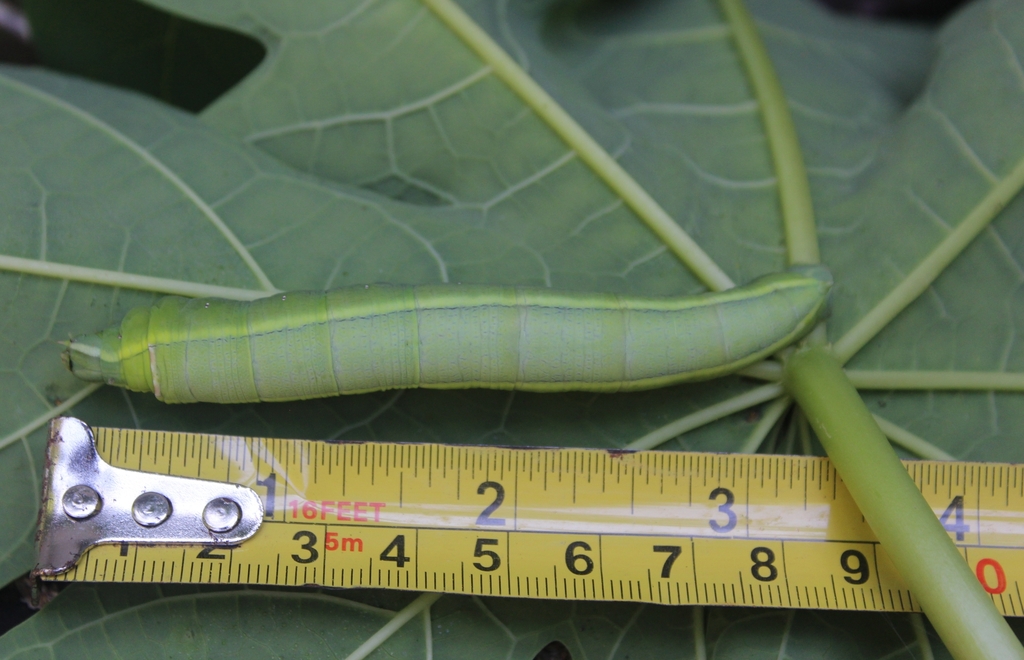
(c) Ricard Busquets Reverte, some rights reserved (CC BY) · licence
Family: Sphingidae · Class: Insecta · Order: Lepidoptera
Erinnyis ello (Ello sphinx) is a California animal in the Sphingidae family.
The Ello sphinx (Erinnyis ello) is a large hawkmoth in the family Sphingidae with a wingspan ranging from 95 to 125 mm (3.7 to 4.9 inches). Adults display brown forewings with darker brown and gray mottling, creating cryptic patterns that provide camouflage when resting against bark. The hindwings are pale orange to yellow with dark brown borders. The robust body is typically gray-brown with darker longitudinal stripes. The species exhibits sexual dimorphism, with males possessing more pointed forewings and slightly smaller body size compared to females. The Ello sphinx maintains a resident population from Argentina north through Central America, Mexico, and the West Indies to south Florida, Texas, Arizona, southern California, and southern Nevada. The species also strays northward beyond its established range, with occasional records from more northern states. In California, populations are primarily concentrated in the southern regions where suitable host plants and favorable climate conditions exist year-round. This species inhabits tropical and subtropical environments, favoring areas with abundant host plant vegetation. Adults are commonly found in gardens, agricultural areas, and forest edges where papaya and other host plants grow. The species thrives in warm climates and cannot survive prolonged freezing temperatures, which limits its permanent establishment in temperate regions. Urban and suburban environments with ornamental plantings often support transient populations. Ello sphinx moths are crepuscular and nocturnal, becoming active at dusk to feed and mate. Adults are strong fliers capable of hovering while feeding on nectar from various flowers, including those of their host plants. Females deposit eggs singly on host plant leaves. The species utilizes papaya (Carica papaya) in the Caricaceae family as its primary host plant, with larvae also feeding on various plants in the spurge family (Euphorbiaceae) including poinsettia (Euphorbia pulcherrima), guava species (Psidium) in the myrtle family (Myrtaceae), and saffron plum (Bumelia angustifolia) in the Sapotaceae family. Caterpillars are large, reaching lengths of 100 to 120 mm when fully mature, and display green coloration with distinctive eyespots on the thorax. The larvae possess a characteristic horn at the posterior end, typical of sphinx moth caterpillars. The Ello sphinx is not federally or state listed and appears to maintain stable populations throughout its range. The species benefits from human cultivation of papaya and ornamental euphorbias, which has likely expanded available habitat in some regions. Climate change may facilitate range expansion northward as temperatures warm, though the species remains dependent on frost-free conditions for year-round survival. In agricultural areas, larvae are occasionally considered minor pests of papaya crops, though populations rarely reach economically damaging levels. The species faces typical threats associated with habitat modification and pesticide use in agricultural and urban environments.
Classification
Class: Insecta · Order: Lepidoptera · Family: Sphingidae
Frequently asked questions
How is Erinnyis ello classified?
Erinnyis ello belongs to class Insecta, order Lepidoptera, family Sphingidae.
What family does Erinnyis ello belong to?
Erinnyis ello is in the Sphingidae family.
What is Erinnyis ello?
The Ello sphinx (Erinnyis ello) is a large hawkmoth in the family Sphingidae with a wingspan ranging from 95 to 125 mm (3.7 to 4.9 inches).
Is Erinnyis ello found in California?
Yes. Erinnyis ello is recorded in California in The California Species Project's catalogue.
Related species
Other California species in the same genus, family, or bioregion.
Data from The California Species Project — 14,000+ California species with verified data from CNPS, CDFW, USFWS, and more.