Eriophyes emarginatae
Plum Finger Gall Mite
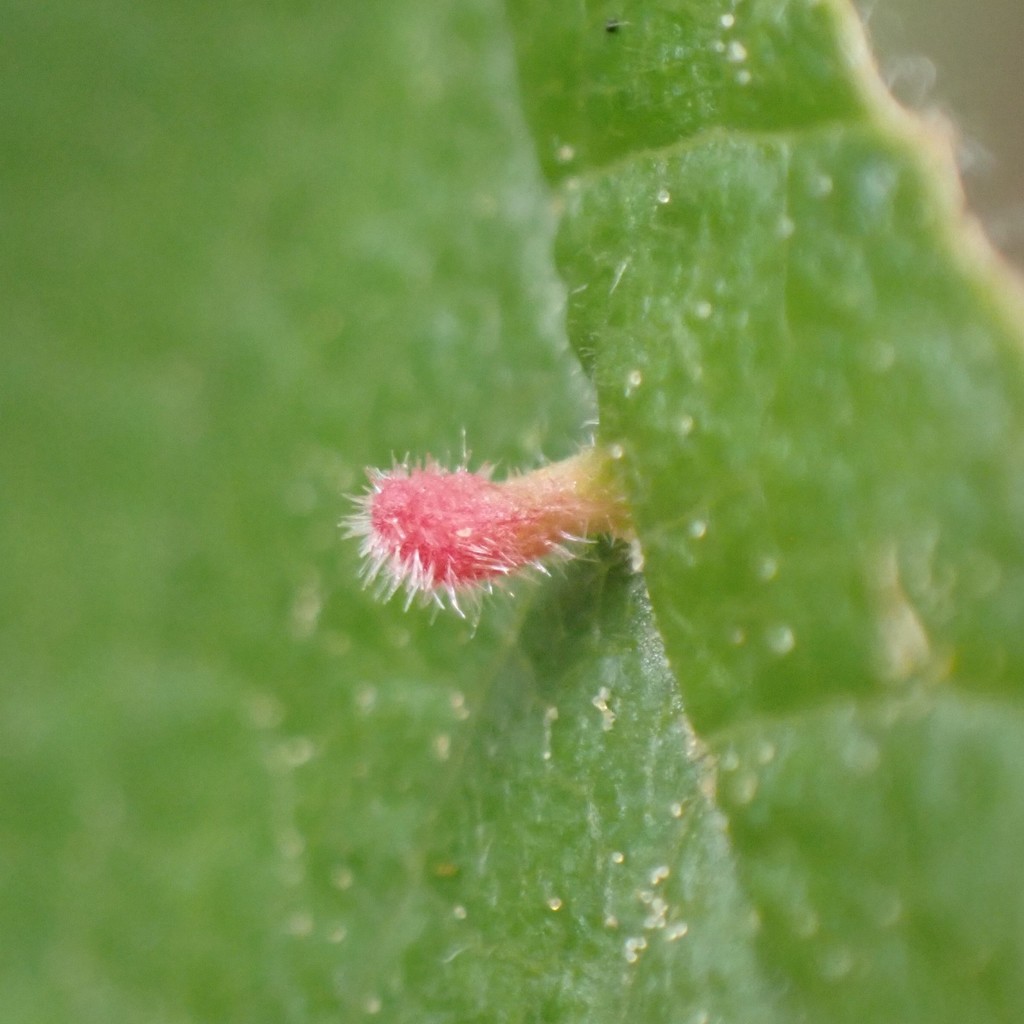
(c) giantcicada, some rights reserved (CC BY) · licence
Family: Eriophyidae · Class: Arachnida · Order: Trombidiformes
Eriophyes emarginatae (Plum Finger Gall Mite) is a California animal in the Eriophyidae family.
Eriophyes emarginatae is a microscopic eriophyid mite that induces distinctive finger-like galls on plants in the Prunus genus, particularly western chokecherry (Prunus virginiana). As with all eriophyid mites, adults are extremely small, measuring less than 0.2 millimeters in length, and possess only two pairs of legs rather than the typical four pairs found in most mites. The body is elongated and worm-like, with females distinguished by the absence of microtubercles on their abdominal rings, a diagnostic feature for this species (BugGuide 2025). The mites are translucent to pale in coloration and require magnification for detailed observation. This species occurs across western North America, with documented populations extending from the southwestern United States into higher elevation montane regions. Specific records include locations in New Mexico's Sandia Mountains at elevations around 7,530 feet, where specimens have been collected on western chokecherry along mountain trails (BugGuide 2025). The species' range likely corresponds with the distribution of its primary host plants throughout mountainous regions of the western states. Eriophyes emarginatae inhabits montane and subalpine environments where Prunus species are present. The species shows a clear preference for western chokecherry (Prunus virginiana) as its primary host, though it may utilize other Prunus species within its range. The mites are typically found at moderate to high elevations in areas supporting native cherry and plum vegetation, including forest edges, riparian zones, and mountain slopes where host plants occur naturally. The species exhibits a specialized gall-forming lifestyle characteristic of many eriophyid mites. Adult females initiate gall formation by feeding on plant tissues and injecting salivary secretions that stimulate abnormal plant growth. This feeding behavior results in the development of distinctive finger-like projections or pouch-like galls on leaves of the host plant. The mites complete their entire life cycle within these protected gall structures, feeding on plant fluids and reproducing in the modified plant tissue. Multiple generations may occur annually, with peak activity typically coinciding with the growing season of host plants. The galls provide both nutrition and protection from environmental conditions and natural enemies. As a specialized herbivorous mite, Eriophyes emarginatae does not appear to have any formal conservation status at federal or state levels. The species' conservation outlook depends largely on the health and distribution of its Prunus host plants, particularly western chokecherry populations in montane ecosystems. While specific population data are not available, the mite's highly specialized relationship with its host plants makes it potentially vulnerable to habitat modifications that affect native Prunus communities. Climate change impacts on montane ecosystems and forest management practices that alter native plant communities could influence the species' long-term persistence, though current population trends have not been systematically assessed.
Classification
Class: Arachnida · Order: Trombidiformes · Family: Eriophyidae
Frequently asked questions
How is Eriophyes emarginatae classified?
Eriophyes emarginatae belongs to class Arachnida, order Trombidiformes, family Eriophyidae.
What family does Eriophyes emarginatae belong to?
Eriophyes emarginatae is in the Eriophyidae family.
What is Eriophyes emarginatae?
Eriophyes emarginatae is a microscopic eriophyid mite that induces distinctive finger-like galls on plants in the Prunus genus, particularly western chokecherry (Prunus virginiana).
Is Eriophyes emarginatae found in California?
Yes. Eriophyes emarginatae is recorded in California in The California Species Project's catalogue.
Related species
Other California species in the same genus, family, or bioregion.
Data from The California Species Project — 14,000+ California species with verified data from CNPS, CDFW, USFWS, and more.