Eriophyes laevis
Alder Leaf Gall Mite
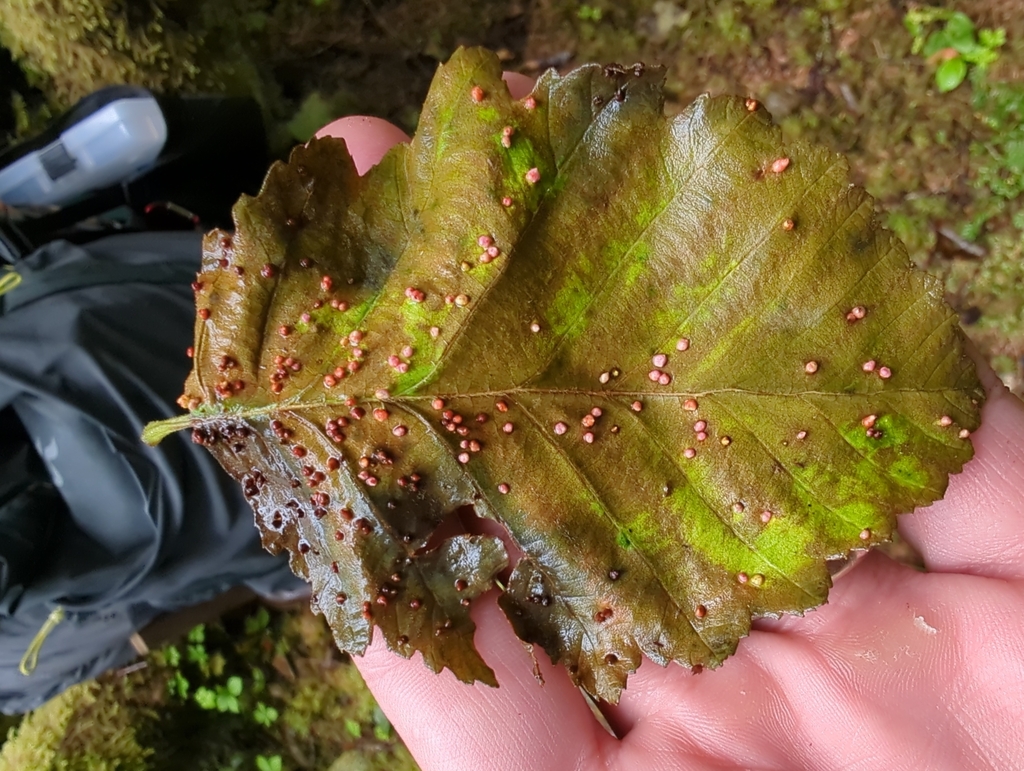
(c) Matt Muir, some rights reserved (CC BY) · licence
Family: Eriophyidae · Class: Arachnida · Order: Trombidiformes
Eriophyes laevis (Alder Leaf Gall Mite) is a California animal in the Eriophyidae family.
Eriophyes laevis is a microscopic eriophyid mite that creates distinctive galls on alder leaves throughout North America. As members of the family Eriophyidae, these mites are extremely small, typically measuring less than 0.2 mm in length, with elongated, worm-like bodies and only two pairs of legs positioned at the front of the body. The species occurs across a broad range in North America, documented from California, Georgia, Kansas, Washington, and West Virginia, with additional records from Europe (Amrine 2019). In California, the mite has been recorded on Oregon alder (Alnus rubra), white alder (A. rhombifolia), and mountain alder (A. tenuifolia). The species also utilizes multiple alder species across its range, including European black alder (A. glutinosa), speckled alder (A. incana), downy alder (A. pubescens), speckled alder (A. rugosa), and green alder (A. viridis). Eriophyes laevis inhabits deciduous forests and riparian areas where alder species grow naturally. The mites are found within the leaf galls they create, spending their entire life cycle protected within these structures. The species appears to be habitat-specific to alder-dominated ecosystems and may be restricted to particular elevation ranges where different alder species occur. The mites induce the formation of distinctive beadlike galls that appear on both upper and lower leaf surfaces (Keifer et al. 1982). These galls are small and hemispherical, varying in size and occurring either scattered individually or clustered along the midrib. The galls are firmly attached to the leaf tissue with exit holes located on the underside. Externally, the galls have a shiny appearance, while the interior contains fleshy tissue. Gall coloration changes as they mature, progressing from green to yellowish, red, and finally reddish-brown. Heavy gall infestations can cause significant leaf distortion and inhibit normal leaf growth, with a single leaf sometimes supporting numerous galls. Little is documented about the species' seasonal biology and life history. Specimens have been recorded as abundant in August, suggesting peak activity during late summer months (Keifer et al. 1982). The taxonomic status of E. laevis remains somewhat uncertain, with researchers suggesting this may represent a complex of closely related species, each potentially specialized on one or two alder species rather than the broad host range currently attributed to the taxon (Amrine 2019). Some host plant records, particularly those citing paper birch (Betula papyrifera) and black willow (Salix nigra), are likely misidentifications. No formal conservation status has been assigned to Eriophyes laevis. The species appears to be relatively common where suitable alder habitat exists, though comprehensive population assessments have not been conducted. As a native species with apparent host specificity, the mite's conservation status likely correlates with the health and distribution of native alder populations across its range.
Classification
Class: Arachnida · Order: Trombidiformes · Family: Eriophyidae
Frequently asked questions
How is Eriophyes laevis classified?
Eriophyes laevis belongs to class Arachnida, order Trombidiformes, family Eriophyidae.
What family does Eriophyes laevis belong to?
Eriophyes laevis is in the Eriophyidae family.
What is Eriophyes laevis?
Eriophyes laevis is a microscopic eriophyid mite that creates distinctive galls on alder leaves throughout North America.
Is Eriophyes laevis found in California?
Yes. Eriophyes laevis is recorded in California in The California Species Project's catalogue.
Related species
Other California species in the same genus, family, or bioregion.
Data from The California Species Project — 14,000+ California species with verified data from CNPS, CDFW, USFWS, and more.