Eriophyes pyri
Pearleaf Blister Mite
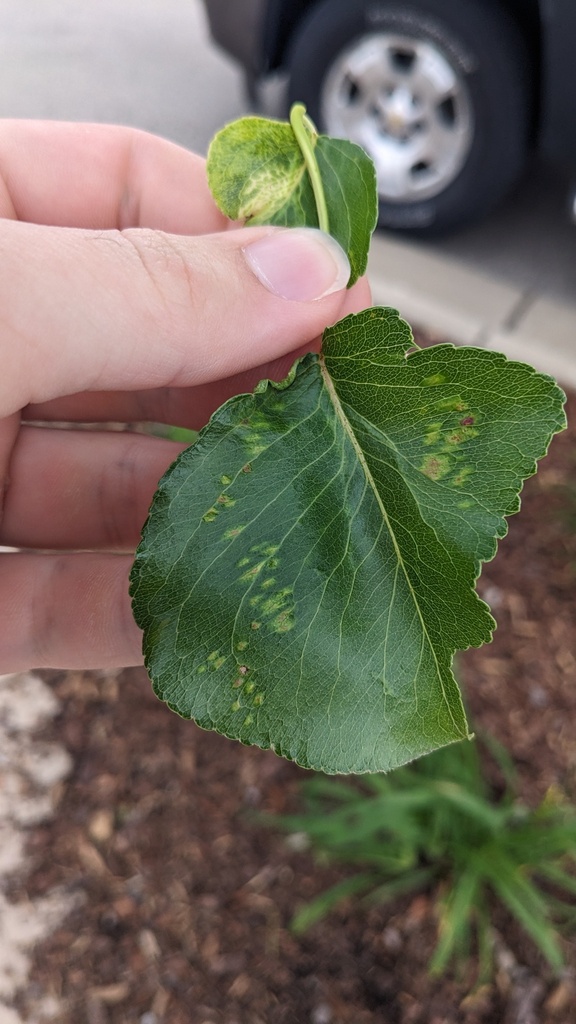
(c) Eric Schmidt, some rights reserved (CC BY) · licence
Family: Eriophyidae · Class: Arachnida · Order: Trombidiformes
Eriophyes pyri (Pearleaf Blister Mite) is a California animal in the Eriophyidae family.
The Pearleaf Blister Mite (Eriophyes pyri) is a microscopic arachnid in the family Eriophyidae, measuring approximately 0.1 to 0.2 mm in length. These eriophyid mites possess an elongated, worm-like body typical of the family, with only two pairs of legs positioned at the anterior end. The body is translucent to whitish and lacks the four pairs of legs found in most arachnids. Adults are characterized by their vermiform appearance and feathered claws adapted for gripping plant surfaces. Eriophyes pyri has a cosmopolitan distribution, occurring throughout temperate regions where its host plants grow. The species is found across North America, Europe, and Asia, following the cultivation and natural range of pear trees. In California, the mite occurs wherever ornamental and commercial pear varieties are planted, from coastal regions to inland valleys. The species' distribution closely mirrors that of Pyrus species, as it demonstrates strict host specificity. This mite inhabits the leaf surfaces and buds of pear trees (Pyrus species), creating characteristic blisters or galls on the foliage. The mites colonize the undersides of leaves, where they feed by piercing plant cells and extracting contents. They prefer young, tender leaf tissue and are most commonly found on new growth. The species can survive in various climatic conditions but thrives in moderate temperatures with adequate moisture. Eriophyes pyri feeds exclusively on pear tree tissues, using specialized mouthparts to puncture epidermal cells and consume cellular contents. Their feeding activity causes the formation of distinctive raised blisters or pustules on leaf surfaces, initially appearing green to yellow and later turning brown or reddish-brown. The mites overwinter as adults in bark crevices, bud scales, or other protected locations on the host tree. In spring, females emerge and begin laying eggs within developing leaf tissue. The species can complete multiple generations per year, with population peaks typically occurring during late spring and early summer when new foliage is abundant. Eriophyes pyri is not listed under any conservation framework and is not considered threatened or endangered. As an agricultural pest, the species is more commonly the subject of control measures rather than conservation efforts. The mite can cause economic damage to commercial pear operations by reducing fruit quality and tree vigor through extensive leaf damage. Integrated pest management strategies typically focus on monitoring population levels and implementing targeted control measures when necessary. Climate change may affect the species' distribution and seasonal activity patterns, potentially expanding its range as suitable habitat conditions shift. The mite's status remains stable across its range, with populations primarily limited by host plant availability and natural predation by beneficial mites and insects.
Classification
Class: Arachnida · Order: Trombidiformes · Family: Eriophyidae
Frequently asked questions
How is Eriophyes pyri classified?
Eriophyes pyri belongs to class Arachnida, order Trombidiformes, family Eriophyidae.
What family does Eriophyes pyri belong to?
Eriophyes pyri is in the Eriophyidae family.
What is Eriophyes pyri?
The Pearleaf Blister Mite (Eriophyes pyri) is a microscopic arachnid in the family Eriophyidae, measuring approximately 0.1 to 0.2 mm in length.
Is Eriophyes pyri found in California?
Yes. Eriophyes pyri is recorded in California in The California Species Project's catalogue.
Related species
Other California species in the same genus, family, or bioregion.
Data from The California Species Project — 14,000+ California species with verified data from CNPS, CDFW, USFWS, and more.