Eristalinus taeniops
Stripe-eyed Lagoon Fly
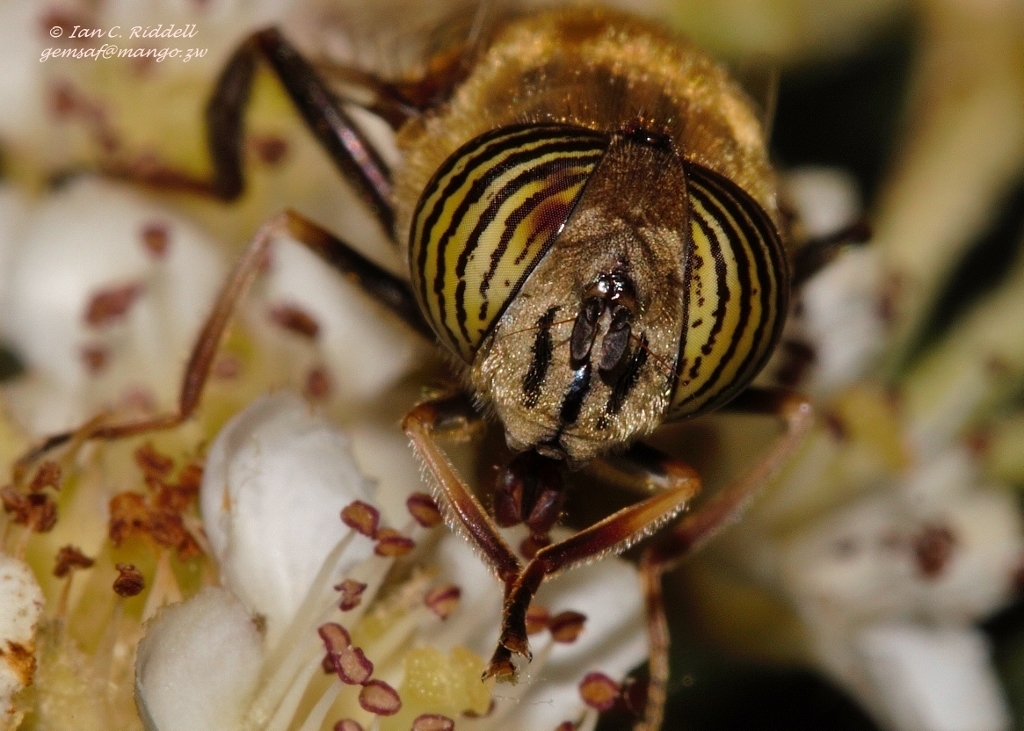
(c) i_c_riddell, some rights reserved (CC BY) · licence
Family: Syrphidae · Class: Insecta · Order: Diptera
Eristalinus taeniops (Stripe-eyed Lagoon Fly) is a California animal in the Syrphidae family.
The stripe-eyed lagoon fly (Eristalinus taeniops) is a medium-sized hover fly in the family Syrphidae, subfamily Eristalinae. This species belongs to the tribe Eristaliini and subtribe Eristaliina, representing a group of flies that mimic bees and wasps in appearance and behavior. Adults display the characteristic striped eyes that give the species its common name, with distinctive banding patterns across the compound eyes that distinguish it from related species. Eristalinus taeniops has a broad distribution across multiple continents and is considered an introduced species in the Americas (NatureServe 2025). The species occurs throughout much of the United States, including California, where it has established populations in various aquatic and semi-aquatic habitats. As a non-native species, it likely arrived through human transport and has successfully colonized suitable habitats across North America. This hover fly inhabits areas near standing or slow-moving water, including lagoons, ponds, marshes, and artificial water bodies such as retention ponds and irrigation channels. The larvae, known as rat-tailed maggots, are aquatic and develop in organically enriched water with low oxygen levels. These environments include livestock watering areas, sewage treatment facilities, and other locations where organic matter accumulates. Adults are commonly found on flowers near these breeding sites, particularly favoring open, sunny areas with abundant nectar sources. Adult stripe-eyed lagoon flies are active during warm months and exhibit typical syrphid behavior, hovering over flowers while feeding on nectar and pollen. Males engage in territorial behavior, often hovering in specific areas and chasing away competitors. Females seek appropriate aquatic sites for egg laying, depositing eggs in or near water where larvae will develop. The larvae are detritivores, feeding on decaying organic matter in aquatic sediments and playing a role in nutrient cycling within these ecosystems. The species completes its development from egg to adult in aquatic environments, with larvae possessing the characteristic extensible breathing tube that allows them to obtain oxygen from the water surface while feeding in anaerobic sediments. As an introduced species, Eristalinus taeniops is not considered threatened or endangered. According to NatureServe, the species has a large range, many recent occurrences, and populations appear stable throughout its introduced range. No special conservation measures are required for this species, and it is not listed under any federal or state endangered species acts. The successful establishment of this hover fly in North America demonstrates its adaptability to diverse environmental conditions and its ability to exploit anthropogenic habitats. While not native to California, the species appears to have integrated into local ecosystems without causing significant ecological disruption, though continued monitoring of its impacts on native syrphid species may be warranted.
Classification
Class: Insecta · Order: Diptera · Family: Syrphidae
Frequently asked questions
How is Eristalinus taeniops classified?
Eristalinus taeniops belongs to class Insecta, order Diptera, family Syrphidae.
What family does Eristalinus taeniops belong to?
Eristalinus taeniops is in the Syrphidae family.
What is Eristalinus taeniops?
The stripe-eyed lagoon fly (Eristalinus taeniops) is a medium-sized hover fly in the family Syrphidae, subfamily Eristalinae.
Is Eristalinus taeniops found in California?
Yes. Eristalinus taeniops is recorded in California in The California Species Project's catalogue.
Related species
Other California species in the same genus, family, or bioregion.
Data from The California Species Project — 14,000+ California species with verified data from CNPS, CDFW, USFWS, and more.