Eristalis hirta
Black-footed Drone Fly
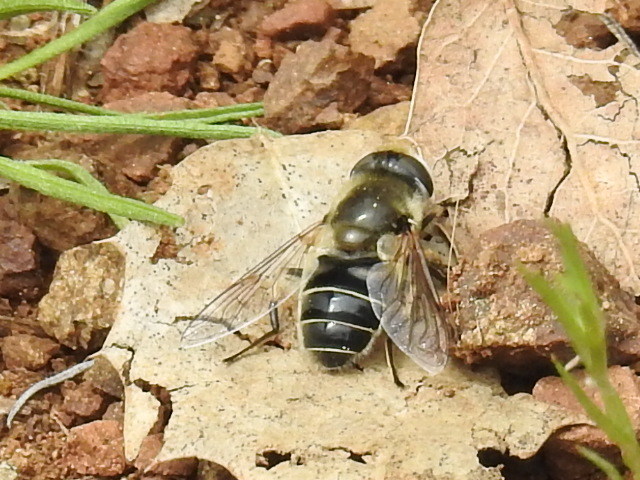
(c) Sam Kieschnick, some rights reserved (CC BY) · licence
Family: Syrphidae · Class: Insecta · Order: Diptera
Eristalis hirta (Black-footed Drone Fly) is a California animal in the Syrphidae family.
The black-footed drone fly (Eristalis hirta) is a species of hover fly in the family Syrphidae. As a member of the genus Eristalis, this species belongs to a group commonly known as drone flies due to their superficial resemblance to honey bee drones. Like other Eristalis species, E. hirta likely exhibits the characteristic hover fly body plan with a robust, somewhat flattened abdomen and large compound eyes. The species name "hirta" suggests the presence of notable hair or bristle structures, though specific morphological details have not been well documented in available literature. The distribution of Eristalis hirta appears to encompass a broad geographic range across North America, though specific occurrence records in California require further documentation. According to NatureServe, this species has a large range with many occurrences and populations that appear relatively stable across its distribution. However, detailed county-level or regional occurrence data for California specifically has not been comprehensively compiled in accessible databases. Habitat requirements for E. hirta have not been extensively studied or documented. As with most Eristalis species, the larvae likely develop in aquatic or semi-aquatic environments rich in organic matter, such as stagnant pools, water-filled tree holes, or other standing water bodies with decaying vegetation. Adult flies typically inhabit areas near these larval development sites and are commonly found in gardens, fields, and woodland edges where they visit flowers for nectar. Adult black-footed drone flies are presumed to be generalist pollinators, visiting a variety of flowering plants for nectar and potentially playing a role in pollination services. Like other hover flies, they likely exhibit hovering flight behavior and may engage in territorial displays or mate-seeking activities around suitable habitat. The larvae, known as rat-tailed maggots, presumably feed on bacteria and organic detritus in their aquatic environments, breathing through a telescopic siphon that extends to the water surface. Currently, Eristalis hirta has no federal or state conservation listing status. The species appears to maintain stable populations across its range, suggesting it is not facing immediate conservation threats. However, like many native pollinators, hover flies can be affected by habitat loss, pesticide use, and changes in land management practices that reduce the availability of both larval development sites and adult nectar sources. Scientific documentation for this species remains limited. The information presented here is based on available sources including NatureServe Explorer and iNaturalist observations. If you have additional verified information about this species' biology, distribution, or ecology in California, please contact us to help improve this species account.
Classification
Class: Insecta · Order: Diptera · Family: Syrphidae
Frequently asked questions
How is Eristalis hirta classified?
Eristalis hirta belongs to class Insecta, order Diptera, family Syrphidae.
What family does Eristalis hirta belong to?
Eristalis hirta is in the Syrphidae family.
What is Eristalis hirta?
The black-footed drone fly (Eristalis hirta) is a species of hover fly in the family Syrphidae.
Is Eristalis hirta found in California?
Yes. Eristalis hirta is recorded in California in The California Species Project's catalogue.
Related species
Other California species in the same genus, family, or bioregion.
Data from The California Species Project — 14,000+ California species with verified data from CNPS, CDFW, USFWS, and more.