Eristalis tenax
Common Drone Fly
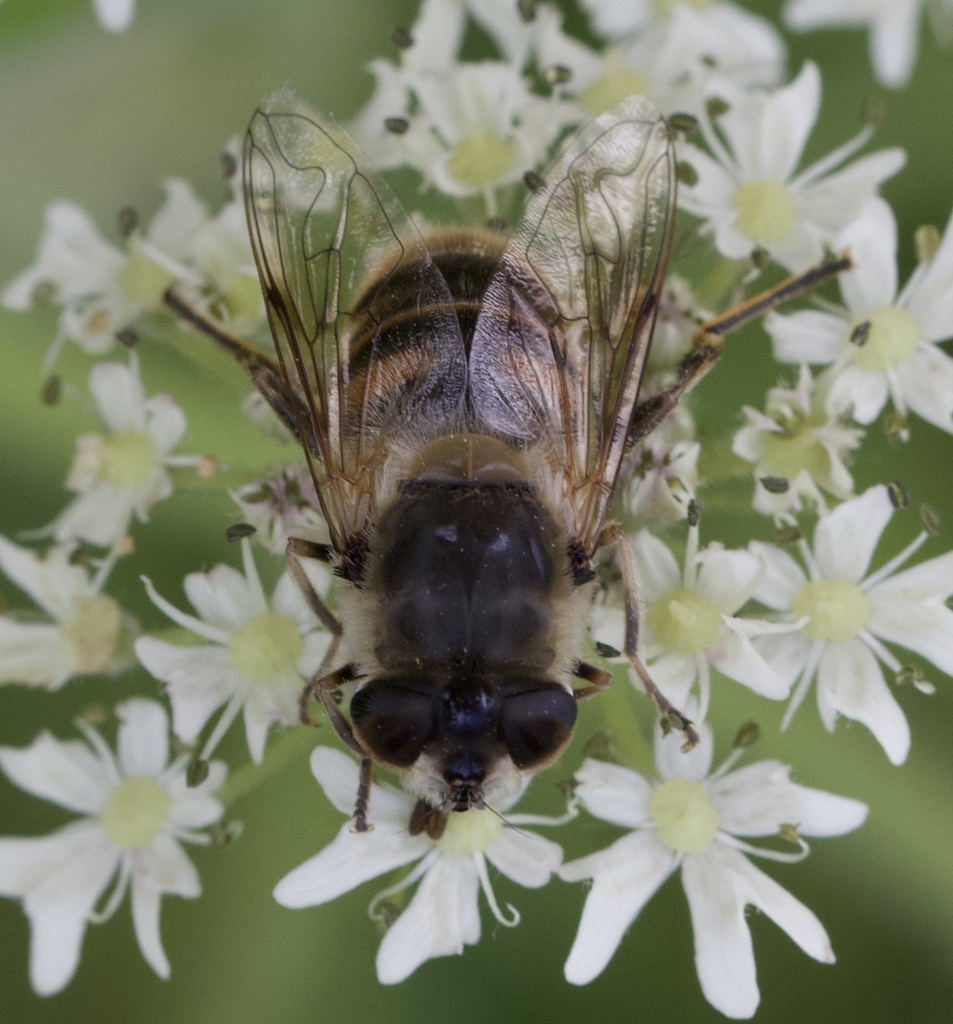
(c) nevwright, some rights reserved (CC BY) · licence
Family: Syrphidae · Class: Insecta · Order: Diptera
Eristalis tenax (Common Drone Fly) is a California animal in the Syrphidae family.
The Common Drone Fly (Eristalis tenax) is a medium-sized hover fly measuring 10-16 mm (0.4-0.6 inches) in length. This species is notable for its morphological mimicry of the European honey bee, featuring a robust, hairy body with brown and yellow coloration patterns. Adults display large compound eyes positioned near the front of the head, short thick antennae, and possess only one pair of wings - distinguishing characteristics that separate flies from their bee mimics. The thorax and abdomen show variable brown and yellow striping, with dense pile (hair-like structures) covering much of the body surface. Eristalis tenax exhibits a cosmopolitan distribution, occurring across North America, Europe, Asia, and other temperate regions worldwide. Originally native to Europe, this species has become established globally through human-mediated dispersal, making it one of the most widespread syrphid flies (Stubbs & Falk 2002). In California, this species is found throughout the state from sea level to moderate elevations, inhabiting urban gardens, agricultural areas, wildlands, and riparian zones. This species demonstrates significant habitat flexibility, occurring in diverse environments including gardens, parks, agricultural fields, wetlands, and forest edges. Adults are commonly observed visiting flowers in both natural and cultivated landscapes. The larvae, known as rat-tailed maggots, develop in organically enriched aquatic or semi-aquatic habitats including stagnant pools, manure lagoons, sewage treatment facilities, and decomposing organic matter with high moisture content. These larval habitats are characterized by low oxygen conditions and high organic loading (Rotheray & Gilbert 2011). Adult drone flies are active pollinators, feeding on nectar from a wide variety of flowering plants including members of Asteraceae, Apiaceae, and Rosaceae families (BugGuide 2023). Flight activity occurs primarily during warm, sunny conditions from spring through fall. Mating typically involves aerial courtship displays, with females subsequently seeking appropriate aquatic breeding sites. The distinctive rat-tailed larvae possess an extensible breathing tube allowing them to obtain atmospheric oxygen while submerged in organically enriched water. Complete development from egg to adult requires 3-5 weeks depending on temperature and resource availability (Hartley 1961). As an introduced species, Eristalis tenax faces no conservation concerns and maintains stable populations throughout its range. The species actually provides ecological benefits as a pollinator of both native and cultivated plants. However, its success as an invasive species demonstrates the potential for widespread establishment of non-native insects in suitable habitats. The drone fly's ability to exploit human-modified environments, particularly those with organic waste and standing water, has contributed to its global success. Current populations appear secure with no management interventions required, though its role in pollination networks and potential competitive effects on native hover fly species remain areas for further ecological investigation (Ssymank et al. 2008).
Classification
Class: Insecta · Order: Diptera · Family: Syrphidae
Frequently asked questions
How is Eristalis tenax classified?
Eristalis tenax belongs to class Insecta, order Diptera, family Syrphidae.
What family does Eristalis tenax belong to?
Eristalis tenax is in the Syrphidae family.
What is Eristalis tenax?
The Common Drone Fly (Eristalis tenax) is a medium-sized hover fly measuring 10-16 mm (0.4-0.6 inches) in length.
Is Eristalis tenax found in California?
Yes. Eristalis tenax is recorded in California in The California Species Project's catalogue.
Related species
Other California species in the same genus, family, or bioregion.
Data from The California Species Project — 14,000+ California species with verified data from CNPS, CDFW, USFWS, and more.