Erynnis afranius
Afranius Duskywing
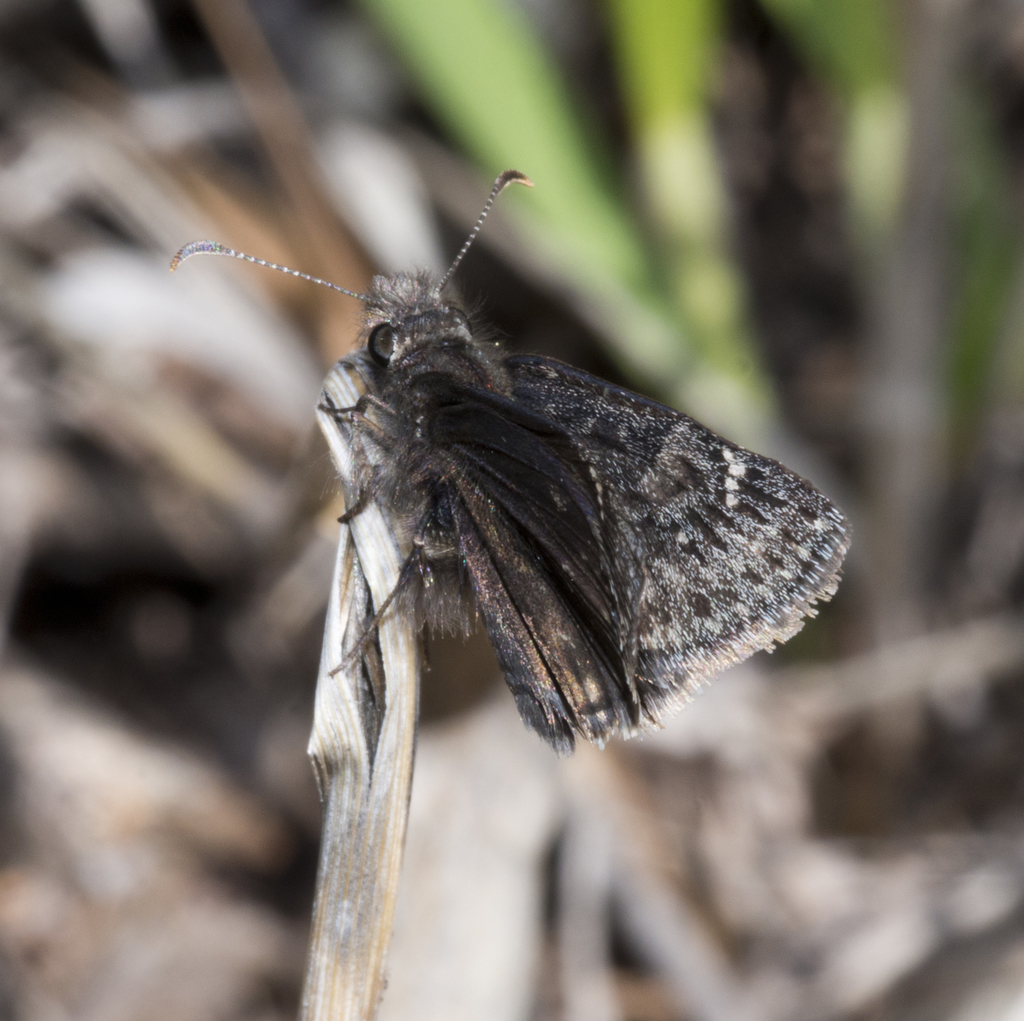
no rights reserved · CC0
Family: Hesperiidae · Class: Insecta · Order: Lepidoptera
Erynnis afranius (Afranius Duskywing) is a California animal in the Hesperiidae family.
The Afranius Duskywing is a medium-sized skipper butterfly with a wingspan ranging from 25 to 35 mm (1.0 to 1.4 inches). Males are dark brown to blackish-brown on the dorsal surfaces with small white spots on the forewings, while females are typically larger and lighter brown with more prominent white markings. The ventral surfaces are lighter brown to gray-brown with indistinct pale spotting. The forewings are relatively broad with rounded tips, and the antennae terminate in curved clubs characteristic of skippers. Both sexes have a robust, hairy body typical of the Hesperiidae family, with males possessing a distinctive black stigma (scent patch) on the forewings. The Afranius Duskywing ranges from Montana and North Dakota south through the mountains to southern California, Arizona, New Mexico, and Mexico. Within California, the species occurs primarily in mountainous regions of the Sierra Nevada, Cascade Range, and southern California mountains. Populations are documented from elevations ranging from approximately 900 to 3,000 meters (3,000 to 10,000 feet), with highest densities typically found between 1,500 and 2,500 meters. This species inhabits open montane and subalpine environments including mountain meadows, forest clearings, sagebrush slopes, and alpine zones. Preferred habitats feature scattered shrubs and herbaceous vegetation with abundant flowering plants for nectar sources. The butterfly shows strong association with areas containing its host plants, particularly in sunny exposures with well-drained soils. Adults are commonly observed on ridgetops, hillsides, and in canyon bottoms where host legumes are present. Afranius Duskywings are univoltine, producing one generation per year. Adults typically emerge from late May through August, with peak flight periods varying by elevation and latitude. Males exhibit territorial behavior, perching on prominent rocks, shrubs, or bare ground to intercept passing females. Mating occurs during midday hours when temperatures are optimal for flight activity. Females deposit eggs singly on or near host plants, including various legumes such as deerweed (Lotus scoparius), lupine (Lupinus species), and milkvetch (Astragalus species). Larvae construct silk shelters by folding or tying host plant leaves together, feeding within these protected chambers. The species overwinters as a mature larva, pupating the following spring. The Afranius Duskywing is not federally listed and appears to maintain stable populations across much of its range. However, localized populations may face pressure from habitat loss due to development, fire suppression altering natural disturbance regimes, and climate change affecting montane ecosystems. The species' dependence on specific leguminous host plants makes it vulnerable to changes in plant community composition. Grazing practices and invasive plant species may impact habitat quality in some areas. Conservation efforts focus on maintaining diverse montane plant communities and preserving connectivity between suitable habitat patches across elevational gradients.
Classification
Class: Insecta · Order: Lepidoptera · Family: Hesperiidae
Frequently asked questions
How is Erynnis afranius classified?
Erynnis afranius belongs to class Insecta, order Lepidoptera, family Hesperiidae.
What family does Erynnis afranius belong to?
Erynnis afranius is in the Hesperiidae family.
What is Erynnis afranius?
The Afranius Duskywing is a medium-sized skipper butterfly with a wingspan ranging from 25 to 35 mm (1.0 to 1.4 inches).
Is Erynnis afranius found in California?
Yes. Erynnis afranius is recorded in California in The California Species Project's catalogue.
Related species
Other California species in the same genus, family, or bioregion.
Data from The California Species Project — 14,000+ California species with verified data from CNPS, CDFW, USFWS, and more.