Erynnis brizo
Sleepy Duskywing
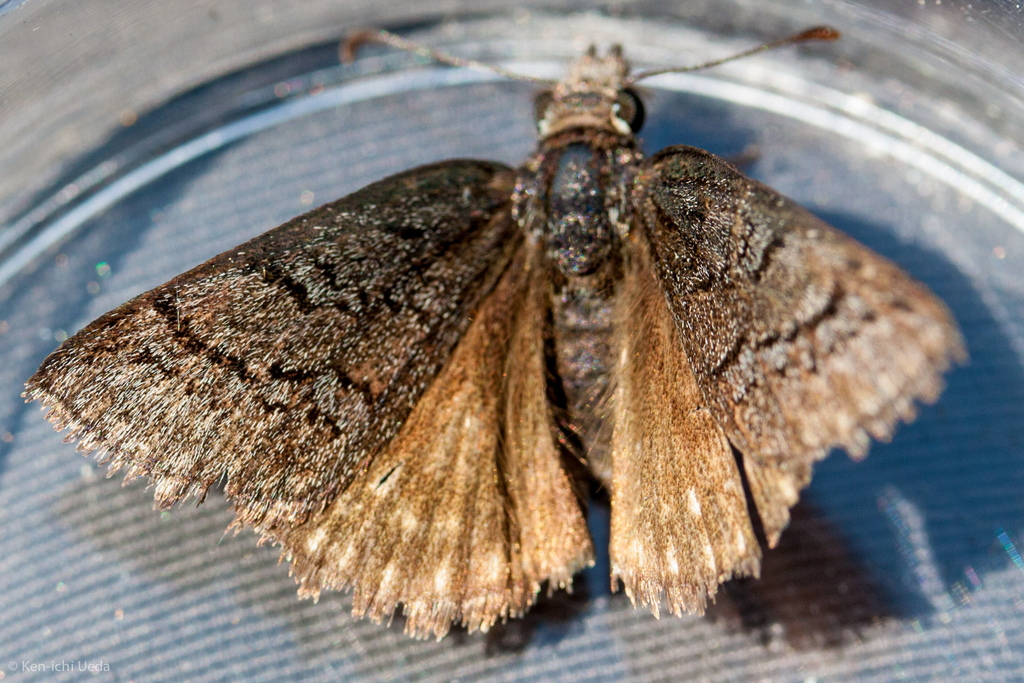
(c) Ken-ichi Ueda, some rights reserved (CC BY) · licence
Family: Hesperiidae · Class: Insecta · Order: Lepidoptera
Erynnis brizo (Sleepy Duskywing) is a California animal in the Hesperiidae family.
The Sleepy Duskywing (Erynnis brizo) is a medium-sized skipper butterfly with a wingspan ranging from 2.5 to 3.5 cm (1.0 to 1.4 inches). Adults display dark brown to charcoal gray wings marked with distinctive white and pale gray spots arranged in irregular patterns. The forewings feature a series of small white spots near the apex and larger pale gray patches toward the base. Hindwings are darker with scattered white spotting. Males possess scent patches called stigma on their forewings. The body is robust and covered in grayish-brown scales, typical of the duskywing group. At rest, the species holds its wings horizontally, distinguishing it from other skippers that fold wings vertically. The Sleepy Duskywing exhibits a transcontinental distribution across North America. In western regions, the species ranges from California east to Utah and southern Wyoming, extending south through mountainous areas to Arizona, New Mexico, Baja California Norte, and central Mexico. Eastern populations occur from Manitoba south through southern Ontario and throughout the eastern United States to central Florida, the Gulf Coast, and central Texas. In California, populations are documented primarily in foothill and montane regions where suitable oak habitat occurs. This species inhabits oak woodlands, chaparral, and scrublands from sea level to approximately 2,100 meters (6,900 feet) elevation. Preferred habitats include areas with dense oak stands, particularly where scrub oak and other shrubby oak species form the dominant vegetation. Adults are commonly observed in clearings, along woodland edges, and on hilltops where males establish territories. The species shows strong fidelity to areas supporting its larval host plants and requires a mosaic of open areas for nectaring and dense oak cover for reproduction. Sleepy Duskywings are univoltine, producing one generation annually. Adults emerge from late February through June, with peak flight periods varying by latitude and elevation. Males exhibit territorial behavior, perching on prominent rocks, tree branches, or bare ground to intercept passing females. Mating occurs in spring, with females depositing eggs singly on young oak leaves. Larvae feed exclusively on scrub oak (Quercus ilicifolia) and other shrubby oak species, creating leaf shelters by folding or tying leaves together with silk. Caterpillars overwinter in the larval stage within these shelters, pupating the following spring. Adults nectar on various wildflowers including lupines, ceanothus, and manzanita. The Sleepy Duskywing is not federally or state listed in California, though local populations may face pressure from habitat loss due to urban development and fire suppression practices that alter oak woodland structure. Climate change poses potential threats through shifts in oak distribution and altered precipitation patterns affecting host plant vigor. The species benefits from oak woodland conservation efforts and fire management practices that maintain natural oak regeneration cycles.
Classification
Class: Insecta · Order: Lepidoptera · Family: Hesperiidae
Frequently asked questions
How is Erynnis brizo classified?
Erynnis brizo belongs to class Insecta, order Lepidoptera, family Hesperiidae.
What family does Erynnis brizo belong to?
Erynnis brizo is in the Hesperiidae family.
What is Erynnis brizo?
The Sleepy Duskywing (Erynnis brizo) is a medium-sized skipper butterfly with a wingspan ranging from 2.5 to 3.5 cm (1.0 to 1.4 inches).
Is Erynnis brizo found in California?
Yes. Erynnis brizo is recorded in California in The California Species Project's catalogue.
Related species
Other California species in the same genus, family, or bioregion.
Data from The California Species Project — 14,000+ California species with verified data from CNPS, CDFW, USFWS, and more.