Erynnis funeralis
Funereal Duskywing
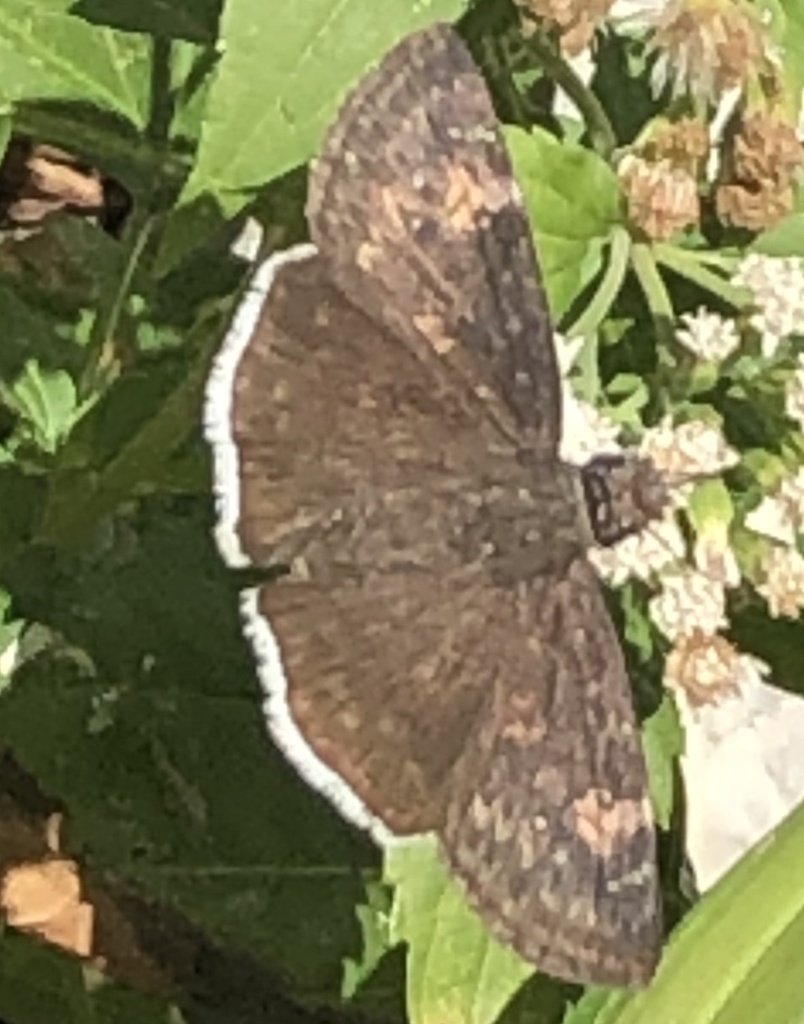
no rights reserved · CC0
Family: Hesperiidae · Class: Insecta · Order: Lepidoptera
Erynnis funeralis (Funereal Duskywing) is a California animal in the Hesperiidae family.
The Funereal Duskywing is a medium-sized skipper butterfly with a wingspan ranging from 32 to 44 mm (1.3 to 1.7 inches). Males display dark brown to blackish forewings with prominent white spots arranged in irregular bands, while the hindwings are uniformly dark with subtle iridescent scaling. Females are similarly colored but typically larger, with more pronounced white markings on the forewings. The species exhibits sexual dimorphism in wing shape, with males having more pointed forewings and females displaying broader, more rounded wings. The underside of both sexes is mottled brown and gray, providing effective camouflage when at rest. The Funereal Duskywing ranges from southern California, Arizona, New Mexico, and Texas south through Mexico to Argentina, representing one of the most extensive distributions among North American skippers. In California, the species is primarily found in the southern counties, with established populations in San Diego, Imperial, Riverside, and San Bernardino counties. Occasional strays have been documented as far north as central California, extending the species' range beyond its typical breeding areas. The butterfly also strays northward to northern Illinois, northeast Nebraska, central Colorado, and southern Nevada, demonstrating extensive dispersal capabilities. This species inhabits diverse environments including desert washes, chaparral slopes, open woodlands, and disturbed areas with abundant leguminous plants. Elevational range extends from sea level to approximately 1,500 meters (4,900 feet), with populations adapting to both arid desert conditions and more mesic foothill environments. The butterfly shows preference for areas with partial shade and proximity to water sources, particularly during hot summer months. Funereal Duskywings are multivoltine, producing multiple generations annually in favorable conditions. Adults are active year-round in southern California, with peak abundance occurring from March through October. Males exhibit territorial behavior, perching on prominent vegetation and engaging in rapid chase flights when encountering other butterflies. Mating typically occurs during midday hours when temperatures are optimal. Females deposit single eggs on various leguminous host plants including New Mexican locust (Robinia neomexicana), bur clover (Medicago hispida), deerweed (Lotus scoparius), desert ironwood (Olneya tesota), and vetch (Vicia species). Larvae develop through five instars, constructing shelters by folding or tying leaves together with silk. Pupation occurs within leaf shelters or in ground litter. The Funereal Duskywing is not federally or state-listed and appears to maintain stable populations throughout most of its range. The species benefits from its diverse host plant associations and ability to utilize disturbed habitats, including urban and agricultural areas where leguminous weeds are present. Climate change may potentially expand the species' northern range as temperatures increase, while habitat conversion in desert regions could impact local populations. The butterfly's strong dispersal ability and broad ecological tolerance suggest resilience to moderate environmental changes.
Classification
Class: Insecta · Order: Lepidoptera · Family: Hesperiidae
Frequently asked questions
How is Erynnis funeralis classified?
Erynnis funeralis belongs to class Insecta, order Lepidoptera, family Hesperiidae.
What family does Erynnis funeralis belong to?
Erynnis funeralis is in the Hesperiidae family.
What is Erynnis funeralis?
The Funereal Duskywing is a medium-sized skipper butterfly with a wingspan ranging from 32 to 44 mm (1.3 to 1.7 inches).
Is Erynnis funeralis found in California?
Yes. Erynnis funeralis is recorded in California in The California Species Project's catalogue.
Related species
Other California species in the same genus, family, or bioregion.
Data from The California Species Project — 14,000+ California species with verified data from CNPS, CDFW, USFWS, and more.