Erynnis icelus
Dreamy Duskywing
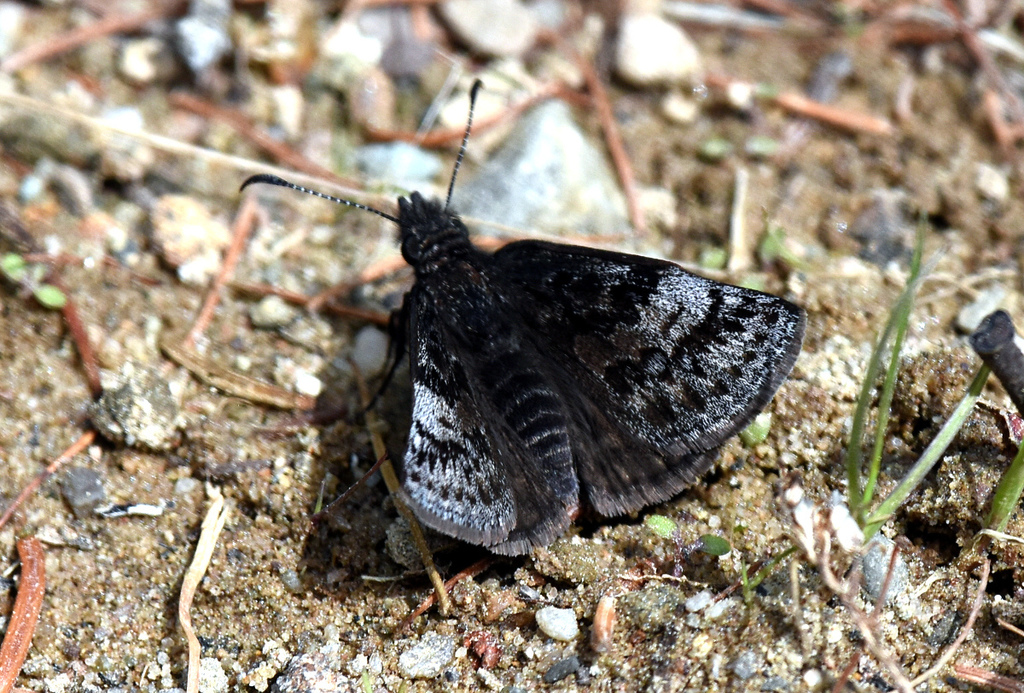
(c) Jimmy Dee, some rights reserved (CC BY-SA) · licence
Family: Hesperiidae · Class: Insecta · Order: Lepidoptera
Erynnis icelus (Dreamy Duskywing) is a California animal in the Hesperiidae family.
The Dreamy Duskywing (Erynnis icelus) is a small to medium-sized skipper butterfly with a wingspan of 25 to 35 mm (1.0 to 1.4 inches). Adults display dark brown to blackish forewings with distinct white or cream-colored spots arranged in a scattered pattern across the wing surface. The hindwings are typically darker brown with less prominent markings. Males can be distinguished from females by the presence of a costal fold on the forewing and specialized scent scales. The species exhibits sexual dimorphism, with males generally smaller and darker than females. At rest, Dreamy Duskywings hold their wings in a tent-like position characteristic of the skipper family. The Dreamy Duskywing has an extensive range across boreal North America, extending from the Northwest Territories east across southern Canada to Nova Scotia. In the western United States, the species occurs south through mountainous regions to southern Arizona and southern New Mexico. The eastern distribution extends south to Arkansas, northeastern Alabama, and northern Georgia. In California, populations are found primarily in the northern mountain regions, including the Sierra Nevada and Cascade Range, typically at elevations between 1,200 and 2,400 meters (4,000 to 8,000 feet). This species inhabits deciduous and mixed forests, riparian woodlands, mountain meadows, and forest edges where host plants are abundant. Dreamy Duskywings show a strong association with areas containing willows (Salix species), poplars, and aspens (Populus species), and occasionally birch (Betula species). Adults are frequently observed along streams, forest clearings, and in montane parks where these deciduous trees and shrubs create suitable microhabitats. The species requires both nectar sources for adults and appropriate host plants for larval development. Dreamy Duskywings are univoltine, producing one generation per year. Adults typically emerge from late May through July, depending on elevation and local climate conditions. Males engage in perching behavior, establishing territories on prominent features such as rocks, fallen logs, or exposed soil where they await passing females. Mating occurs during mid-summer, and females deposit single eggs on host plant leaves, particularly young growth of willows and poplars. Larvae feed on host plant foliage and overwinter as partially grown caterpillars, resuming feeding and development the following spring. Adults nectar on various flowers including dogbane, milkweeds, and other available blooms. The Dreamy Duskywing is not federally listed and appears to have stable populations across much of its range. However, like many forest-associated butterflies, the species may face localized threats from habitat loss due to logging, urban development, and climate change effects on montane ecosystems. Forest management practices that maintain diverse age classes of deciduous trees and preserve riparian corridors support population persistence. The species' dependence on specific host plants makes it vulnerable to changes in forest composition and structure.
Classification
Class: Insecta · Order: Lepidoptera · Family: Hesperiidae
Frequently asked questions
How is Erynnis icelus classified?
Erynnis icelus belongs to class Insecta, order Lepidoptera, family Hesperiidae.
What family does Erynnis icelus belong to?
Erynnis icelus is in the Hesperiidae family.
What is Erynnis icelus?
The Dreamy Duskywing (Erynnis icelus) is a small to medium-sized skipper butterfly with a wingspan of 25 to 35 mm (1.0 to 1.4 inches).
Is Erynnis icelus found in California?
Yes. Erynnis icelus is recorded in California in The California Species Project's catalogue.
Related species
Other California species in the same genus, family, or bioregion.
Data from The California Species Project — 14,000+ California species with verified data from CNPS, CDFW, USFWS, and more.