Erynnis meridianus
Meridian Duskywing
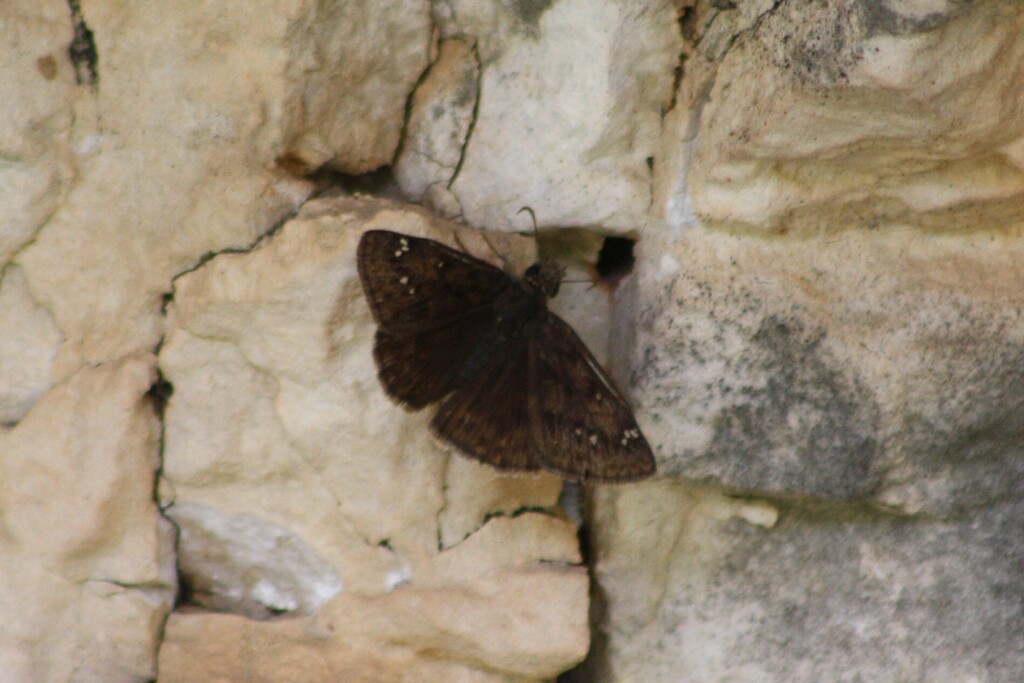
no rights reserved · CC0
Family: Hesperiidae · Class: Insecta · Order: Lepidoptera
Erynnis meridianus (Meridian Duskywing) is a California animal in the Hesperiidae family.
The Meridian Duskywing is a small to medium-sized skipper butterfly belonging to the spread-wing skipper subfamily. Adults typically measure 32-42 mm (1.3-1.7 inches) in wingspan. The forewings are dark brown to blackish-brown with distinctive white translucent spots arranged in irregular bands. Males possess a dark stigma (scent patch) on the forewings, while females lack this feature and generally appear larger with more prominent white spotting. The hindwings are uniformly dark brown with subtle lighter markings near the margins. The body is robust and covered in dark scales, characteristic of the duskywing group. The Meridian Duskywing ranges from southern Nevada, Arizona, New Mexico, and west Texas south to Mexico City. Within this distribution, the species occurs primarily in mountainous regions and elevated plateaus. The butterfly is most commonly encountered in oak woodlands and oak-pine forests at elevations typically ranging from 1,200 to 2,400 meters (4,000 to 8,000 feet). Populations in the northern portions of the range are often associated with sky island mountain ranges of the Sonoran and Chihuahuan deserts. This species inhabits oak woodlands where its host plants occur naturally. The butterfly demonstrates a strong association with Arizona white oak (Quercus arizonica) and plateau oak (Q. fusiformis), though it may utilize additional oak species within its range. Adult butterflies are most active in areas with partial canopy cover, utilizing both sunny clearings for nectaring and shaded areas beneath oak canopies. The species shows preference for slopes and canyon bottoms where moisture levels support robust oak growth. Meridian Duskywings are univoltine, producing one generation per year. Adults typically emerge in late spring through early summer, with peak flight periods occurring from May through July depending on elevation and local climate conditions. Males establish territories on hilltops and ridge lines, engaging in perching behavior to locate potential mates. Females deposit eggs singly on young oak leaves, with caterpillars feeding on tender foliage during summer months. Larvae construct shelters by folding and securing oak leaves with silk threads. The species overwinters as mature caterpillars, pupating the following spring. Adults nectar on various flowering plants including penstemons, composites, and other native wildflowers blooming during their flight period. The species exhibits strong site fidelity, with adults rarely venturing far from oak groves that support breeding populations. The Meridian Duskywing currently holds no federal or state listing status and appears to maintain stable populations throughout most of its range. However, the species faces potential threats from habitat modification, including oak woodland conversion and fragmentation due to urban development and altered fire regimes. Climate change may impact populations at lower elevations and range margins, potentially forcing upslope habitat shifts. The butterfly's dependence on specific oak species makes it vulnerable to factors affecting oak woodland health, including drought stress, disease, and invasive species encroachment.
Classification
Class: Insecta · Order: Lepidoptera · Family: Hesperiidae
Frequently asked questions
How is Erynnis meridianus classified?
Erynnis meridianus belongs to class Insecta, order Lepidoptera, family Hesperiidae.
What family does Erynnis meridianus belong to?
Erynnis meridianus is in the Hesperiidae family.
What is Erynnis meridianus?
The Meridian Duskywing is a small to medium-sized skipper butterfly belonging to the spread-wing skipper subfamily.
Is Erynnis meridianus found in California?
Yes. Erynnis meridianus is recorded in California in The California Species Project's catalogue.
Related species
Other California species in the same genus, family, or bioregion.
Data from The California Species Project — 14,000+ California species with verified data from CNPS, CDFW, USFWS, and more.