Erynnis pacuvius
Pacuvius Duskywing
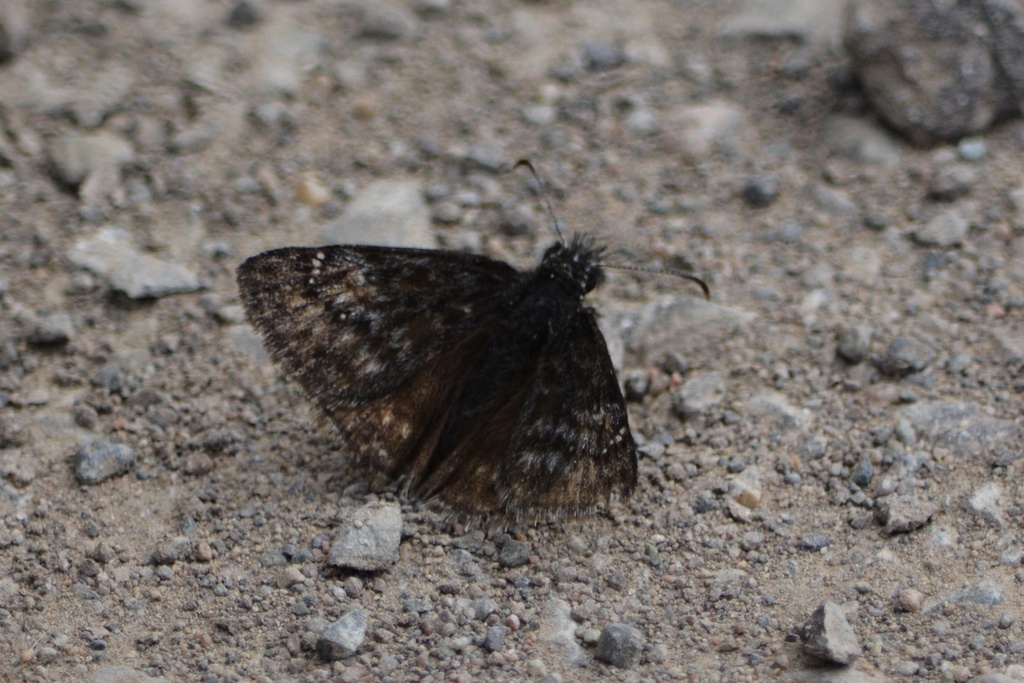
no rights reserved · CC0
Family: Hesperiidae · Class: Insecta · Order: Lepidoptera
Erynnis pacuvius (Pacuvius Duskywing) is a California animal in the Hesperiidae family.
The Pacuvius duskywing is a medium-sized skipper butterfly with a wingspan of 32 to 44 mm (1.3 to 1.7 inches). Males display dark brown to black forewings with distinctive white and pale yellow spotting patterns, while females are typically larger with more subdued coloration and broader wings. The species exhibits sexual dimorphism in wing pattern, with males having more prominent white patches on the forewings and clearer cell spots. The hindwings are darker brown with subtle pale markings, and the body is robust and hairy, characteristic of the duskywing group. Fresh specimens show a slight purplish sheen on the wing surfaces. The Pacuvius duskywing ranges from British Columbia south through the mountains of western North America to southern California, Arizona, New Mexico, Baja California Norte, and south to Veracruz, Mexico. In California, populations occur primarily in mountainous regions including the Sierra Nevada, Cascade Range, and higher elevations of the Coast Ranges. The species is documented from elevations ranging from 1,200 to 3,200 meters (4,000 to 10,500 feet), with most California records from montane and subalpine zones. This species inhabits mountainous areas with open woodlands, chaparral, and forest edges where its host plants thrive. Pacuvius duskywings are closely associated with various wild lilac species including deer brier (Ceanothus fendleri), mountain whitethorn (Ceanothus cordulatus), and hairy ceanothus (Ceanothus oliganthus). Adults are typically found in areas with scattered Ceanothus shrubs, often near clearings, ridgetops, and south-facing slopes that provide adequate sunlight for both adult nectar sources and larval host plants. Adults are active from late May through August, with peak flight periods varying by elevation and latitude. Males exhibit territorial behavior, perching on prominent rocks, shrubs, or bare ground to intercept passing females and potential rivals. Mating occurs during mid-morning to early afternoon hours when temperatures are optimal. Females deposit eggs singly on young leaves or flower buds of Ceanothus species. Larvae construct silk shelters by folding or tying leaves together, feeding primarily at night during early instars. The species overwinters as mature larvae or pupae, with pupation occurring in spring within leaf litter or shallow soil chambers near the host plant base. The Pacuvius duskywing is not federally or state-listed and appears to maintain stable populations throughout much of its range. However, localized populations may face pressure from habitat loss due to development, fire suppression that alters natural disturbance regimes, and climate change affecting montane ecosystems. The species' dependence on specific Ceanothus host plants makes it vulnerable to habitat modifications that reduce native shrub communities. Conservation of mountain chaparral and mixed woodland habitats is essential for maintaining viable populations across the species' California range.
Classification
Class: Insecta · Order: Lepidoptera · Family: Hesperiidae
Frequently asked questions
How is Erynnis pacuvius classified?
Erynnis pacuvius belongs to class Insecta, order Lepidoptera, family Hesperiidae.
What family does Erynnis pacuvius belong to?
Erynnis pacuvius is in the Hesperiidae family.
What is Erynnis pacuvius?
The Pacuvius duskywing is a medium-sized skipper butterfly with a wingspan of 32 to 44 mm (1.3 to 1.7 inches).
Is Erynnis pacuvius found in California?
Yes. Erynnis pacuvius is recorded in California in The California Species Project's catalogue.
Related species
Other California species in the same genus, family, or bioregion.
Data from The California Species Project — 14,000+ California species with verified data from CNPS, CDFW, USFWS, and more.