Erynnis persius
Persius Duskywing
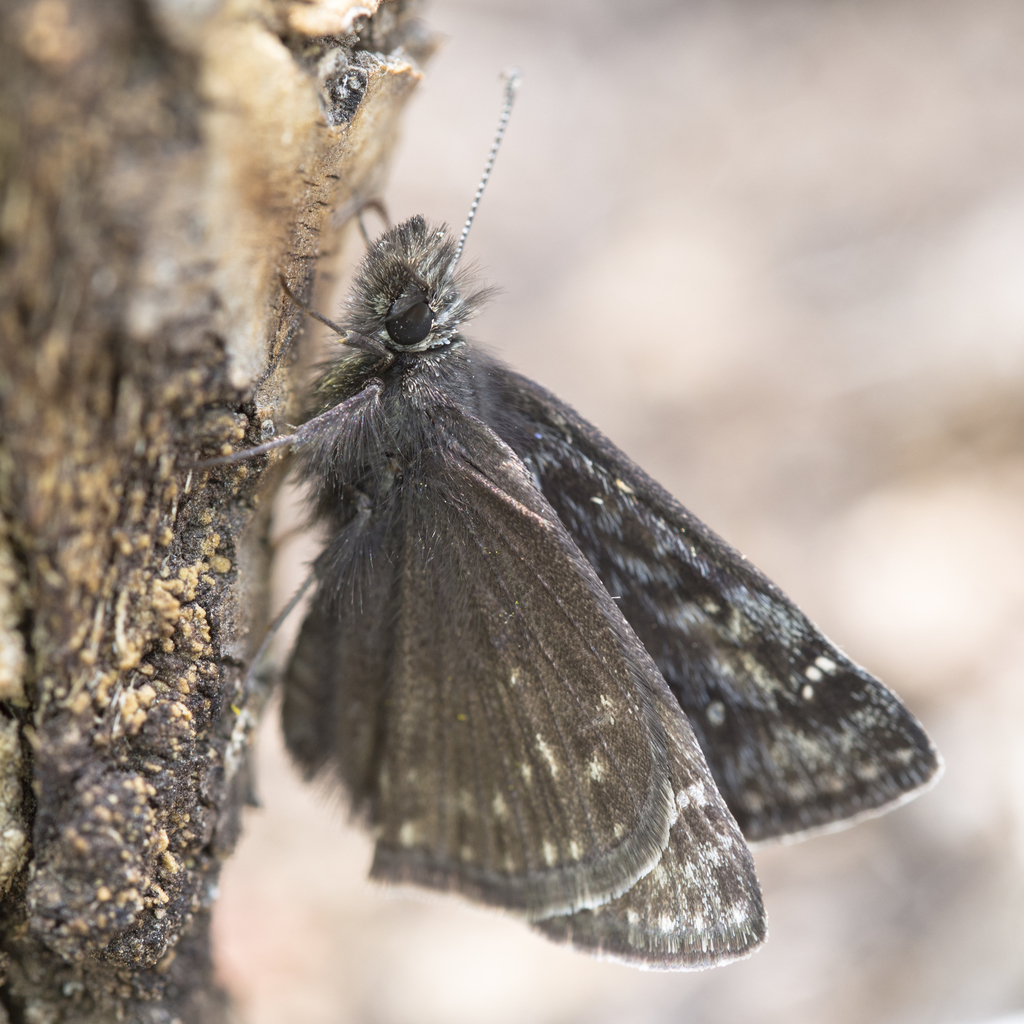
no rights reserved · CC0
Family: Hesperiidae · Class: Insecta · Order: Lepidoptera
Erynnis persius (Persius Duskywing) is a California animal in the Hesperiidae family.
The Persius duskywing is a small to medium-sized skipper butterfly with a wingspan ranging from 32 to 38 mm (1.3 to 1.5 inches). The dorsal wing surfaces are dark brown to black with distinctive white or pale yellow spots arranged in bands across the forewings. Males display a prominent stigma, a specialized scent patch, on the forewings. The hindwings typically show a series of small white spots along the outer margin. The undersides are lighter brown with more pronounced pale spotting. Sexual dimorphism is evident, with females generally larger and displaying more extensive pale markings than males. The Persius duskywing exhibits a disjunct distribution across North America. In western regions, the species ranges from Alaska and the McKenzie River delta south to southeastern Manitoba, extending through the western mountains to southern California, southeastern Arizona, and southeastern New Mexico. Eastern populations occur from northern New England west to Wisconsin, with southern extensions through the Appalachian Mountains to Virginia. In California, populations are documented in montane areas of the Sierra Nevada and other mountain ranges. The species belongs to the "Persius complex," a taxonomically challenging group that includes the Columbine and Wild Indigo duskywings, which are morphologically similar and require careful examination for accurate identification. Persius duskywings inhabit open areas within forested landscapes, including meadows, forest clearings, woodland edges, and mountain slopes. The species typically occurs at elevations ranging from sea level to approximately 3,000 meters (9,800 feet), with higher elevation populations in western mountain ranges. Adults are commonly found in areas where host plants are abundant, particularly in sunny exposures with well-drained soils. The species shows a preference for disturbed or semi-natural habitats that maintain populations of leguminous host plants. Larvae feed exclusively on leguminous plants, with documented host species including lupines (Lupinus species), golden banner (Thermopsis species), Lotus species, and other members of the pea family (Fabaceae). Adult butterflies are active from late spring through early fall, with flight periods varying by elevation and latitude. Males engage in territorial behavior, perching on elevated positions to intercept females and competing males. Mating typically occurs during midday hours when temperatures are optimal for flight activity. Females deposit eggs singly on or near host plant foliage. The species overwinters as mature larvae, pupating the following spring. The Persius duskywing is not federally listed and lacks specific state-level protection status. Population trends vary regionally, with some areas experiencing stable populations while others show evidence of decline. Primary threats include habitat loss due to development, forest succession that eliminates open meadow habitats, and potential impacts from climate change on high-elevation populations. Fire suppression practices may negatively affect the species by allowing forest encroachment into historically open areas. Conservation efforts focus on maintaining suitable habitat through prescribed burning, mechanical treatments, and protection of areas supporting host plant populations.
Classification
Class: Insecta · Order: Lepidoptera · Family: Hesperiidae
Frequently asked questions
How is Erynnis persius classified?
Erynnis persius belongs to class Insecta, order Lepidoptera, family Hesperiidae.
What family does Erynnis persius belong to?
Erynnis persius is in the Hesperiidae family.
What is Erynnis persius?
The Persius duskywing is a small to medium-sized skipper butterfly with a wingspan ranging from 32 to 38 mm (1.3 to 1.5 inches).
Is Erynnis persius found in California?
Yes. Erynnis persius is recorded in California in The California Species Project's catalogue.
Related species
Other California species in the same genus, family, or bioregion.
Data from The California Species Project — 14,000+ California species with verified data from CNPS, CDFW, USFWS, and more.