Erynnis propertius
Propertius Duskywing
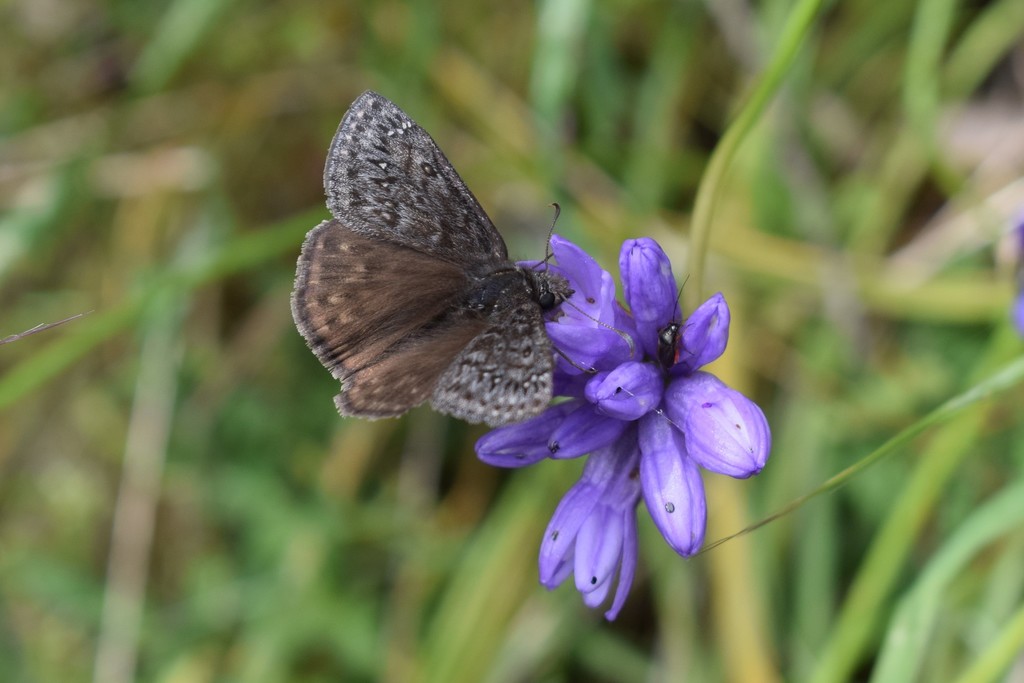
no rights reserved · CC0
Family: Hesperiidae · Class: Insecta · Order: Lepidoptera
Erynnis propertius (Propertius Duskywing) is a California animal in the Hesperiidae family.
The Propertius Duskywing is a medium-sized skipper butterfly with a wingspan ranging from 32 to 44 mm (1.3 to 1.7 inches). Males display dark brown to black wings with white hyaline spots on the forewings and a distinctive pattern of pale spots along the wing margins. The hindwings are uniformly dark with a subtle purplish sheen. Females are larger and lighter in coloration, with more prominent white spots on the forewings and pale gray-brown hindwings. Both sexes have thick, robust bodies typical of skipper butterflies, with large heads and prominent eyes. The antennae are club-shaped with recurved tips, a characteristic feature of the Hesperiidae family. The Propertius Duskywing ranges from southern British Columbia south along the Pacific Slope to Baja California Norte. In California, the species occurs primarily in oak woodlands and mixed oak forests throughout the coastal ranges and Sierra Nevada foothills, from sea level to approximately 1,800 meters (5,900 feet) in elevation. Populations are documented from Humboldt County south to San Diego County, with the species being most abundant in central and northern California oak habitats. This species inhabits oak woodland ecosystems, particularly areas dominated by coast live oak and Garry oak. Adults are commonly found in oak groves, woodland edges, and adjacent chaparral habitats. The butterflies prefer areas with partial shade and open spaces for flight activities. Males establish territories on hilltops and ridges where they perch on prominent objects to await females. The species shows strong fidelity to oak habitats, rarely venturing far from host plant communities. Propertius Duskywing larvae feed exclusively on coast live oak (Quercus agrifolia), Garry oak (Q. garryana), and potentially other oak species. The species produces one generation per year, with adults flying from March through July, with peak activity typically occurring in May and June. Females deposit eggs singly on young oak leaves, and larvae construct silk shelters by folding leaves together. Caterpillars are pale green with dark stripes and feed primarily at night, remaining hidden in their leaf shelters during daylight hours. The species overwinters as mature larvae in leaf litter or bark crevices, pupating in early spring. Adults are strong, rapid fliers with an erratic flight pattern characteristic of skipper butterflies. Males engage in territorial behavior, chasing other butterflies and returning to favored perching sites. The species nectars on various flowers including ceanothus, manzanita, and wildflowers in oak woodland understories. The Propertius Duskywing is not currently listed under federal or state endangered species legislation. However, the species faces ongoing pressure from oak woodland habitat loss due to urban development, agricultural conversion, and fire suppression policies that alter natural oak woodland structure. Climate change may also impact the species through shifts in oak forest distribution and altered precipitation patterns affecting host plant health.
Classification
Class: Insecta · Order: Lepidoptera · Family: Hesperiidae
Frequently asked questions
How is Erynnis propertius classified?
Erynnis propertius belongs to class Insecta, order Lepidoptera, family Hesperiidae.
What family does Erynnis propertius belong to?
Erynnis propertius is in the Hesperiidae family.
What is Erynnis propertius?
The Propertius Duskywing is a medium-sized skipper butterfly with a wingspan ranging from 32 to 44 mm (1.3 to 1.7 inches).
Is Erynnis propertius found in California?
Yes. Erynnis propertius is recorded in California in The California Species Project's catalogue.
Related species
Other California species in the same genus, family, or bioregion.
Data from The California Species Project — 14,000+ California species with verified data from CNPS, CDFW, USFWS, and more.