Erynnis tristis
Mournful Duskywing
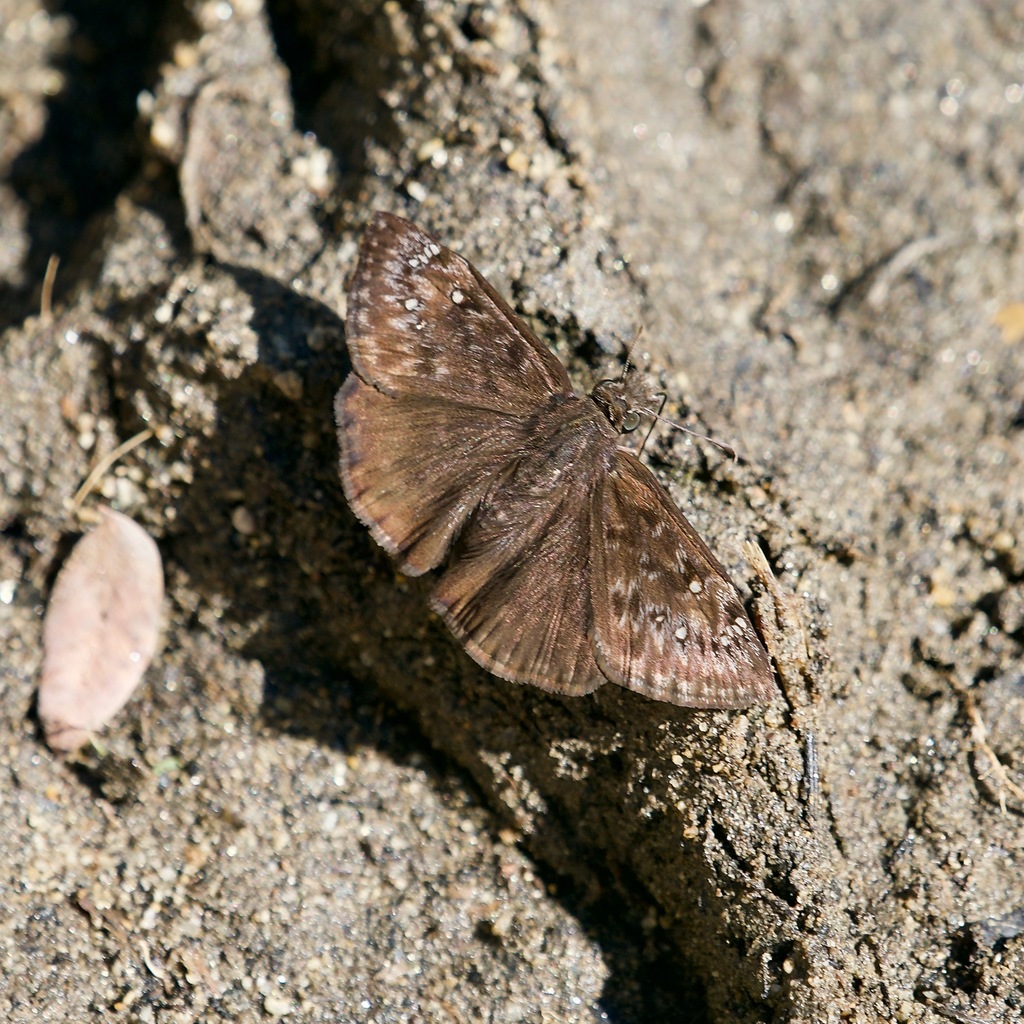
(c) Bill Levine, some rights reserved (CC BY) · licence
Family: Hesperiidae · Class: Insecta · Order: Lepidoptera
Erynnis tristis (Mournful Duskywing) is a California animal in the Hesperiidae family.
The Mournful Duskywing is a medium-sized skipper butterfly with distinctive dark brown to blackish forewings and hindwings. Adults measure 32 to 40 mm (1.3 to 1.6 inches) in wingspan. The forewings display a characteristic pattern of small white or pale yellow translucent spots arranged in irregular bands across the wing surface. Males possess a distinctive stigma, a dark scent patch, along the forewing costa. The hindwings are typically darker than the forewings with subtle spotting. At rest, the wings are held in a tent-like position typical of skippers. The body is robust and densely covered with dark scales, giving the butterfly its somber appearance that inspired the common name. The Mournful Duskywing ranges from northern California south through central Arizona and southern New Mexico, extending through the mountains of Mexico and Central America to Colombia. Occasional strays have been documented in South Texas. Within California, populations occur primarily in oak woodlands of the Coast Ranges, Sierra Nevada foothills, and southern California mountains. The species is most commonly encountered in areas with suitable oak habitat below 1,500 meters (4,900 feet) elevation. This species inhabits oak woodlands, chaparral, and mixed oak-pine forests where host plants are abundant. Adults are most frequently observed in sunny clearings, woodland edges, and along ridgetops where they engage in territorial behavior. The butterfly shows a strong association with areas containing multiple oak species, particularly where coast live oak, blue oak, and valley oak occur in proximity. Habitat requirements include both nectar sources and appropriate oviposition sites on oak foliage. Mournful Duskywings are univoltine in most locations, producing one generation per year. Adults emerge from late April through July, with peak flight occurring in May and June. Males establish territories on hilltops and ridges where they engage in aggressive encounters with other butterflies. Mating typically occurs during afternoon hours. Females deposit single eggs on various oak species including coast live oak (Quercus agrifolia), blue oak (Q. douglasii), and valley oak (Q. lobata). Larvae feed on oak foliage, constructing leaf shelters by folding and securing leaves with silk. The caterpillars overwinter in leaf litter as partially grown larvae, resuming feeding in spring before pupating. The Mournful Duskywing lacks federal or state listing status in California. However, populations may face localized pressures from habitat loss due to urban development, oak woodland conversion, and wildfire. Climate change poses additional concerns through altered precipitation patterns affecting oak health and phenology mismatches between butterfly emergence and optimal oak leaf quality. Oak sudden death syndrome has impacted host plant availability in some regions. The species benefits from oak woodland conservation efforts and fire management practices that maintain habitat heterogeneity.
Classification
Class: Insecta · Order: Lepidoptera · Family: Hesperiidae
Frequently asked questions
How is Erynnis tristis classified?
Erynnis tristis belongs to class Insecta, order Lepidoptera, family Hesperiidae.
What family does Erynnis tristis belong to?
Erynnis tristis is in the Hesperiidae family.
What is Erynnis tristis?
The Mournful Duskywing is a medium-sized skipper butterfly with distinctive dark brown to blackish forewings and hindwings.
Is Erynnis tristis found in California?
Yes. Erynnis tristis is recorded in California in The California Species Project's catalogue.
Related species
Other California species in the same genus, family, or bioregion.
Data from The California Species Project — 14,000+ California species with verified data from CNPS, CDFW, USFWS, and more.