Erythemis collocata
Western Pondhawk
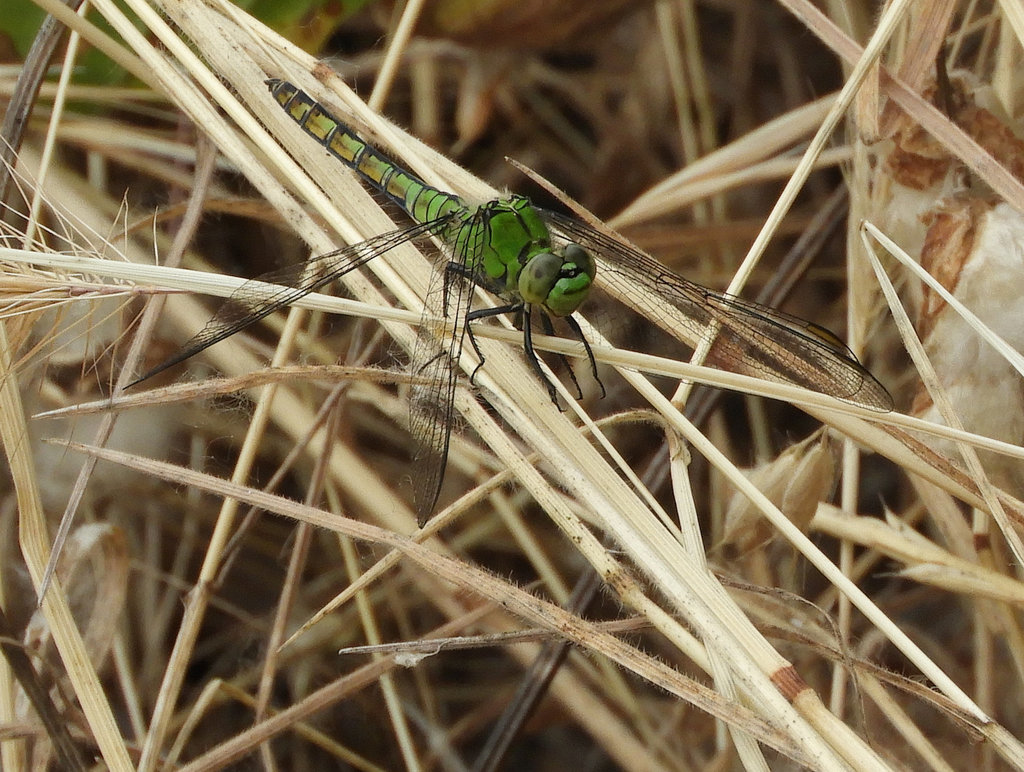
(c) Mary K. Hanson, some rights reserved (CC BY) · licence
Family: Libellulidae · Class: Insecta · Order: Odonata
Erythemis collocata (Western Pondhawk) is a California animal in the Libellulidae family.
The Western Pondhawk is a medium-sized dragonfly in the family Libellulidae, characterized by distinctive sexual dimorphism in coloration. Males display a bright blue pruinescent coating over their abdomen and thorax, while females and juveniles exhibit green coloration with yellow stripes. Adults typically measure 38-48 mm (1.5-1.9 inches) in body length with a wingspan of 60-80 mm (2.4-3.1 inches). The species can be distinguished from similar dragonflies by the male's vibrant blue coloration and the characteristic white face that develops with maturity. Erythemis collocata ranges across much of North America, from southern Canada to Central America. In the western United States, the species occurs from British Columbia south through California, extending east to the Rocky Mountains. The species is widely distributed in California, inhabiting suitable aquatic habitats from sea level to moderate elevations in both coastal and inland regions. According to NatureServe, the species maintains a global conservation status of G5, indicating it is secure across its range (NatureServe 2016). Western Pondhawks inhabit a variety of still and slow-moving freshwater environments, including ponds, lakes, marshes, slow streams, and artificial water bodies such as stock tanks and irrigation ditches. Adults are commonly observed around vegetation-rich shorelines and open water areas. The species shows a preference for warm, shallow waters with abundant emergent and submerged vegetation that provides perching sites and hunting grounds. Elevation tolerance ranges from sea level to approximately 2,000 meters (6,500 feet) in suitable habitat. This species exhibits typical libellulid behavior patterns, with adults being strong fliers and aggressive territorial hunters. Males establish and defend territories over prime breeding habitat, often perching on prominent vegetation or structures near water. Western Pondhawks are generalist predators, capturing a wide variety of flying insects including mosquitoes, midges, flies, and smaller dragonflies. Mating occurs during flight, followed by oviposition where females deposit eggs directly into water or soft substrates. The aquatic larval stage, known as naiads, are voracious predators in the benthic environment, feeding on various aquatic invertebrates and small vertebrates. Development from egg to adult typically requires one to two years, depending on climate and water temperature. The Western Pondhawk is not listed under state or federal endangered species legislation and appears to maintain stable populations throughout its range. The species demonstrates considerable adaptability to human-modified landscapes and can utilize artificial water sources, contributing to its conservation stability. Climate change and habitat modification represent potential long-term concerns, particularly drought conditions that may reduce available breeding habitat in arid regions. However, the species' broad habitat tolerance and widespread distribution suggest resilience to moderate environmental changes. Conservation efforts focus on maintaining water quality and preserving wetland habitats that support diverse odonate communities.
Classification
Class: Insecta · Order: Odonata · Family: Libellulidae
Frequently asked questions
How is Erythemis collocata classified?
Erythemis collocata belongs to class Insecta, order Odonata, family Libellulidae.
What family does Erythemis collocata belong to?
Erythemis collocata is in the Libellulidae family.
What is Erythemis collocata?
The Western Pondhawk is a medium-sized dragonfly in the family Libellulidae, characterized by distinctive sexual dimorphism in coloration.
Is Erythemis collocata found in California?
Yes. Erythemis collocata is recorded in California in The California Species Project's catalogue.
Related species
Other California species in the same genus, family, or bioregion.
Data from The California Species Project — 14,000+ California species with verified data from CNPS, CDFW, USFWS, and more.