Ethmia arctostaphylella
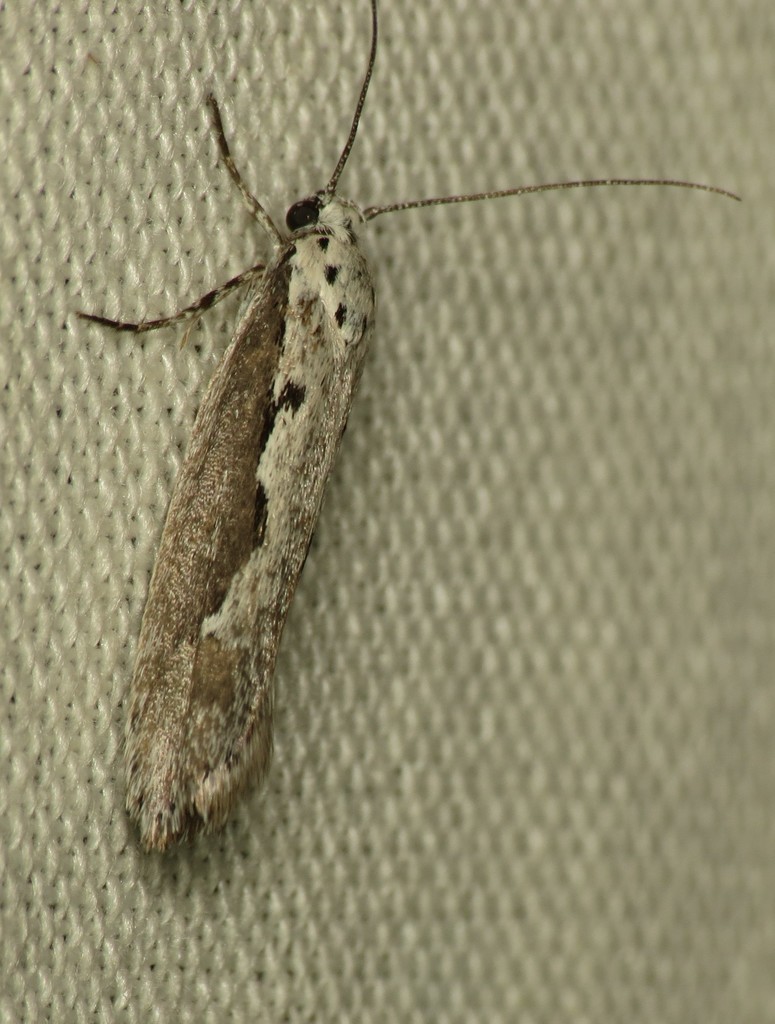
(c) Donald Hobern, some rights reserved (CC BY) · licence
Family: Depressariidae · Class: Insecta · Order: Lepidoptera
Ethmia arctostaphylella is a California animal in the Depressariidae family.
Ethmia arctostaphylella is a small moth in the family Depressariidae, originally described by Walsingham in 1880 under the name Psecadia arctostaphylella. The moth exhibits distinctive coloration with black and white forewings and a bright yellow abdomen. Adults display a pattern that allows them to rest inconspicuously along the midrib of host plant leaves during daylight hours, where they resemble bird droppings (BugGuide). The species occurs across a broad range in western North America, extending from southern Oregon and northern California southward to the Sierra San Pedro Mártir in Baja California, Mexico. The distribution includes eastern populations in southern Nevada at Mount Charleston and Arizona in the Pinaleno Mountains and Oak Creek Canyon. California records from the Butterflies and Moths of North America database document the species from numerous counties including San Bernardino, San Benito, Inyo, Los Angeles, Ventura, Plumas, Yolo, Santa Clara, Mariposa, Siskiyou, Colusa, Contra Costa, Santa Cruz, El Dorado, San Luis Obispo, Shasta, Sonoma, and Marin counties (BAMONA). The range possibly extends northward in Oregon and into Utah following the distribution of its host plants. Ethmia arctostaphylella larvae are associated with plants in the genus Eriodictyon, commonly known as yerba santa (BugGuide). These shrubs typically occur in chaparral and woodland habitats throughout California's foothills and mountains. The moth's distribution closely follows that of its host plants, which grow in well-drained soils on slopes and ridges in Mediterranean climate zones. Adults exhibit cryptic daytime behavior, positioning themselves along the central vein of Eriodictyon leaves where their coloration provides effective camouflage. This behavioral adaptation helps protect the moths from predation during their inactive daytime period. Flight periods and specific reproductive timing have not been extensively documented in the literature, though museum and citizen science records suggest activity occurs across multiple seasons. The species belongs to the semilugens species group within the genus Ethmia, which includes 52 named species north of Mexico (BugGuide). Ethmia arctostaphylella can be distinguished from related species such as E. discostrigella and E. semitenebrella by differences in forewing patterns and geographic distribution. The moth is catalogued as Hodges number 0979 in the standard reference system for North American Lepidoptera. Currently, Ethmia arctostaphylella has no formal conservation listing at federal or state levels. The species appears to maintain stable populations across its range, with continued documentation through citizen science platforms and museum collections. However, like many specialized herbivorous insects, the species could be vulnerable to habitat loss affecting its Eriodictyon host plants, particularly in California's rapidly developing foothill regions. The moth's dependence on specific plant hosts makes it sensitive to changes in chaparral and woodland ecosystems. Long-term population trends have not been systematically studied, and the species would benefit from targeted surveys to assess current population status and distribution patterns.
Classification
Class: Insecta · Order: Lepidoptera · Family: Depressariidae
Frequently asked questions
How is Ethmia arctostaphylella classified?
Ethmia arctostaphylella belongs to class Insecta, order Lepidoptera, family Depressariidae.
What family does Ethmia arctostaphylella belong to?
Ethmia arctostaphylella is in the Depressariidae family.
What is Ethmia arctostaphylella?
Ethmia arctostaphylella is a small moth in the family Depressariidae, originally described by Walsingham in 1880 under the name Psecadia arctostaphylella.
Is Ethmia arctostaphylella found in California?
Yes. Ethmia arctostaphylella is recorded in California in The California Species Project's catalogue.
Related species
Other California species in the same genus, family, or bioregion.
Data from The California Species Project — 14,000+ California species with verified data from CNPS, CDFW, USFWS, and more.