Ethmia semitenebrella
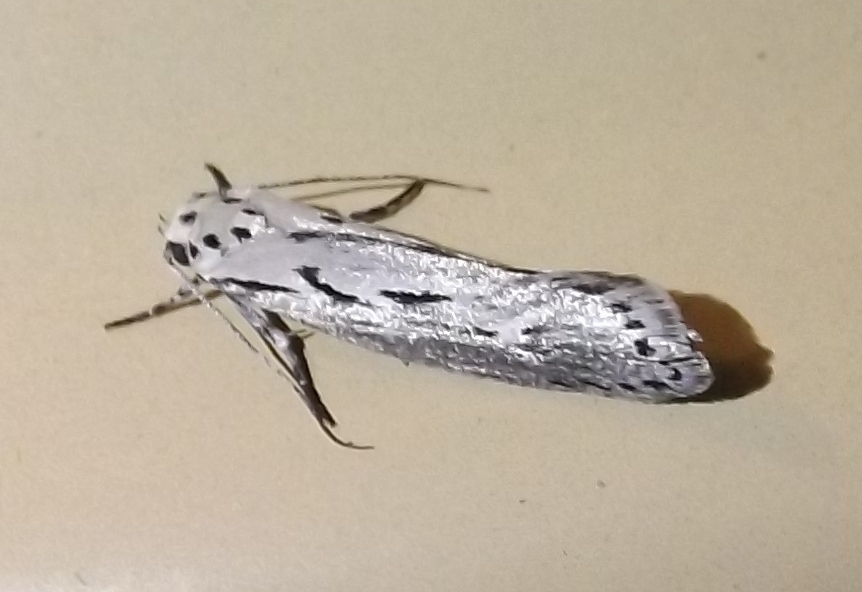
no rights reserved · CC0
Family: Depressariidae · Class: Insecta · Order: Lepidoptera
Ethmia semitenebrella is a California animal in the Depressariidae family.
Ethmia semitenebrella is a small moth in the family Depressariidae, one of numerous microlepidopteran species found in western North America. This species belongs to the genus Ethmia, which comprises approximately 200 described species worldwide, with several dozen occurring in North America. Adults typically measure 8 to 12 millimeters in forewing length, characteristic of the Depressariidae family. The forewings of E. semitenebrella display a distinctive pattern of dark and light markings, with the species name 'semitenebrella' translating to 'half-darkened,' likely referring to contrasting coloration on the wing surfaces. The forewings are generally grayish-brown with darker patches and pale spots or streaks. The hindwings are typically paler, often whitish or light gray, with reduced markings compared to the forewings. When at rest, the wings are held roof-like over the body, a typical posture for elachistid moths. The distribution of Ethmia semitenebrella appears to be centered in western North America, though specific range data for this species remains limited in the literature. Many Ethmia species have restricted distributions tied to their host plant requirements, suggesting E. semitenebrella likely occupies specific habitats within California and potentially adjacent states. The genus Ethmia shows greatest diversity in arid and semi-arid regions of western North America. Habitat preferences for E. semitenebrella are closely linked to the distribution of its larval host plants. Like other Ethmia species, the larvae likely feed on plants in the family Boraginaceae, which includes species such as Phacelia, Cryptantha, and Amsinckia. These host plants are commonly found in chaparral, coastal sage scrub, desert scrub, and oak woodland communities throughout California. Adults are attracted to lights and may be found in areas adjacent to larval habitats. The life cycle of E. semitenebrella follows the typical lepidopteran pattern of complete metamorphosis. Larvae are external feeders on host plant foliage, creating characteristic feeding damage. Pupation likely occurs in soil or leaf litter near the host plant. Adults are primarily nocturnal, with flight periods varying by elevation and local climate conditions. In California, many Ethmia species have spring flight periods coinciding with host plant growth, though some may have multiple generations per year. Conservation status information for Ethmia semitenebrella is lacking, as the species has not been formally assessed by state or federal agencies. Many microlepidopteran species remain poorly studied, with limited data on population trends, distribution, and ecological requirements. The species does not appear on federal or California state threatened or endangered species lists. However, like many specialized herbivorous insects, E. semitenebrella may be vulnerable to habitat loss, particularly if it has narrow host plant requirements or limited distribution. Urban development, agricultural conversion, and altered fire regimes could potentially impact populations if they occur in affected areas.
Classification
Class: Insecta · Order: Lepidoptera · Family: Depressariidae
Frequently asked questions
How is Ethmia semitenebrella classified?
Ethmia semitenebrella belongs to class Insecta, order Lepidoptera, family Depressariidae.
What family does Ethmia semitenebrella belong to?
Ethmia semitenebrella is in the Depressariidae family.
What is Ethmia semitenebrella?
Ethmia semitenebrella is a small moth in the family Depressariidae, one of numerous microlepidopteran species found in western North America.
Is Ethmia semitenebrella found in California?
Yes. Ethmia semitenebrella is recorded in California in The California Species Project's catalogue.
Related species
Other California species in the same genus, family, or bioregion.
Data from The California Species Project — 14,000+ California species with verified data from CNPS, CDFW, USFWS, and more.