Eubalaena japonica
North Pacific right whale
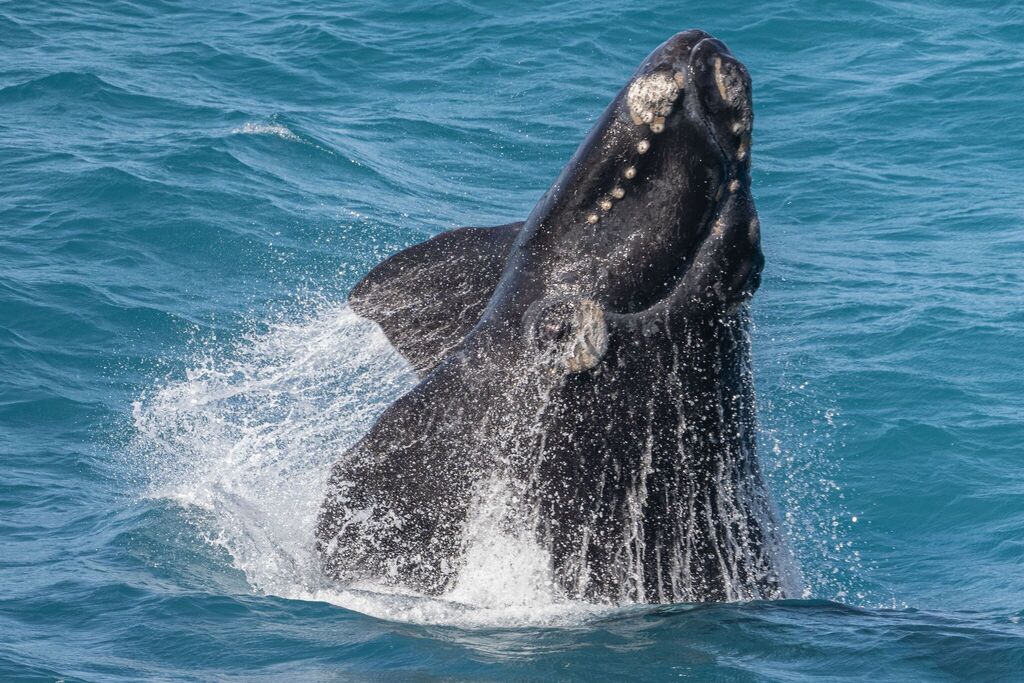
(c) Alan Bell, some rights reserved (CC BY) · licence
Family: Balaenidae · Class: Mammalia · Order: Artiodactyla
Conservation status: FP · Endangered
Eubalaena japonica (North Pacific right whale) is a California animal in the Balaenidae family.
The North Pacific right whale (Eubalaena japonica) is one of the world's most critically endangered cetaceans and the rarest large whale in the North Pacific. Adults reach lengths of 15-17 meters (49-56 feet) and can weigh up to 80 metric tons. The species exhibits the characteristic robust body shape of right whales, with a large head comprising up to one-third of total body length. The dark gray to black body lacks a dorsal fin, and distinctive callosities—raised patches of keratinized skin—occur on the head, particularly around the rostrum and lower jaw. These callosities appear white or cream-colored due to colonies of whale lice and provide unique identification patterns for individual whales. Historically, North Pacific right whales ranged across the North Pacific from Japan to Alaska and south to California waters. The species was once abundant throughout this range but commercial whaling from the 1840s to 1960s reduced populations to near extinction. Current distribution is extremely limited, with the only known feeding aggregation occurring in the southeastern Bering Sea, primarily in Bristol Bay. Occasional sightings have been documented along the U.S. West Coast, including California waters, though these are exceptionally rare. North Pacific right whales inhabit continental shelf and slope waters, typically at depths of 50-200 meters (164-656 feet). They prefer areas with high concentrations of zooplankton, particularly copepods of the genus Calanus and Neocalanus. The species exhibits seasonal migration patterns, moving to northern feeding areas during summer and presumably to warmer waters for breeding, though specific breeding areas remain largely unknown. These baleen whales are specialized filter feeders, using their massive baleen plates to strain copepods and other small crustaceans from the water. They feed by skimming through dense prey patches with mouths partially open. Reproduction is poorly understood due to the species' rarity, but females likely give birth to single calves after an 11-12 month gestation period. Sexual maturity is estimated to occur at 8-15 years of age, and the calving interval is believed to be 3-4 years. The North Pacific right whale has been federally listed as endangered since 1973. According to California Department of Fish and Wildlife, the species was originally listed as part of the northern right whale species concept but was reclassified in 2008 as a separate species following taxonomic clarification. The current population is estimated at fewer than 30 individuals based on acoustic and visual surveys, making it one of the most endangered marine mammals globally. Primary threats include ship strikes, entanglement in fishing gear, noise pollution, climate change effects on prey distribution, and the species' extremely small population size, which increases vulnerability to inbreeding and stochastic events. Recovery efforts focus on population monitoring, threat reduction, and habitat protection, though the species' critically low numbers present significant challenges for conservation success.
Classification
Class: Mammalia · Order: Artiodactyla · Family: Balaenidae
Conservation status
FP · Endangered
Frequently asked questions
How is Eubalaena japonica classified?
Eubalaena japonica belongs to class Mammalia, order Artiodactyla, family Balaenidae.
What family does Eubalaena japonica belong to?
Eubalaena japonica is in the Balaenidae family.
Is Eubalaena japonica protected or of conservation concern?
Eubalaena japonica carries the following status: FP · Endangered.
What is Eubalaena japonica?
The North Pacific right whale (Eubalaena japonica) is one of the world's most critically endangered cetaceans and the rarest large whale in the North Pacific.
Is Eubalaena japonica found in California?
Yes. Eubalaena japonica is recorded in California in The California Species Project's catalogue.
More California species
This species has no close relatives in our California data — here are other species to explore.
Data from The California Species Project — 14,000+ California species with verified data from CNPS, CDFW, USFWS, and more.