Eublemma minima
Everlasting Bud Moth
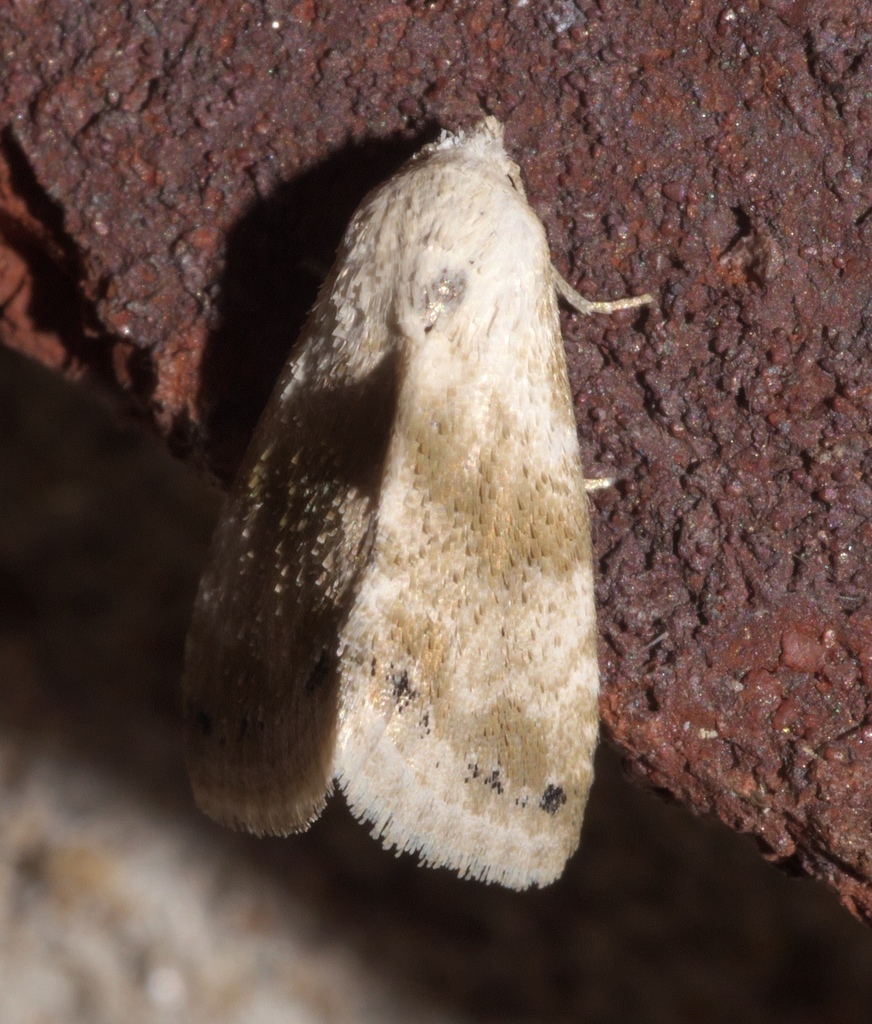
(c) Robert Webster, some rights reserved (CC BY-SA) · licence
Family: Erebidae · Class: Insecta · Order: Lepidoptera
Eublemma minima (Everlasting Bud Moth) is a California animal in the Erebidae family.
The Everlasting Bud Moth is a small moth in the family Erebidae, subfamily Eublemminae. The forewing displays cream to tan coloration with fine, slightly darker lines and broad olive-brown median and subterminal shade bands. The median shade line continues onto the hindwing scales, creating a distinctive pattern that aids in field identification. Adults typically measure 8-12 mm in wingspan, making this one of the smaller members of its family. This species exhibits a notably broad global distribution, occurring across multiple continents. In North America, the Everlasting Bud Moth ranges from North Carolina south to Florida, extending west along the Gulf Coast to Texas and continuing to California (BugGuide). The species also occurs throughout Central America and South America, reaching as far south as Argentina, as well as in the Caribbean. Outside the Americas, populations are documented in Kenya, Madagascar, South Africa, and Yemen (iNaturalist), demonstrating broad dispersal capabilities for such a small moth. The Everlasting Bud Moth inhabits areas where its host plants occur, primarily associating with members of the Asteraceae family. In its southwestern North American range, the species occurs primarily in semi-arid montane habitats. The moth's distribution closely follows the availability of suitable host vegetation across diverse ecological zones, from coastal plains to mountain foothills. Larvae feed specifically on the buds of sweet everlasting (Pseudognaphalium obtusifolium), pearly everlasting (Anaphalis margaritacea), and rabbit tobacco (Pseudognaphalium helleri), boring into the flower heads during development. This specialized feeding behavior gives the species its common name and represents a narrow ecological niche within the broader plant family. The larvae's bud-boring habit distinguishes it from many other small moths that feed on leaves or stems. Adult flight periods and specific reproductive behaviors have not been extensively documented in the scientific literature, though the species appears to be multivoltine across much of its range. The Everlasting Bud Moth currently has no formal conservation status designation at federal or state levels. iNaturalist reports no conservation status for this taxon, and it does not appear on major conservation concern lists. The species' extremely wide global distribution suggests stable populations, though local abundance patterns across its range have not been systematically studied. The moth's dependence on specific host plants within the everlasting genus may make it vulnerable to habitat conversion in some regions, particularly where native plant communities face pressure from development or invasive species. However, the broad ecological tolerance demonstrated by its presence across multiple continents and climate zones indicates considerable adaptability. Scientific documentation for this species remains limited regarding specific population trends, ecological interactions, and detailed life history characteristics.
Classification
Class: Insecta · Order: Lepidoptera · Family: Erebidae
Frequently asked questions
How is Eublemma minima classified?
Eublemma minima belongs to class Insecta, order Lepidoptera, family Erebidae.
What family does Eublemma minima belong to?
Eublemma minima is in the Erebidae family.
What is Eublemma minima?
The Everlasting Bud Moth is a small moth in the family Erebidae, subfamily Eublemminae.
Is Eublemma minima found in California?
Yes. Eublemma minima is recorded in California in The California Species Project's catalogue.
Related species
Other California species in the same genus, family, or bioregion.
Data from The California Species Project — 14,000+ California species with verified data from CNPS, CDFW, USFWS, and more.