Euborellia annulipes
Ring-legged Earwig
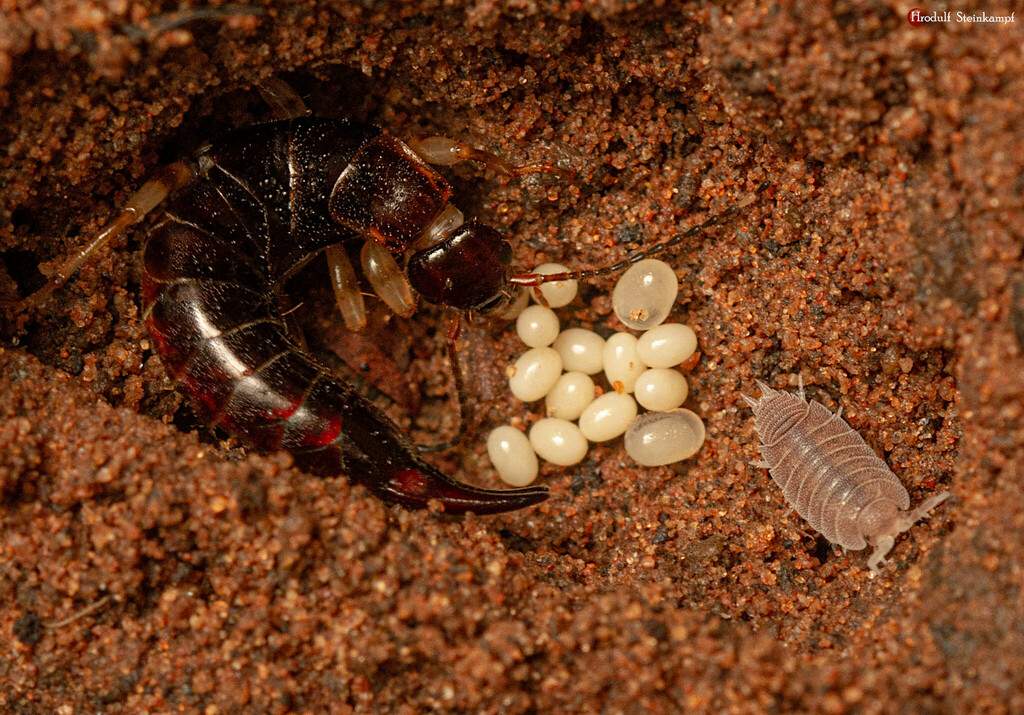
(c) Rudolph Steenkamp, some rights reserved (CC BY-SA) · licence
Family: Anisolabididae · Class: Insecta · Order: Dermaptera
Euborellia annulipes (Ring-legged Earwig) is a California animal in the Anisolabididae family.
The Ring-legged Earwig (Euborellia annulipes) is a dermapteran insect belonging to the family Anisolabididae. Adults typically measure 10-15 mm (0.4-0.6 inches) in length and display the characteristic forceps-like cerci at the posterior end that define the earwig order. The species is distinguished by distinctive banding or ring-like markings on the legs, which give rise to its common name. The body is elongated and somewhat flattened, typically brownish in coloration, with short wing covers that may or may not conceal functional hindwings depending on the individual. Euborellia annulipes has a cosmopolitan distribution and occurs throughout much of North America, including California. The species appears to be widely distributed across multiple biogeographic regions, though specific distributional data within California counties remains poorly documented in the scientific literature. This earwig has likely expanded its range through human-mediated dispersal, as is common among many dermapteran species. The Ring-legged Earwig inhabits diverse terrestrial environments and demonstrates considerable habitat flexibility. The species is commonly found in soil, leaf litter, under bark, beneath stones, and in other cryptic microhabitats that provide moisture and protection from desiccation. It occurs in both natural and anthropogenic environments, including gardens, agricultural areas, and disturbed habitats. The species appears to prefer areas with adequate moisture and organic matter, which support both the earwig and its prey species. As an omnivorous predator and scavenger, E. annulipes feeds on a variety of small invertebrates, decaying organic matter, and occasionally plant material. The species exhibits typical earwig behavior, being primarily nocturnal and seeking shelter in crevices and under objects during daylight hours. Reproduction involves direct development, with females providing maternal care by guarding eggs and early instar nymphs. The reproductive biology follows the general dermapteran pattern, with multiple molts required to reach sexual maturity. Currently, Euborellia annulipes holds no federal or state conservation listing status in California or nationally. The species appears to maintain stable populations and faces no immediate conservation concerns. Its apparent ecological flexibility and ability to exploit both natural and human-modified habitats suggest resilience to environmental changes. However, detailed population studies and long-term monitoring data are lacking for this species, as is common for many non-pest dermapteran taxa. Scientific documentation for this species remains limited despite its apparent widespread distribution. The information presented here synthesizes available taxonomic and ecological data from federal databases and general dermapteran literature. Detailed ecological studies, specific habitat requirements, and comprehensive distributional surveys within California have not been well documented. Additional field research would enhance understanding of this species' role in California's terrestrial arthropod communities and its specific ecological requirements across different habitat types throughout the state.
Classification
Class: Insecta · Order: Dermaptera · Family: Anisolabididae
Frequently asked questions
How is Euborellia annulipes classified?
Euborellia annulipes belongs to class Insecta, order Dermaptera, family Anisolabididae.
What family does Euborellia annulipes belong to?
Euborellia annulipes is in the Anisolabididae family.
What is Euborellia annulipes?
The Ring-legged Earwig (Euborellia annulipes) is a dermapteran insect belonging to the family Anisolabididae.
Is Euborellia annulipes found in California?
Yes. Euborellia annulipes is recorded in California in The California Species Project's catalogue.
More California species
This species has no close relatives in our California data — here are other species to explore.
Data from The California Species Project — 14,000+ California species with verified data from CNPS, CDFW, USFWS, and more.