Euchloe ausonides
Large marble
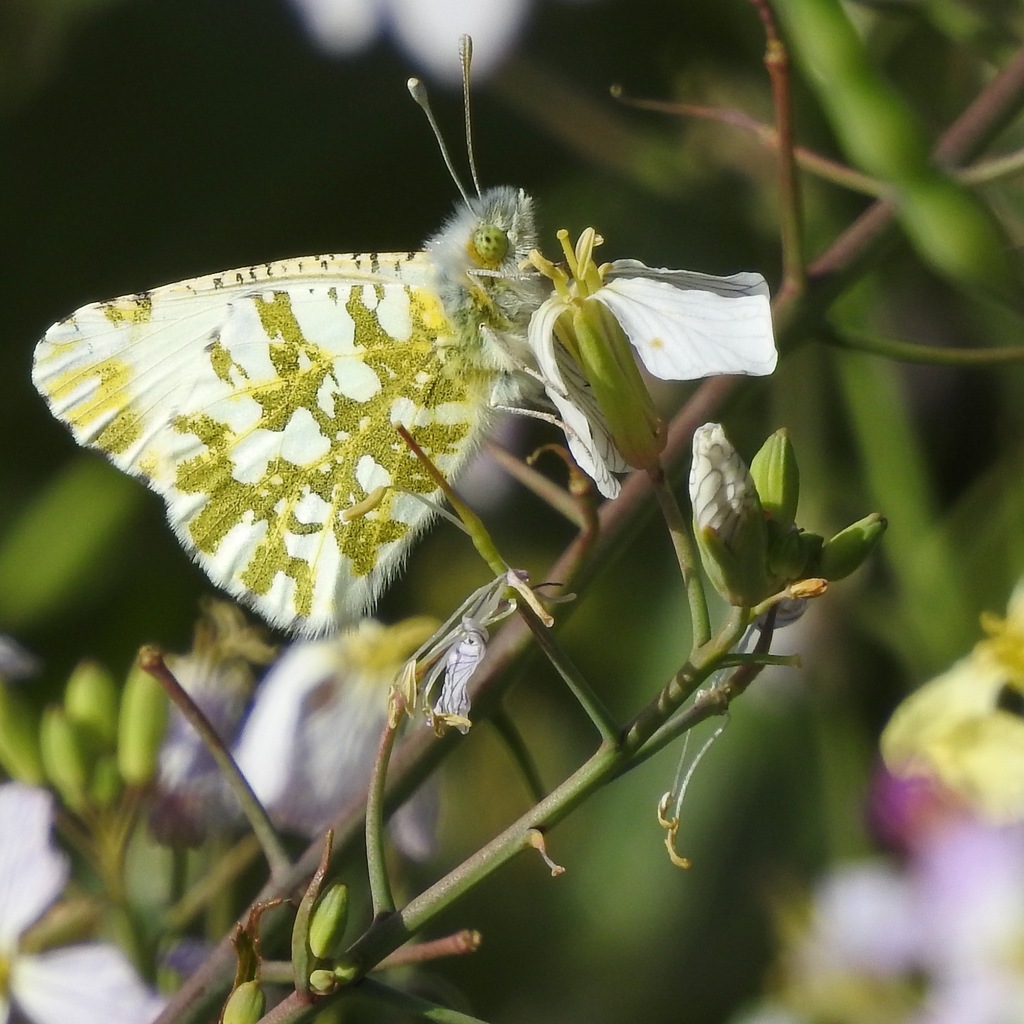
(c) Daniel Levitis, some rights reserved (CC BY) · licence
Family: Pieridae · Class: Insecta · Order: Lepidoptera
Euchloe ausonides (Large marble) is a California animal in the Pieridae family.
The large marble (Euchloe ausonides) is a medium-sized butterfly in the family Pieridae, distinguished by its white wings marked with distinctive green marbling patterns on the undersides. Adults have a wingspan of 32 to 45 mm (1.3 to 1.8 inches). The dorsal wing surfaces are predominantly white with black markings along the forewing tips and borders. The ventral hindwings display characteristic green and white marbled patterns that give the species its common name, created by scales that reflect light to produce the mottled appearance. Males typically have more pronounced black markings on the forewings compared to females. The large marble ranges from Alaska south to central California and northern New Mexico, extending east to southwest Manitoba. This species occurs across much of western and northern North America, with documented populations in California, Nevada, and Oregon. The distribution encompasses diverse elevational zones from sea level to montane environments, with populations found at elevations up to 3,200 meters (10,500 feet) in some regions. This butterfly inhabits open habitats including grasslands, sagebrush steppes, alpine meadows, disturbed areas, and forest clearings. Large marbles are commonly found in areas with abundant mustard family plants, including roadsides, vacant lots, agricultural margins, and natural openings in forested landscapes. The species shows preference for sunny, exposed sites with moderate moisture availability during the flight period. Large marbles are univoltine, producing one generation per year with flight periods typically occurring from March through July, varying by latitude and elevation. Earlier flights occur at lower elevations and southern latitudes. Adults are active during daylight hours and feed on nectar from various flowers including mustards, composites, and other available blooms. Mating occurs during peak flight periods, with females laying single eggs on or near host plants. Larvae feed exclusively on plants in the mustard family (Brassicaceae), including rockcress (Arabis drummondi), dyer's woad (Isatis tinctoria), mustards (Brassica species), and hedge mustard (Sisymbrium species). Caterpillars are green with white stripes and complete development through five instars before pupating. The species overwinters as a chrysalis attached to host plants or nearby vegetation. Seven subspecies of Euchloe ausonides are recognized: E. a. ausonides, E. a. coloradensis, E. a. insulanus, E. a. mayi, E. a. ogilvia, E. a. palaeoreios, and E. a. transmontana. These subspecies show variation in wing patterns, size, and geographic distribution. The large marble is not federally listed or state-listed in California, and populations appear stable across most of the range. However, localized populations may face threats from habitat loss due to urban development, agricultural intensification, and invasive plant species that displace native mustard family host plants. Climate change may affect the timing of emergence and host plant availability, particularly at higher elevations where snowmelt patterns are shifting.
Classification
Class: Insecta · Order: Lepidoptera · Family: Pieridae
Frequently asked questions
How is Euchloe ausonides classified?
Euchloe ausonides belongs to class Insecta, order Lepidoptera, family Pieridae.
What family does Euchloe ausonides belong to?
Euchloe ausonides is in the Pieridae family.
What is Euchloe ausonides?
The large marble (Euchloe ausonides) is a medium-sized butterfly in the family Pieridae, distinguished by its white wings marked with distinctive green marbling patterns on the undersides.
Is Euchloe ausonides found in California?
Yes. Euchloe ausonides is recorded in California in The California Species Project's catalogue.
Related species
Other California species in the same genus, family, or bioregion.
Data from The California Species Project — 14,000+ California species with verified data from CNPS, CDFW, USFWS, and more.