Euchloe hyantis andrewsi
Andrew's Marble Butterfly
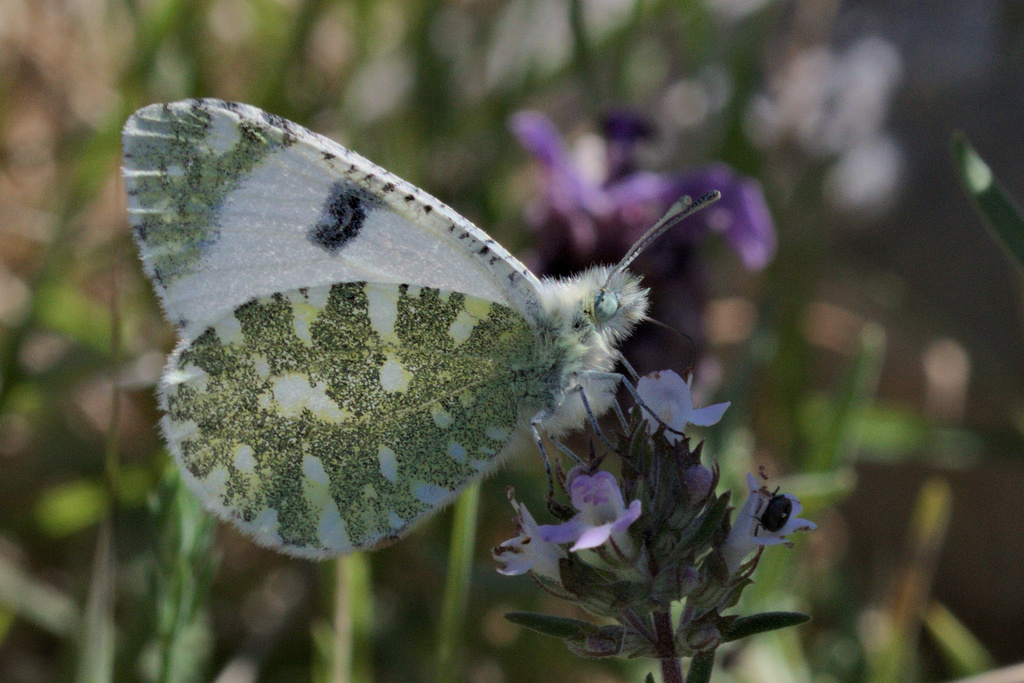
(c) Carlos Franquinho, some rights reserved (CC BY-SA) · licence
Family: Pieridae · Class: Insecta · Order: Lepidoptera
Conservation status: G3G4T2 S2
Euchloe hyantis andrewsi (Andrew's Marble Butterfly) is a California animal in the Pieridae family.
Andrew's Marble Butterfly is a subspecies of the Large Marble butterfly endemic to California's coastal regions. Adults display the characteristic pierid wing pattern with white dorsal surfaces marked by distinctive green marbling along the wing veins. Males typically measure 38-45 mm (1.5-1.8 inches) in wingspan, while females are slightly larger at 42-48 mm (1.7-1.9 inches). The undersides of the hindwings exhibit prominent green mottling that provides effective camouflage when at rest. Males possess bright yellow-orange patches on the forewings that are absent or reduced in females. The species can be distinguished from other Euchloe subspecies by its more extensive green marbling and specific geographic distribution. Andrew's Marble Butterfly occurs along California's coast from Marin County south to Santa Barbara County. Historically documented populations existed in San Francisco, San Mateo, Santa Clara, Santa Cruz, Monterey, San Luis Obispo, and Santa Barbara counties. The subspecies inhabits coastal prairie, coastal scrub, and mixed grassland communities typically within 10 kilometers of the Pacific Ocean. Current populations are fragmented and restricted to scattered locations where suitable habitat and host plants persist. This subspecies requires areas containing its primary host plants in the mustard family (Brassicaceae), particularly native species such as Arabis blepharophylla, Streptanthus glandulosus, and Caulanthus species. Adults prefer open grasslands and coastal prairie habitats with scattered shrubs at elevations from sea level to approximately 600 meters (2,000 feet). The species shows strong site fidelity, with populations often restricted to specific microsites where host plant densities are sufficient for larval development. Andrew's Marble Butterfly exhibits a single generation per year, with adults typically emerging from late February through May, depending on weather conditions and elevation. Females deposit eggs singly on flower buds and young seed pods of host plants. Larvae feed exclusively on developing seeds and seed pods, completing development through five instars over 4-6 weeks. The species overwinters as a chrysalis attached to dried plant stems or debris near the host plant. Males engage in patrolling behavior, searching for females along ridgelines and open areas within habitat patches. With a global rank of G3G4T2 and state rank of S2, Andrew's Marble Butterfly is considered imperiled in California. Population declines result primarily from habitat loss due to urban development, agricultural conversion, and invasive plant species that displace native host plants. Coastal development has eliminated numerous historical localities, particularly in the San Francisco Bay Area and Central Coast. Fire suppression has altered natural disturbance regimes that historically maintained open grassland habitat. Climate change poses additional threats through altered precipitation patterns and increased drought frequency. Current populations are small and isolated, making them vulnerable to local extinctions from stochastic events. Conservation efforts focus on habitat protection, invasive species management, and restoration of native plant communities in remaining suitable areas.
Classification
Class: Insecta · Order: Lepidoptera · Family: Pieridae
Conservation status
G3G4T2 S2
Frequently asked questions
How is Euchloe hyantis andrewsi classified?
Euchloe hyantis andrewsi belongs to class Insecta, order Lepidoptera, family Pieridae.
What family does Euchloe hyantis andrewsi belong to?
Euchloe hyantis andrewsi is in the Pieridae family.
Is Euchloe hyantis andrewsi protected or of conservation concern?
Euchloe hyantis andrewsi carries the following status: G3G4T2 S2.
What is Euchloe hyantis andrewsi?
Andrew's Marble Butterfly is a subspecies of the Large Marble butterfly endemic to California's coastal regions.
Is Euchloe hyantis andrewsi found in California?
Yes. Euchloe hyantis andrewsi is recorded in California in The California Species Project's catalogue.
Related species
Other California species in the same genus, family, or bioregion.
Data from The California Species Project — 14,000+ California species with verified data from CNPS, CDFW, USFWS, and more.