Euchloe lotta
Desert Marble
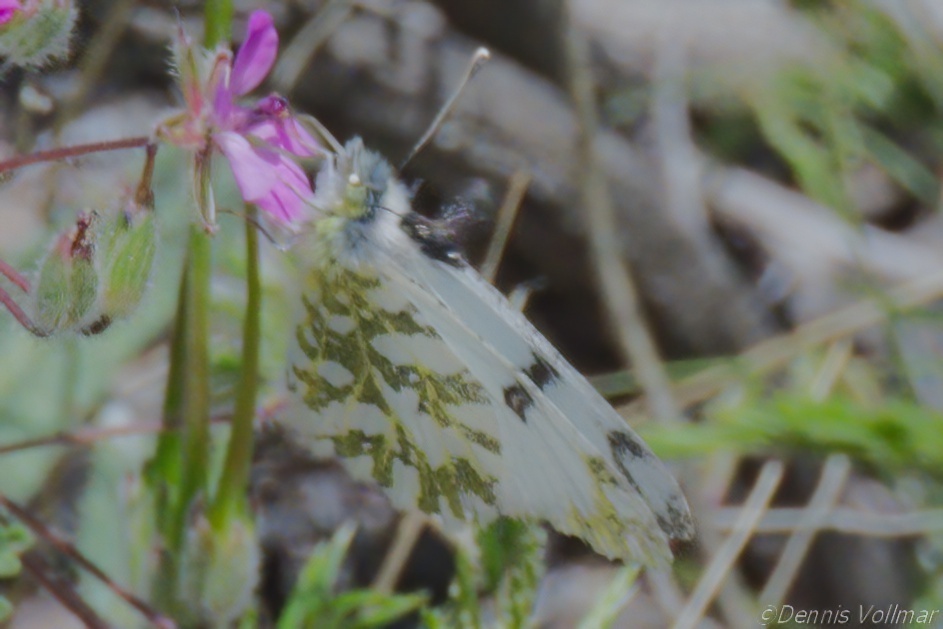
(c) Dennis Vollmar, some rights reserved (CC BY) · licence
Family: Pieridae · Class: Insecta · Order: Lepidoptera
Euchloe lotta (Desert Marble) is a California animal in the Pieridae family.
The Desert Marble (Euchloe lotta) is a small to medium-sized butterfly in the white and sulfur family (Pieridae). Adults exhibit a wingspan of approximately 32 to 44 mm (1.3 to 1.7 inches). The dorsal wing surfaces are predominantly white with dark marginal borders on the forewings. Males typically display more pronounced dark markings along the wing edges compared to females. The ventral hindwings feature distinctive marbled green and white patterns that provide the species its common name, creating effective camouflage when the butterfly rests with wings closed. The underwing pattern consists of irregular green patches interspersed with white areas, resembling veined marble stone. Desert Marble occurs across the interior regions of south British Columbia east of the Cascades and Sierra Nevada, extending south through the western United States to southern California and eastward to Colorado and New Mexico. In California, populations are documented from the eastern Sierra Nevada, Mojave Desert, and portions of the Sonoran Desert. The species inhabits arid and semi-arid environments, typically at elevations ranging from 300 to 2,400 meters (1,000 to 7,900 feet). Preferred habitats include desert washes, canyon bottoms, foothills, and areas with scattered desert scrub vegetation. Adult Desert Marble butterflies are closely associated with plants in the mustard family (Brassicaceae), which serve as both larval host plants and adult nectar sources. Primary host plants include various species of rock cress (Arabis), peppergrass (Lepidium), and tansy-mustard (Descurainia). Larvae develop on these cruciferous plants, feeding on leaves, flowers, and developing seed pods. The caterpillars are typically green with pale longitudinal stripes, providing camouflage among the host plant foliage. Desert Marble exhibits a flight period that varies by elevation and geographic location, generally occurring from March through June in lower elevations and May through July at higher elevations. The species may produce one to two broods annually, depending on environmental conditions and resource availability. Adults are most active during morning and late afternoon hours, seeking shelter during the hottest parts of the day. Mating occurs after males locate females through pheromone detection and visual cues. Females oviposit singly on host plant buds, flowers, or young leaves. The Desert Marble is not currently listed under federal or state endangered species legislation. Population trends are not well-documented across the species' range, though the butterfly appears to maintain stable populations in suitable habitat. Primary conservation concerns include habitat degradation from urban development, off-road vehicle use, and invasive plant species that may displace native mustard family plants. Climate change poses potential long-term threats through altered precipitation patterns and increased temperatures in desert environments. The species benefits from habitat protection in national parks, wilderness areas, and other protected lands throughout its range.
Classification
Class: Insecta · Order: Lepidoptera · Family: Pieridae
Frequently asked questions
How is Euchloe lotta classified?
Euchloe lotta belongs to class Insecta, order Lepidoptera, family Pieridae.
What family does Euchloe lotta belong to?
Euchloe lotta is in the Pieridae family.
What is Euchloe lotta?
The Desert Marble (Euchloe lotta) is a small to medium-sized butterfly in the white and sulfur family (Pieridae).
Is Euchloe lotta found in California?
Yes. Euchloe lotta is recorded in California in The California Species Project's catalogue.
Related species
Other California species in the same genus, family, or bioregion.
Data from The California Species Project — 14,000+ California species with verified data from CNPS, CDFW, USFWS, and more.