Euchromius californicalis
California Grass-veneer Moth
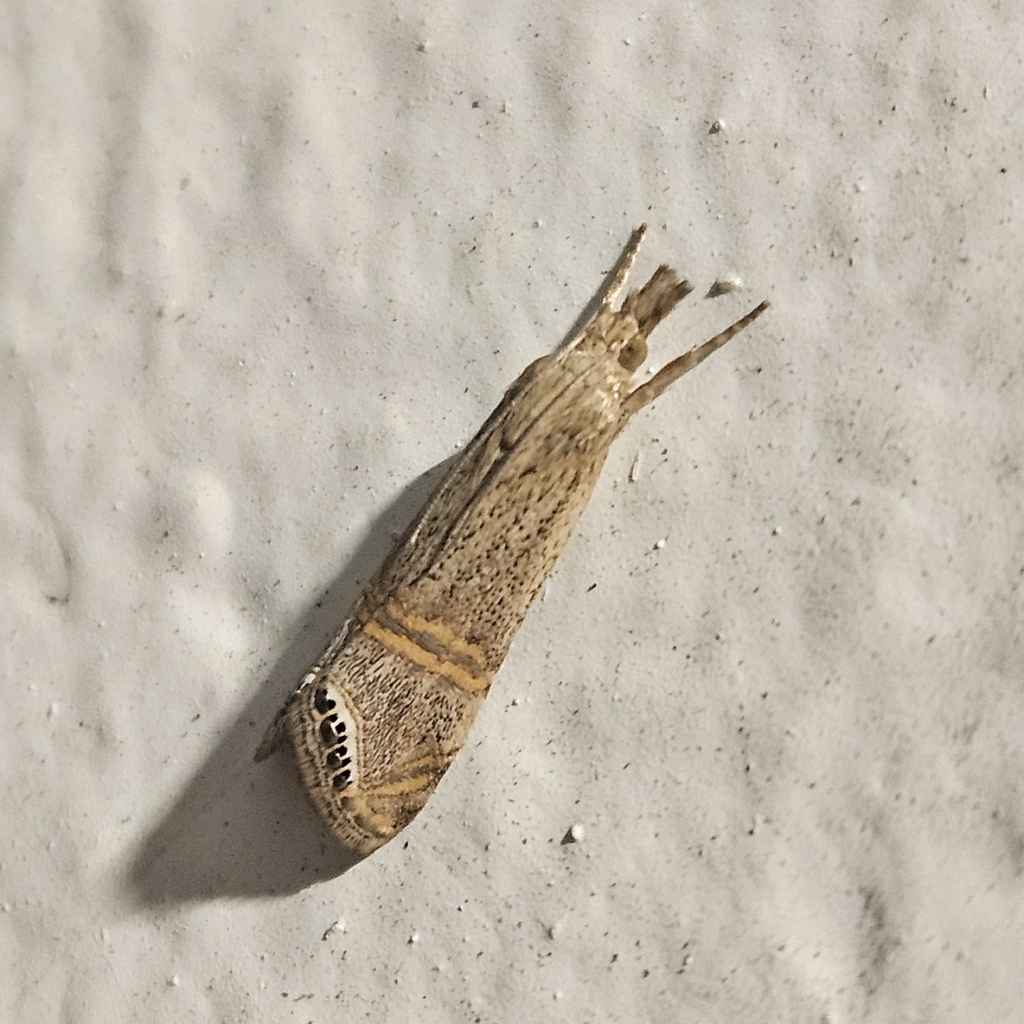
(c) Bennett Grappone, some rights reserved (CC BY) · licence
Family: Crambidae · Class: Insecta · Order: Lepidoptera
Euchromius californicalis (California Grass-veneer Moth) is a California animal in the Crambidae family.
The California grass-veneer moth (Euchromius californicalis) is a small lepidopteran species in the family Crambidae, commonly known as grass moths or snout moths. Adults typically measure 12-16 mm (0.47-0.63 inches) in wingspan, with forewings displaying a characteristic pattern of pale yellow to light brown ground coloration marked by darker brown or gray striping. The forewings feature distinct longitudinal lines that create a grass-like venation pattern, giving the species its common name. The hindwings are typically paler, ranging from whitish to pale yellow. At rest, the moth holds its wings close to the body in a triangular profile, with the labial palps extending forward like a snout. This species exhibits an extensive North American distribution, ranging from British Columbia and Alberta in Canada southward through Washington, Idaho, Montana, North Dakota, South Dakota, Oregon, Wyoming, California, Nevada, Utah, Colorado, and New Mexico. Within California, the species occurs across multiple ecological zones, from coastal regions to interior valleys and mountainous areas. The broad distribution suggests considerable ecological adaptability across diverse climatic conditions. Euchromius californicalis inhabits grasslands, prairies, meadows, and disturbed areas where suitable host plants occur. The species shows preference for open habitats with native and introduced grass species. Elevational range extends from sea level to moderate mountain elevations, though specific altitudinal limits require further documentation. Adults are typically found in areas with mixed grass communities, including both native bunchgrasses and introduced annual species. Adults are active during summer months, with peak flight periods varying by latitude and elevation. Males and females exhibit typical crambid mating behavior, with males using pheromones to locate females. Larvae develop as grass feeders, creating galleries within grass stems or feeding on roots and lower stem tissues. The species likely completes one generation per year in most of its range, though voltinism may vary with local climate conditions. Overwintering occurs in the larval stage within host plant tissues or soil. Like many grass-feeding moths, Euchromius californicalis larvae feed on various grass species, though specific host plant associations require further study. The species appears to utilize both native grasses and introduced species, suggesting some adaptability to habitat modification. Adults are attracted to lights and can be collected using standard lepidopteran survey methods including light traps and blacklight sheets. Currently, Euchromius californicalis holds no special conservation status at federal or state levels. The species appears stable across its range, likely benefiting from the widespread availability of grass habitats. However, like many native moths, populations may face localized pressures from habitat conversion, pesticide use, and competition from invasive plant species that alter grass community composition. The broad distribution and apparent habitat flexibility suggest the species maintains viable populations throughout most of its range as of December 2025.
Classification
Class: Insecta · Order: Lepidoptera · Family: Crambidae
Frequently asked questions
How is Euchromius californicalis classified?
Euchromius californicalis belongs to class Insecta, order Lepidoptera, family Crambidae.
What family does Euchromius californicalis belong to?
Euchromius californicalis is in the Crambidae family.
What is Euchromius californicalis?
The California grass-veneer moth (Euchromius californicalis) is a small lepidopteran species in the family Crambidae, commonly known as grass moths or snout moths.
Is Euchromius californicalis found in California?
Yes. Euchromius californicalis is recorded in California in The California Species Project's catalogue.
Related species
Other California species in the same genus, family, or bioregion.
Data from The California Species Project — 14,000+ California species with verified data from CNPS, CDFW, USFWS, and more.