Euchromius ocellea
Belted Grass-veneer
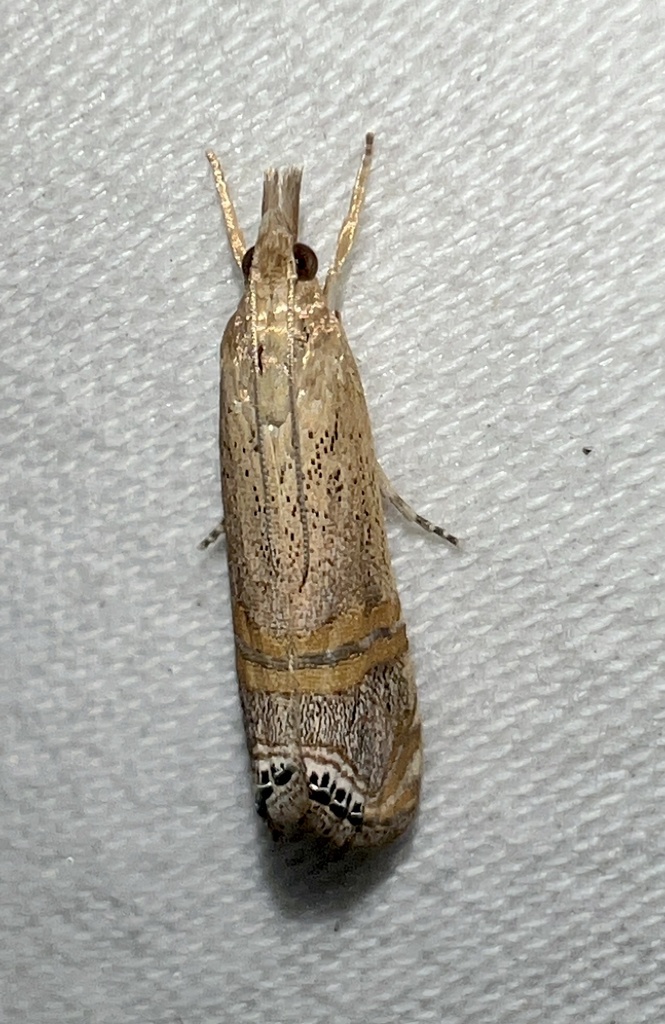
(c) Joshua Ebright, some rights reserved (CC BY) · licence
Family: Crambidae · Class: Insecta · Order: Lepidoptera
Euchromius ocellea (Belted Grass-veneer) is a California animal in the Crambidae family.
The Belted Grass-veneer (Euchromius ocellea) is a small moth in the family Crambidae, distinguished by its narrow forewings and characteristic wing patterns. Adults typically measure 10-15 mm in wingspan, with forewings displaying a pale ground color marked by darker transverse lines and scattered spots that create a distinctive banded or belted appearance across the wing surface. The hindwings are generally lighter in coloration with reduced markings. Males can be distinguished from females by their more bipectinate antennae and slightly smaller size. This species occurs across much of North America, with documented populations ranging from southern Canada through the United States. The moth has been recorded in multiple states, though specific distribution data within California remains limited in published literature. According to NatureServe, the species has a global conservation rank of G4, indicating it is apparently secure across its range with no immediate conservation concerns (NatureServe 2025). Belted Grass-veneer moths inhabit grasslands, prairies, and open areas where their larval host plants are present. Adults are typically found in areas with native grasses and low-growing vegetation. The species shows a preference for relatively undisturbed grassland habitats, though it can occasionally be found in agricultural areas and managed grasslands. Elevation preferences and specific microhabitat requirements have not been thoroughly documented in the scientific literature. Adults are primarily nocturnal and are attracted to artificial lights during their flight period. The species exhibits typical crambid moth behavior, with adults resting during the day in grass clumps or low vegetation with wings folded close to the body. Flight periods vary by location but generally occur during summer months. Larvae are believed to be grass feeders, though specific host plant relationships have not been comprehensively studied. Like other grass-veneer moths, larvae likely feed on grass roots and stems in a concealed manner, potentially creating silken galleries or tunnels. The conservation status of Euchromius ocellea appears stable, with no federal or state listing status. The species' apparently secure global ranking suggests stable populations across its range, though local population trends have not been systematically monitored. As with many grassland-associated species, potential threats may include habitat conversion, intensive agricultural practices, and grassland fragmentation. However, the species' broad distribution and apparent adaptability to various grassland types suggest resilience to moderate habitat modifications. Scientific documentation for this species remains limited compared to more extensively studied moths. Research gaps exist regarding detailed host plant relationships, specific habitat requirements, and population dynamics. The information presented here synthesizes available data from taxonomic databases and general knowledge of related Crambidae species. Additional field studies and systematic surveys would enhance understanding of this species' ecology and distribution patterns, particularly within California's diverse grassland ecosystems.
Classification
Class: Insecta · Order: Lepidoptera · Family: Crambidae
Frequently asked questions
How is Euchromius ocellea classified?
Euchromius ocellea belongs to class Insecta, order Lepidoptera, family Crambidae.
What family does Euchromius ocellea belong to?
Euchromius ocellea is in the Crambidae family.
What is Euchromius ocellea?
The Belted Grass-veneer (Euchromius ocellea) is a small moth in the family Crambidae, distinguished by its narrow forewings and characteristic wing patterns.
Is Euchromius ocellea found in California?
Yes. Euchromius ocellea is recorded in California in The California Species Project's catalogue.
Related species
Other California species in the same genus, family, or bioregion.
Data from The California Species Project — 14,000+ California species with verified data from CNPS, CDFW, USFWS, and more.