Eucosma apacheana
Apache Eucosma
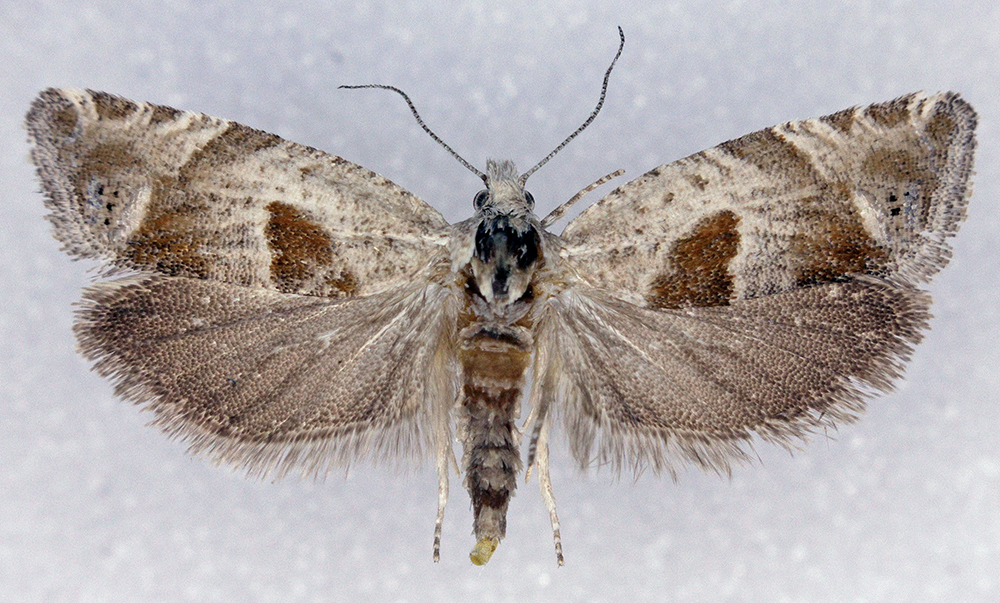
(c) Dave, some rights reserved (CC BY) · licence
Family: Tortricidae · Class: Insecta · Order: Lepidoptera
Eucosma apacheana (Apache Eucosma) is a California animal in the Tortricidae family.
The Apache Eucosma is a small tortricid moth with forewings measuring 4.3-7.5 mm in length, though some females may reach 9.5 mm (BugGuide). Adults display a distinctive dark chevron-shaped patch along the inner margin of the forewings, which serves as a key identifying feature. The species exhibits sexual dimorphism, with females generally larger than males. This species demonstrates a remarkably broad distribution across North America. According to Powell & Opler (2009), the range extends from coastal British Columbia south to southern California and Arizona. The Moth Photographers Group documents additional records from Washington to southern California and Arizona, with populations extending across central regions of the United States to Maryland (BugGuide). In California, the species occurs throughout much of the state, though specific county-level distribution data remains limited in the literature. Habitat preferences for Eucosma apacheana have not been extensively documented in the scientific literature. The species appears to occupy diverse environments across its broad geographic range, from coastal areas to inland mountain regions. Elevation ranges and specific microhabitat requirements remain poorly characterized, representing a significant knowledge gap for this widespread species. The Apache Eucosma exhibits a bivoltine life cycle with two distinct flight periods annually. Adults are active from March to June during the spring flight, followed by a second emergence from September through October (BugGuide). Larvae are documented as feeding on Gnaphalium species (cudweeds), boring into plant tissues during their development (BugGuide). The complete larval biology, including specific developmental stages and overwintering strategy, requires further investigation. Adult behavior patterns, mating systems, and dispersal capabilities have not been well studied. The conservation status of Eucosma apacheana has not been formally assessed by state or federal agencies. The species does not appear on current endangered species lists or species of concern designations. Its broad geographic distribution suggests relatively stable populations, though specific population trends and abundance estimates are unavailable. The species' apparent ability to utilize multiple Gnaphalium host species may provide some resilience against habitat changes. However, localized threats to native plant communities, including habitat conversion and invasive species impacts, could potentially affect regional populations. The specific epithet 'apacheana' likely references Apache County, Arizona, where early specimens were collected, though the type specimen was labeled simply as 'Arizona' (BugGuide). Despite its wide distribution and apparent ecological flexibility, detailed studies of this species' life history, population dynamics, and conservation needs remain lacking. The Apache Eucosma represents one of many small moths requiring additional research to fully understand their ecological roles and conservation requirements across western North American ecosystems.
Classification
Class: Insecta · Order: Lepidoptera · Family: Tortricidae
Frequently asked questions
How is Eucosma apacheana classified?
Eucosma apacheana belongs to class Insecta, order Lepidoptera, family Tortricidae.
What family does Eucosma apacheana belong to?
Eucosma apacheana is in the Tortricidae family.
What is Eucosma apacheana?
The Apache Eucosma is a small tortricid moth with forewings measuring 4.3-7.5 mm in length, though some females may reach 9.5 mm (BugGuide).
Is Eucosma apacheana found in California?
Yes. Eucosma apacheana is recorded in California in The California Species Project's catalogue.
Related species
Other California species in the same genus, family, or bioregion.
Data from The California Species Project — 14,000+ California species with verified data from CNPS, CDFW, USFWS, and more.