Eucyclogobius newberryi
Tidewater goby
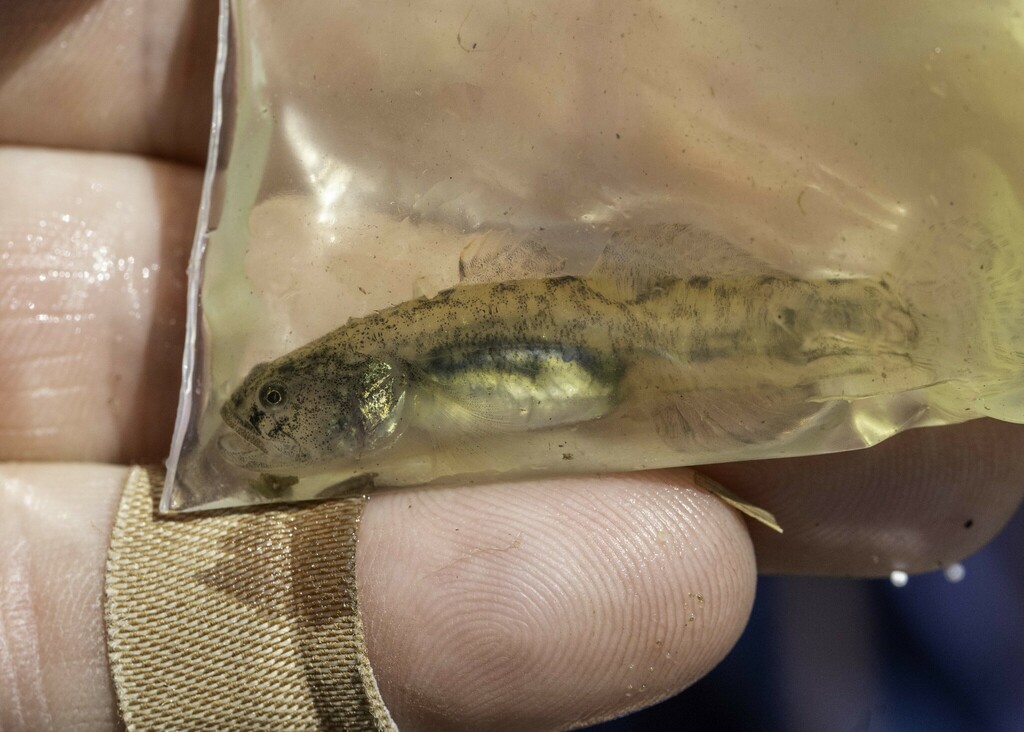
(c) Zack Abbey, some rights reserved (CC BY) · licence
Family: Gobiidae · Class: Actinopterygii · Order: Perciformes
Conservation status: Endangered · G3 S3
Eucyclogobius newberryi (Tidewater goby) is a California animal in the Gobiidae family.
The tidewater goby is a small, endemic fish species found exclusively in California's coastal lagoons and estuaries. Adults typically measure 40 to 60 mm (1.6 to 2.4 inches) in total length, with females growing slightly larger than males. The body is elongated and cylindrical, with a large head comprising approximately 25% of total body length. Coloration ranges from translucent to pale brown dorsally, with darker mottling along the sides and a whitish ventral surface. The species is distinguished by its fused pelvic fins that form a distinctive suction cup, large mouth, and protruding eyes positioned high on the head. Historically, tidewater gobies inhabited coastal lagoons and estuaries from Agua Hedionda Lagoon in San Diego County north to the mouth of the Smith River in Del Norte County. The species currently persists in approximately 100 lagoons along the California coast, representing a significant reduction from its historical range. Populations have been documented in lagoons throughout Santa Barbara, Ventura, Los Angeles, Orange, San Diego, Monterey, San Luis Obispo, Santa Cruz, San Mateo, Marin, Sonoma, Mendocino, Humboldt, and Del Norte counties. Tidewater gobies require shallow, brackish water environments where fresh and salt water mix. They inhabit lagoons that are periodically or permanently connected to the ocean, with salinities ranging from 0 to 42 parts per thousand. The species prefers areas with sandy or muddy substrates and emergent vegetation, typically at depths less than 1.3 meters (4.3 feet). Critical habitat features include quiet backwater areas with minimal current and temperatures between 8 and 25 degrees Celsius. The species exhibits complex reproductive behavior tied to lagoon conditions. Breeding occurs year-round when water temperatures exceed 10 degrees Celsius, with peak spawning during spring and summer months. Males establish territories and construct burrows in sandy substrates, where they attract females for spawning. Females deposit 300 to 3,000 adhesive eggs in the male's burrow, which he guards until hatching occurs after 9 to 11 days. Tidewater gobies feed primarily on small invertebrates, including amphipods, copepods, polychaete worms, and midge larvae. The U.S. Fish and Wildlife Service listed the tidewater goby as endangered in 1994 due to habitat loss and population decline. According to California Department of Fish and Wildlife, a down-listing to threatened status was proposed in 2014 following habitat restoration and population recovery efforts. Primary threats include coastal development, water diversions, lagoon mouth management, sedimentation, and invasive species. Climate change poses additional risks through sea level rise and altered precipitation patterns. Recovery efforts focus on habitat restoration, lagoon management, and population monitoring across the species' range.
Classification
Class: Actinopterygii · Order: Perciformes · Family: Gobiidae
Conservation status
Endangered · G3 S3
Frequently asked questions
How is Eucyclogobius newberryi classified?
Eucyclogobius newberryi belongs to class Actinopterygii, order Perciformes, family Gobiidae.
What family does Eucyclogobius newberryi belong to?
Eucyclogobius newberryi is in the Gobiidae family.
Is Eucyclogobius newberryi protected or of conservation concern?
Eucyclogobius newberryi carries the following status: Endangered · G3 S3.
What is Eucyclogobius newberryi?
The tidewater goby is a small, endemic fish species found exclusively in California's coastal lagoons and estuaries.
Is Eucyclogobius newberryi found in California?
Yes. Eucyclogobius newberryi is recorded in California in The California Species Project's catalogue.
Related species
Other California species in the same genus, family, or bioregion.
Data from The California Species Project — 14,000+ California species with verified data from CNPS, CDFW, USFWS, and more.