Euderma maculatum
Spotted Bat
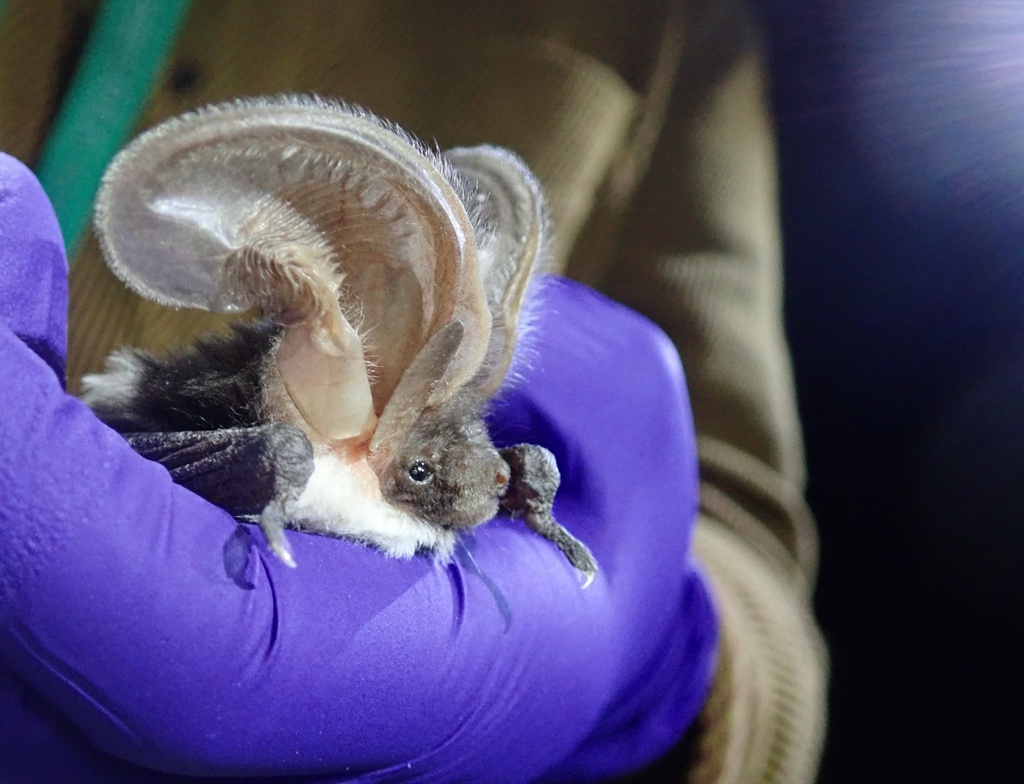
(c) Aiva Noringseth, some rights reserved (CC BY) · licence
Family: Vespertilionidae · Class: Mammalia · Order: Chiroptera
Conservation status: G4 S3
Euderma maculatum (Spotted Bat) is a California animal in the Vespertilionidae family.
The spotted bat is a distinctive medium-sized vespertilionid bat with highly contrasting black and white coloration. Adults measure 105-115 mm (4.1-4.5 inches) in total length with a wingspan of 340-360 mm (13.4-14.2 inches). Body mass ranges from 16-20 grams (0.56-0.71 ounces). The dorsal fur is jet black with three prominent white spots: one on each shoulder and one at the rump base. The ventral surface is white to pale gray. The ears are exceptionally large, measuring 40-50 mm (1.6-2.0 inches) in length, and are pink to flesh-colored, making this species unmistakable among North American bats. Spotted bats occur across western North America from southern British Columbia to central Mexico. In California, the species is documented from the Sierra Nevada, Cascade Range, Coast Ranges, Transverse Ranges, and Peninsular Ranges. Confirmed records exist from scattered locations including Mono, Inyo, Riverside, San Bernardino, Imperial, Kern, Tulare, and Fresno counties. The species appears most common in the eastern Sierra Nevada and desert mountain ranges. Spotted bats inhabit arid and semi-arid regions, typically at elevations from 150-3,000 meters (490-9,840 feet). They roost primarily in cliff faces, rock crevices, and caves, showing strong fidelity to specific roosting sites. Foraging occurs over diverse habitats including desert scrub, pinyon-juniper woodland, ponderosa pine forest, and riparian areas. The species demonstrates seasonal elevational migration, moving to higher elevations during summer and returning to lower desert areas for winter hibernation. Spotted bats are insectivorous, specializing in moths, particularly large-bodied species. Their echolocation calls are audible to humans, consisting of low-frequency clicks at 9-16 kHz. This species is among the most acoustically distinctive North American bats. Mating occurs in fall, with females giving birth to a single pup in late May through July following delayed implantation. Maternity colonies are small, typically containing fewer than 12 females. The species exhibits long-distance foraging flights, traveling up to 10 kilometers (6.2 miles) from roost sites. The spotted bat has no federal listing status but is designated S3 (vulnerable) in California and G4 (apparently secure) globally as of December 2025. Population trends are poorly understood due to the species' cryptic nature and low detection rates in standard bat surveys. Primary threats include habitat loss from urban development, wind energy projects, mining operations, and recreational climbing at roost sites. Climate change may affect prey availability and suitable hibernation sites. White-nose syndrome, while not yet documented in this species, represents a potential future threat. Conservation efforts focus on protecting known roosting sites and conducting acoustic monitoring to better understand population status and distribution patterns.
Classification
Class: Mammalia · Order: Chiroptera · Family: Vespertilionidae
Conservation status
G4 S3
Frequently asked questions
How is Euderma maculatum classified?
Euderma maculatum belongs to class Mammalia, order Chiroptera, family Vespertilionidae.
What family does Euderma maculatum belong to?
Euderma maculatum is in the Vespertilionidae family.
Is Euderma maculatum protected or of conservation concern?
Euderma maculatum carries the following status: G4 S3.
What is Euderma maculatum?
The spotted bat is a distinctive medium-sized vespertilionid bat with highly contrasting black and white coloration.
Is Euderma maculatum found in California?
Yes. Euderma maculatum is recorded in California in The California Species Project's catalogue.
Related species
Other California species in the same genus, family, or bioregion.
Data from The California Species Project — 14,000+ California species with verified data from CNPS, CDFW, USFWS, and more.