Eudioctria sackeni
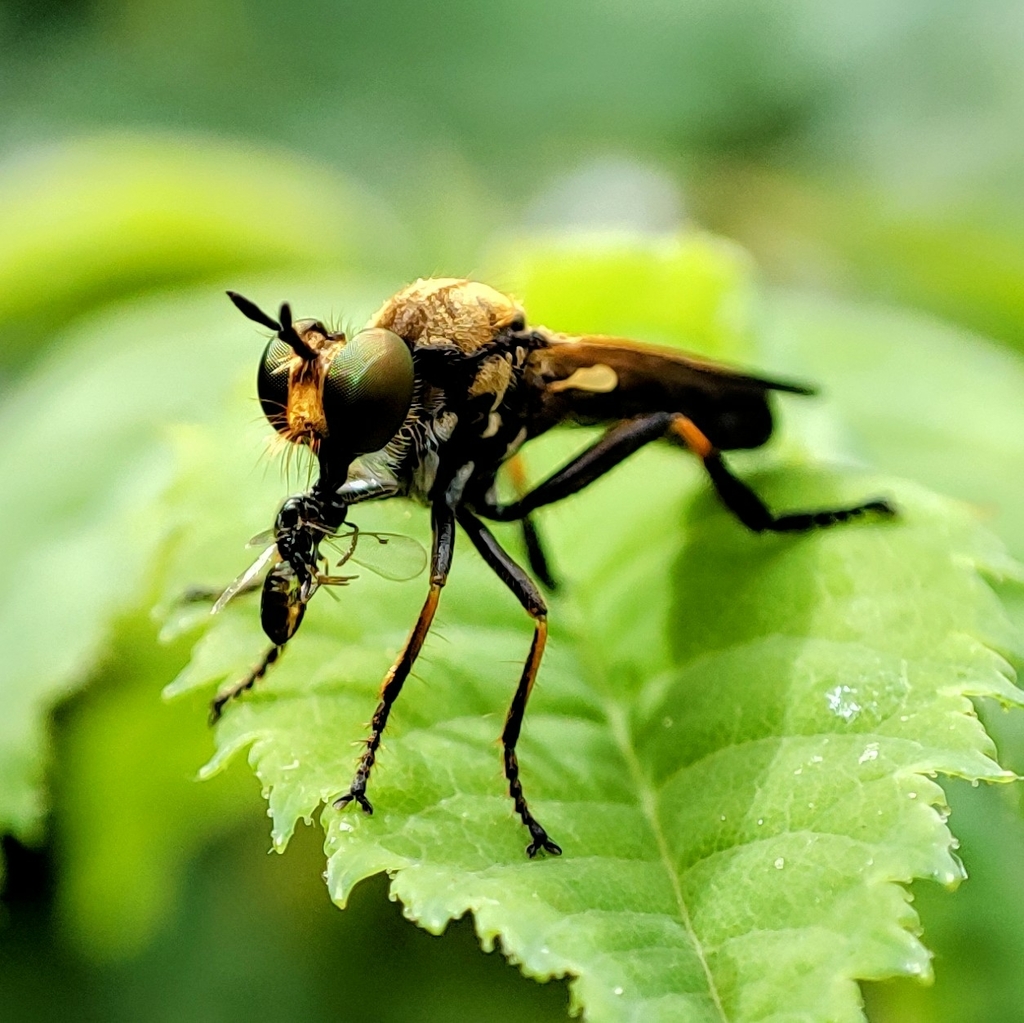
(c) Robin Holm, some rights reserved (CC BY-SA) · licence
Family: Asilidae · Class: Insecta · Order: Diptera
Eudioctria sackeni is a California animal in the Asilidae family.
Eudioctria sackeni is a robber fly in the family Asilidae, subfamily Dasypogoninae, tribe Dioctriini. This predatory dipteran species belongs to a group of flies known for their aggressive hunting behavior and distinctive morphological adaptations for capturing prey in flight. As a member of the Asilidae, E. sackeni likely possesses the characteristic features of robber flies, including a prominent proboscis, large compound eyes, and a robust, bristly body. Robber flies typically measure between 3 and 50 millimeters in length, though specific morphometric data for E. sackeni has not been well documented in available scientific literature. The species exhibits the typical asilid body plan with long, strong legs adapted for grasping prey and forward-projecting mouthparts designed for piercing and fluid extraction. The geographic distribution of E. sackeni within California and broader North America requires further documentation. The species appears in the U.S. Fish and Wildlife Service taxonomic database, indicating its presence within U.S. territories, but specific range boundaries and population centers have not been comprehensively mapped in accessible scientific sources. Habitat preferences for E. sackeni remain poorly characterized in published literature. Most asilid species occupy diverse terrestrial environments ranging from arid desert regions to temperate forests, typically favoring open areas with suitable perching sites for ambush predation. Many robber flies require bare soil or sandy substrates for larval development, as the larvae are typically predatory and develop in soil or decaying organic matter. Like other members of Asilidae, E. sackeni is presumed to be a predatory species throughout its life cycle. Adult robber flies are aerial predators that capture other flying insects through ambush tactics, typically perching on vegetation or elevated surfaces before launching pursuit flights. They inject prey with proteolytic enzymes through their proboscis, then consume the liquefied body contents. Larval stages are likely soil-dwelling predators that feed on other arthropods and organic matter in the substrate. Reproductive biology, including mating behavior, oviposition preferences, and developmental timing, has not been documented for this species. The conservation status of E. sackeni has not been formally assessed by state or federal agencies. The species does not appear on current endangered species lists or conservation priority rankings. Population trends, primary threats, and habitat requirements remain undocumented, representing significant knowledge gaps for this dipteran species. The absence of comprehensive ecological studies limits understanding of the species' conservation needs and population stability. Scientific documentation for this species remains limited. The information presented here synthesizes available taxonomic records from federal databases. Detailed ecological studies, distribution mapping, and population assessments are needed to develop a comprehensive understanding of E. sackeni's biology and conservation status. We welcome contributions of verified scientific data, photographs, or field observations to enhance this species account.
Classification
Class: Insecta · Order: Diptera · Family: Asilidae
Frequently asked questions
How is Eudioctria sackeni classified?
Eudioctria sackeni belongs to class Insecta, order Diptera, family Asilidae.
What family does Eudioctria sackeni belong to?
Eudioctria sackeni is in the Asilidae family.
What is Eudioctria sackeni?
Eudioctria sackeni is a robber fly in the family Asilidae, subfamily Dasypogoninae, tribe Dioctriini.
Is Eudioctria sackeni found in California?
Yes. Eudioctria sackeni is recorded in California in The California Species Project's catalogue.
Related species
Other California species in the same genus, family, or bioregion.
Data from The California Species Project — 14,000+ California species with verified data from CNPS, CDFW, USFWS, and more.