Eudocimus albus
White Ibis
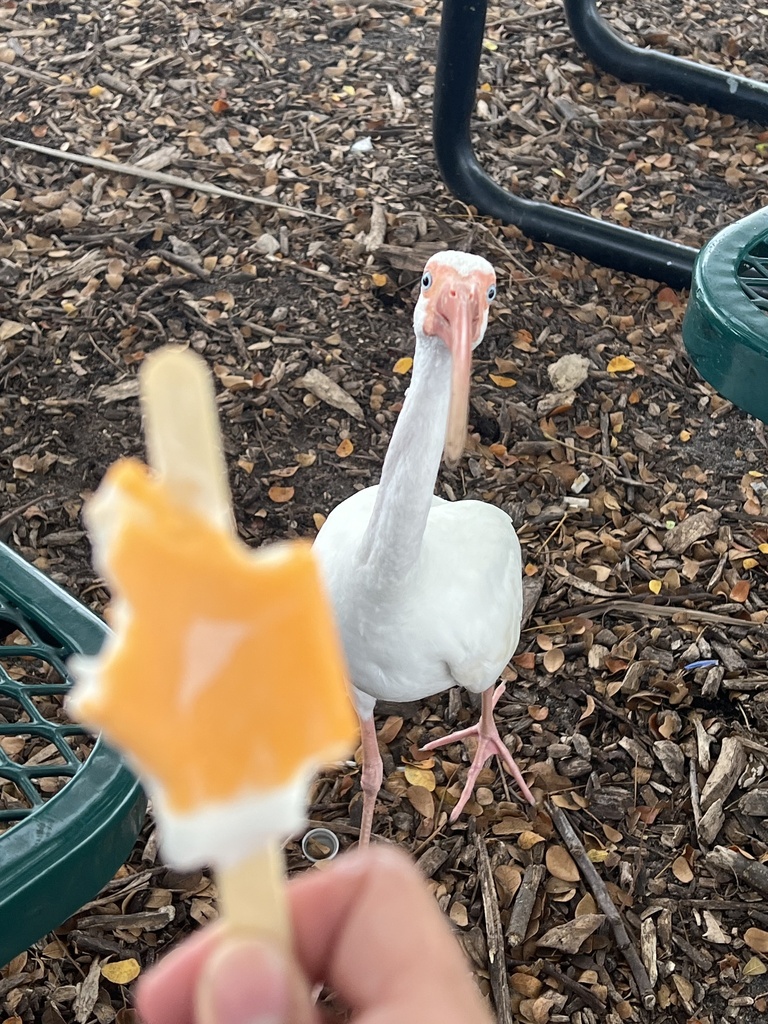
(c) David Garza, some rights reserved (CC BY) · licence
Family: Threskiornithidae · Class: Aves · Order: Pelecaniformes
Eudocimus albus (White Ibis) is a California animal in the Threskiornithidae family.
The White Ibis is a medium-sized wading bird measuring 56 to 68 centimeters (22 to 27 inches) in length with a wingspan of 90 to 105 centimeters (35 to 41 inches). Adults weigh between 750 to 1,050 grams (1.7 to 2.3 pounds). The species exhibits striking sexual dimorphism in size, with males averaging 10 to 15 percent larger than females. Adult plumage is entirely white except for black wingtips visible in flight. The long, curved bill is pink to orange, matching the bare facial skin and legs. During breeding season, the bill, facial skin, and legs intensify to bright orange-red. Juvenile birds display brown and white mottled plumage that gradually transitions to adult white over two to three years. Historically, White Ibis occurred as a vagrant in California, with documented records primarily along the coast and in the Central Valley. The species' core range extends from the southeastern United States through Central America to northern South America. In North America, breeding populations concentrate in Florida, Louisiana, Texas, and along the Atlantic coast to North Carolina. California records remain sporadic, typically involving individual birds that have wandered from established populations during post-breeding dispersal. White Ibis inhabit shallow wetlands including freshwater marshes, swamps, mangroves, mudflats, and flooded agricultural fields. The species prefers areas with water depths of 5 to 25 centimeters (2 to 10 inches) for optimal foraging. They utilize both freshwater and brackish environments but avoid saltwater habitats. Roosting and nesting sites require trees or shrubs adjacent to foraging areas, typically at heights of 1 to 15 meters (3 to 49 feet) above ground. White Ibis are highly social, forming flocks of hundreds to thousands of individuals during foraging and roosting. They feed primarily on aquatic invertebrates, particularly crayfish, crabs, aquatic insects, and small fish. The species uses its sensitive bill to probe soft substrates through tactile feeding. Breeding occurs in colonial rookeries with other wading birds. Females construct platform nests of sticks and vegetation, laying 2 to 5 pale blue eggs with brown markings. Incubation lasts 21 to 23 days, with both parents sharing duties. Young fledge at 35 to 42 days but continue receiving parental care for several additional weeks. The White Ibis is not federally listed and maintains stable populations throughout most of its range. According to the North American Breeding Bird Survey, populations have remained relatively stable since 1970, though regional declines have occurred due to habitat loss in some areas. The species demonstrates adaptability to human-modified landscapes, often utilizing agricultural areas and urban wetlands. In California, the White Ibis remains an uncommon vagrant with no established breeding populations. Climate change may potentially expand the species' range northward, though California occurrences are likely to remain infrequent given the species' preference for southeastern habitats and established flyway patterns.
Classification
Class: Aves · Order: Pelecaniformes · Family: Threskiornithidae
Frequently asked questions
How is Eudocimus albus classified?
Eudocimus albus belongs to class Aves, order Pelecaniformes, family Threskiornithidae.
What family does Eudocimus albus belong to?
Eudocimus albus is in the Threskiornithidae family.
What is Eudocimus albus?
The White Ibis is a medium-sized wading bird measuring 56 to 68 centimeters (22 to 27 inches) in length with a wingspan of 90 to 105 centimeters (35 to 41 inches).
Is Eudocimus albus found in California?
Yes. Eudocimus albus is recorded in California in The California Species Project's catalogue.
Related species
Other California species in the same genus, family, or bioregion.
Data from The California Species Project — 14,000+ California species with verified data from CNPS, CDFW, USFWS, and more.