Eudonia echo
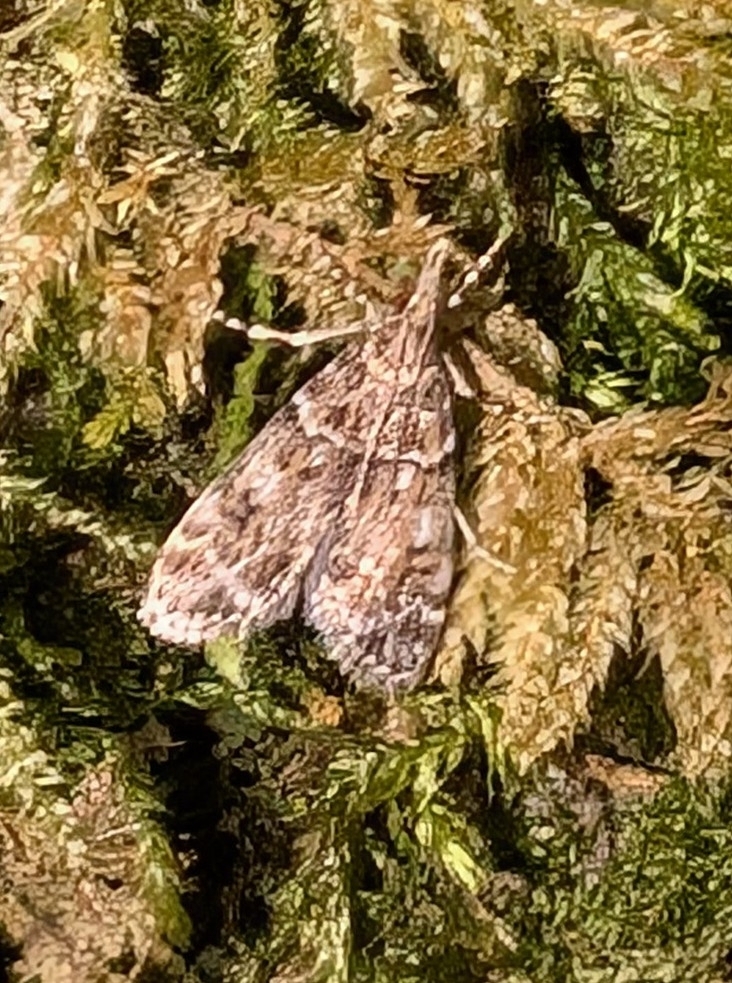
(c) Brodie Cass Talbott, some rights reserved (CC BY) · licence
Family: Crambidae · Class: Insecta · Order: Lepidoptera
Eudonia echo is a California animal in the Crambidae family.
Eudonia echo is a small moth in the family Crambidae, belonging to the grass moth subfamily. As with most species in the genus Eudonia, this moth exhibits the typical crambiid body plan with narrow forewings and relatively broad hindwings. The forewings typically measure 8 to 12 mm in length, giving the species a wingspan of approximately 16 to 24 mm. Coloration patterns in Eudonia species generally consist of muted browns, grays, and pale markings, though specific details for E. echo require further documentation. The antennae are filiform in both sexes, and the labial palps are prominently projected forward, characteristic features of the Crambidae family. The distribution and range of Eudonia echo remain poorly documented in the scientific literature. The species appears to be endemic to California, though specific county records and elevational ranges have not been comprehensively surveyed. Many Eudonia species demonstrate restricted ranges, often associated with particular microclimatic conditions or host plant communities. Without detailed collection records, the full extent of this species' California distribution cannot be definitively established. Habitat preferences for Eudonia echo are not well documented, though the genus Eudonia typically inhabits areas with grasses and low-growing vegetation. Most species in this genus are associated with grasslands, meadows, and open woodland edges where their larval host plants occur. Elevational preferences and specific microhabitat requirements for E. echo remain unknown, representing a significant knowledge gap for this species. The life cycle and behavioral ecology of Eudonia echo follow the general pattern observed in related Crambidae species. Adults are likely nocturnal, attracted to artificial lights during evening hours. Larvae typically feed within silken galleries or tunnels constructed in grass stems, moss, or organic debris. The timing of adult flight periods, number of generations per year, and specific larval feeding behaviors have not been documented for this species. Mating behaviors, pheromone production, and seasonal activity patterns remain unstudied. The conservation status of Eudonia echo is not currently assessed by federal or state agencies. The species lacks formal protection under the Endangered Species Act or California Endangered Species Act. Population trends, threats, and conservation needs are unknown due to insufficient survey data and taxonomic uncertainty. Many small moth species face threats from habitat loss, light pollution, pesticide use, and climate change, though the specific vulnerability of E. echo to these factors has not been evaluated. The limited knowledge of this species' distribution, habitat requirements, and population status represents a significant barrier to effective conservation planning. Systematic surveys and taxonomic studies are needed to determine the species' conservation priority and develop appropriate management strategies if warranted.
Classification
Class: Insecta · Order: Lepidoptera · Family: Crambidae
Frequently asked questions
How is Eudonia echo classified?
Eudonia echo belongs to class Insecta, order Lepidoptera, family Crambidae.
What family does Eudonia echo belong to?
Eudonia echo is in the Crambidae family.
What is Eudonia echo?
Eudonia echo is a small moth in the family Crambidae, belonging to the grass moth subfamily.
Is Eudonia echo found in California?
Yes. Eudonia echo is recorded in California in The California Species Project's catalogue.
Related species
Other California species in the same genus, family, or bioregion.
Data from The California Species Project — 14,000+ California species with verified data from CNPS, CDFW, USFWS, and more.