Eugenes fulgens
Magnificent Hummingbird
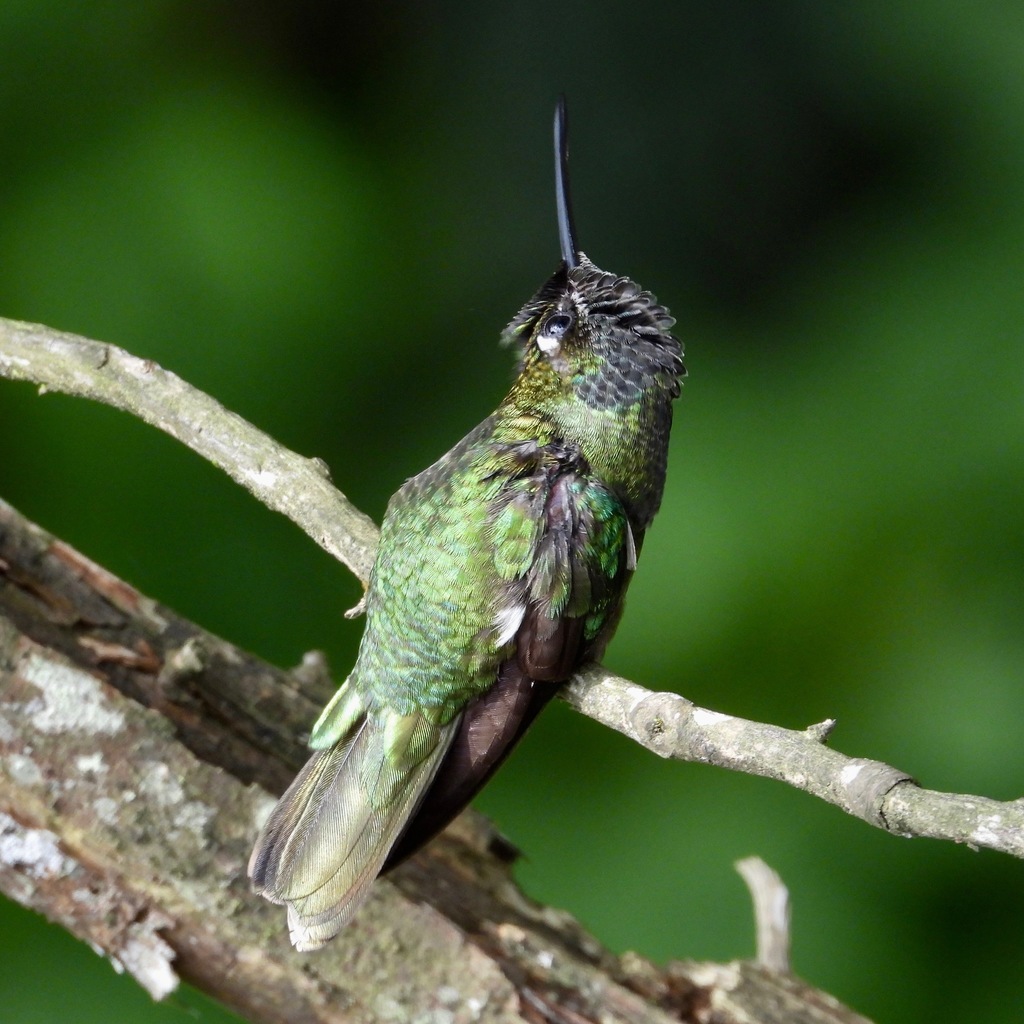
(c) Grete Pasch, some rights reserved (CC BY) · licence
Family: Trochilidae · Class: Aves · Order: Apodiformes
Eugenes fulgens (Magnificent Hummingbird) is a California animal in the Trochilidae family.
Eugenes fulgens, commonly known as the Magnificent Hummingbird or Rivoli's Hummingbird, is a large hummingbird measuring 11.5-13 cm (4.5-5.1 inches) in length with a wingspan of approximately 18 cm (7 inches). Males display an iridescent purple crown, emerald green throat, and dark bronze-green back, while females are bronze-green above with grayish underparts spotted with green. Both sexes have a relatively long, straight black bill and distinctive white postocular stripe. Males weigh 7-10 grams, making this one of the largest hummingbirds in North America. The species ranges from the southwestern United States through Central America to Nicaragua. In North America, breeding populations occur in mountain ranges of Arizona, New Mexico, western Texas, and locally in Colorado. California records are primarily from the desert mountains of southeastern counties, with occasional sightings in the Sierra Nevada and coastal ranges. The species is considered a rare visitor to California, with most records occurring during post-breeding dispersal in late summer and fall. Eugenes fulgens inhabits montane forests between 1,200-3,000 meters (4,000-10,000 feet) elevation. According to Birds of the World, preferred habitats include pine-oak forests, humid montane cloud forests, and forest edges. The species favors areas with diverse flowering plants and requires tall trees for nesting. In California, sightings typically occur in mixed coniferous forests and mountain chaparral with adequate nectar sources. This species exhibits typical hummingbird feeding behavior, hovering at flowers to extract nectar with rapid wingbeats of 10-15 beats per second. Diet consists primarily of nectar from tubular flowers, supplemented with small arthropods for protein. These hummingbirds show preference for red tubular flowers but utilize various native and non-native flowering plants. Males establish feeding territories and perform aerial displays during breeding season. Nesting occurs from March through August, with females constructing small cup-shaped nests on horizontal branches 3-15 meters above ground. Clutch size is typically two white eggs, incubated for 16-19 days. Eugenes fulgens has no federal or state listing status in California or the United States. According to NatureServe Explorer, the species is currently of relatively low conservation concern and does not require significant additional stewardship measures. Global populations appear stable, though specific population estimates are not well documented. Primary threats include habitat loss from logging and development in montane forests, climate change affecting flowering plant phenology, and potential impacts from extreme weather events. The species benefits from forest conservation efforts and maintenance of diverse flowering plant communities in mountain ecosystems. In California, the rarity of the species makes individual records valuable for understanding distribution patterns and habitat requirements at the edge of the species' range.
Classification
Class: Aves · Order: Apodiformes · Family: Trochilidae
Frequently asked questions
How is Eugenes fulgens classified?
Eugenes fulgens belongs to class Aves, order Apodiformes, family Trochilidae.
What family does Eugenes fulgens belong to?
Eugenes fulgens is in the Trochilidae family.
What is Eugenes fulgens?
Eugenes fulgens, commonly known as the Magnificent Hummingbird or Rivoli's Hummingbird, is a large hummingbird measuring 11.5-13 cm (4.5-5.1 inches) in length with a wingspan of approximately 18 cm (7 inches).
Is Eugenes fulgens found in California?
Yes. Eugenes fulgens is recorded in California in The California Species Project's catalogue.
Related species
Other California species in the same genus, family, or bioregion.
Data from The California Species Project — 14,000+ California species with verified data from CNPS, CDFW, USFWS, and more.