Eulithis xylina
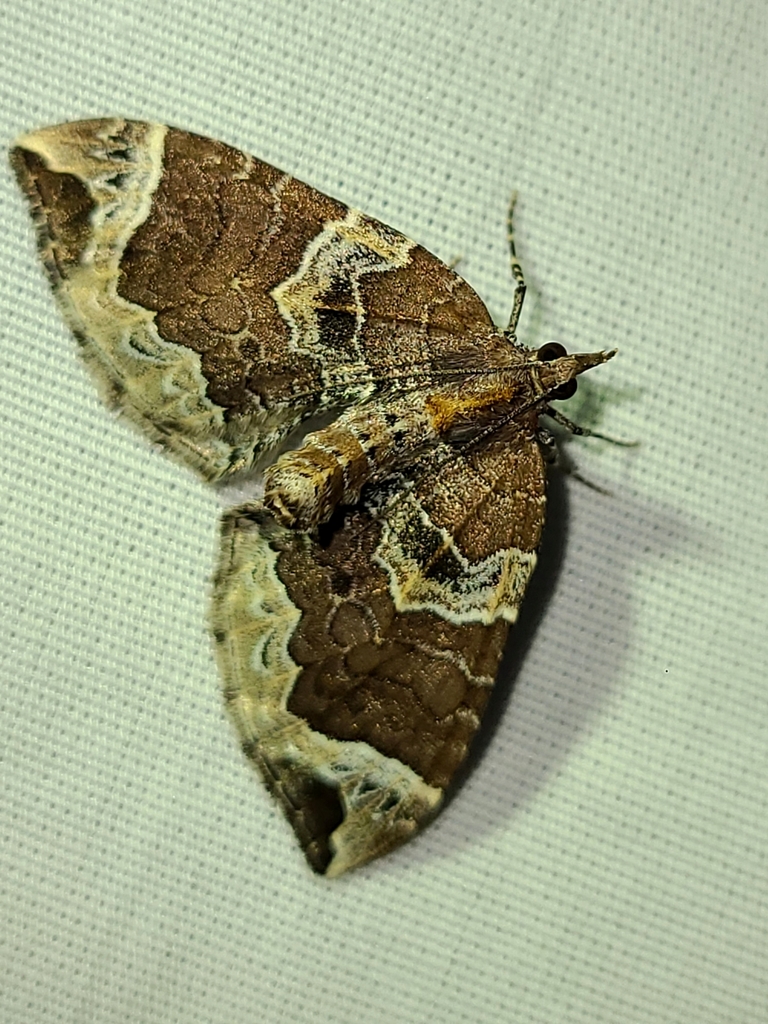
no rights reserved · CC0
Family: Geometridae · Class: Insecta · Order: Lepidoptera
Eulithis xylina is a California animal in the Geometridae family.
Eulithis xylina is a geometrid moth in the family Geometridae, commonly known as a carpet moth or wave moth. Adults have a wingspan typically ranging from 22 to 28 millimeters (0.87 to 1.10 inches). The forewings display a complex pattern of brown and gray crosslines with whitish and darker brown markings. The hindwings are generally paler with less distinct markings. The species exhibits the characteristic broad wings and relatively slender body typical of Geometridae moths. Sexual dimorphism is present, with males possessing more feathered antennae compared to females. Eulithis xylina occurs across a broad range extending from Alaska south to central California, eastward to northern New Mexico, and north to western Alberta. This distribution encompasses much of western North America, including the Pacific Northwest, northern Rocky Mountains, and portions of the Great Basin. In California, the species is documented primarily in the northern and central regions, though specific county records require verification from recent surveys. The species inhabits coniferous and mixed forests, particularly those dominated by fir species (Abies). Adults are associated with forest edges, clearings, and areas of moderate canopy cover where host plants are present. Elevation ranges vary across the geographic distribution, but the species generally occurs in montane habitats. In the Pacific Northwest, populations are found in both coastal and inland forest systems. Adult flight period extends from late spring through early fall, with peak activity typically occurring in mid-summer. Males are attracted to artificial lights and can be collected at light traps and porch lights. Mating occurs shortly after adult emergence, with females depositing eggs on or near host plant foliage. Larvae develop as defoliators, feeding on needles and young shoots of coniferous trees, particularly fir species. The caterpillars are typical geometrid inchworms, moving in the characteristic looping motion. Pupation occurs in the soil or leaf litter, with the species overwintering in the pupal stage. Eulithis xylina appears to maintain stable populations across much of its range and is not currently listed under state or federal endangered species legislation. The species benefits from the extensive coniferous forests throughout western North America, though local populations may be affected by forest management practices, wildfire, and climate change. Clear-cutting and intensive forest management can temporarily reduce suitable habitat, but the species typically recolonizes areas as forest regeneration occurs. Climate change may affect the species through alterations in host plant distribution and forest composition, particularly at elevation and latitudinal range margins. The broad geographic distribution and apparent habitat flexibility suggest the species maintains relatively low conservation concern at present, though continued monitoring of populations in fragmented or heavily managed forest landscapes would be valuable for assessing long-term population trends.
Classification
Class: Insecta · Order: Lepidoptera · Family: Geometridae
Frequently asked questions
How is Eulithis xylina classified?
Eulithis xylina belongs to class Insecta, order Lepidoptera, family Geometridae.
What family does Eulithis xylina belong to?
Eulithis xylina is in the Geometridae family.
What is Eulithis xylina?
Eulithis xylina is a geometrid moth in the family Geometridae, commonly known as a carpet moth or wave moth.
Is Eulithis xylina found in California?
Yes. Eulithis xylina is recorded in California in The California Species Project's catalogue.
Related species
Other California species in the same genus, family, or bioregion.
Data from The California Species Project — 14,000+ California species with verified data from CNPS, CDFW, USFWS, and more.