Eumetopias jubatus
Steller Sea Lion
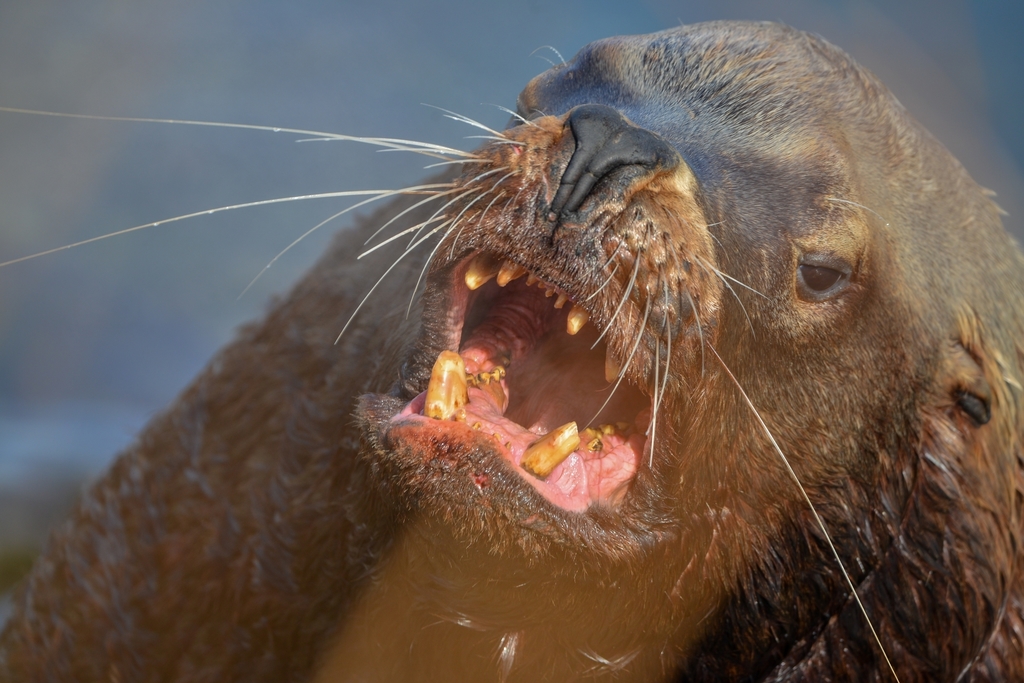
(c) Валерия Ковалева, some rights reserved (CC BY) · licence
Family: Otariidae · Class: Mammalia · Order: Carnivora
Conservation status: Endangered · G3 S2
Eumetopias jubatus (Steller Sea Lion) is a California animal in the Otariidae family.
The Steller sea lion is the largest member of the eared seal family, with adult males reaching 3.0 meters (10 feet) in length and weighing 500 to 1,100 kg (1,100 to 2,400 pounds). Females are considerably smaller, measuring 2.3 meters (7.5 feet) and weighing 240 to 350 kg (530 to 770 pounds). Males develop a pronounced sagittal crest that gives the head a distinctive domed appearance, along with a thick, muscular neck. Both sexes have external ear flaps and long fore-flippers. Adult males are typically golden to dark brown, while females and juveniles are lighter tan to golden brown. Steller sea lions range along the North Pacific Rim from northern Japan to California (NOAA Fisheries). In California waters, they occur primarily along the northern and central coast, with the species divided into two distinct population segments (DPS): the Western DPS west of 144 degrees west longitude, and the Eastern DPS east of that line. California populations belong to the Eastern DPS, which extends from southeast Alaska through British Columbia to California. The species inhabits cold waters of the Pacific Ocean, utilizing both rookeries for breeding and haul-out sites for non-breeding activities. They prefer rocky coastlines, sandy beaches, and marina docks for terrestrial activities, while foraging in nearshore and offshore waters. Steller sea lions are capable of diving to depths exceeding 400 meters (1,300 feet) in pursuit of prey. Steller sea lions are opportunistic predators feeding primarily on fish, including pollock, cod, salmon, herring, and rockfish, as well as cephalopods and occasionally crustaceans. Breeding occurs from May through August, with adult males establishing territories on rookeries and defending harems of females. Females give birth to a single pup after an 11-month gestation period that includes a 3-month delayed implantation. Males reach sexual maturity at 3 to 7 years but typically do not become territorial breeding males until 7 to 8 years old, most commonly between 9 and 13 years (NatureServe). According to NOAA Fisheries, the Steller sea lion was initially listed as threatened throughout its entire range in 1990. In 1997, the species was reclassified into two distinct population segments: the Western DPS was listed as endangered due to severe population declines, while the Eastern DPS remained listed as threatened. The Eastern DPS, which includes California populations, was successfully delisted in 2013 due to population recovery. The Western DPS remains endangered and continues to face threats including commercial fishing interactions, climate change effects on prey availability, and habitat disturbance. NOAA Fisheries continues monitoring both populations through stock assessments and maintains observer programs to document fisheries interactions.
Classification
Class: Mammalia · Order: Carnivora · Family: Otariidae
Conservation status
Endangered · G3 S2
Frequently asked questions
How is Eumetopias jubatus classified?
Eumetopias jubatus belongs to class Mammalia, order Carnivora, family Otariidae.
What family does Eumetopias jubatus belong to?
Eumetopias jubatus is in the Otariidae family.
Is Eumetopias jubatus protected or of conservation concern?
Eumetopias jubatus carries the following status: Endangered · G3 S2.
What is Eumetopias jubatus?
The Steller sea lion is the largest member of the eared seal family, with adult males reaching 3.0 meters (10 feet) in length and weighing 500 to 1,100 kg (1,100 to 2,400 pounds).
Is Eumetopias jubatus found in California?
Yes. Eumetopias jubatus is recorded in California in The California Species Project's catalogue.
Related species
Other California species in the same genus, family, or bioregion.
Data from The California Species Project — 14,000+ California species with verified data from CNPS, CDFW, USFWS, and more.