Eumorpha fasciatus
Banded sphinx
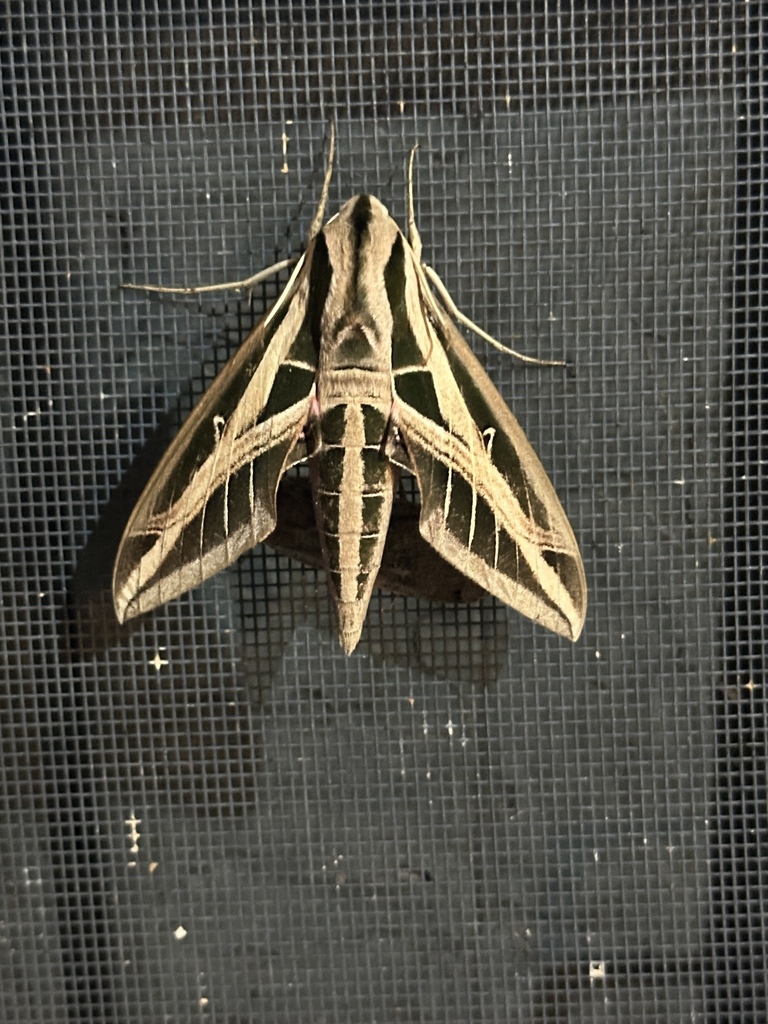
(c) Nancy Tulloch, some rights reserved (CC BY) · licence
Family: Sphingidae · Class: Insecta · Order: Lepidoptera
Eumorpha fasciatus (Banded sphinx) is a California animal in the Sphingidae family.
The banded sphinx (Eumorpha fasciatus) is a large moth in the hawkmoth family Sphingidae, with adults displaying a wingspan of 85 to 110 mm (3.3 to 4.3 inches). The forewings are olive-green to brown with distinctive dark bands and pale patches, while the hindwings are bright pink to rose-colored with black borders. The body is robust and streamlined, typical of hawkmoths, with a dark dorsal stripe and pale lateral markings. The species exhibits sexual dimorphism, with males having more pointed forewings and bushier antennae compared to females. The banded sphinx ranges from northern Argentina north through Central America and Mexico to southern California and southern Arizona, extending east to Texas, Mississippi, Florida, and South Carolina. The species occasionally strays north to Missouri, Michigan, Pennsylvania, New York, and Nova Scotia. In California, populations are primarily found in the southern counties, including San Diego, Imperial, Riverside, and Orange counties, where suitable host plants and climate conditions exist. This moth inhabits riparian areas, wetlands, and disturbed sites where evening primrose family plants grow. Adults are typically found from sea level to approximately 1,500 meters (4,900 feet) elevation. The species prefers areas with permanent or seasonal water sources that support the growth of primrose-willow and related host plants. Urban and suburban environments with ornamental Onagraceae plantings can also support populations. Adult banded sphinx moths are crepuscular and nocturnal, becoming active at dusk to feed on flower nectar. They are strong fliers capable of hovering while feeding, using their long proboscis to reach nectar deep within tubular flowers. Adults are attracted to various flowering plants including four o'clocks, petunias, and honeysuckle. The species has multiple generations per year in warmer climates, with peak abundance typically occurring from spring through fall. Females lay single eggs on host plant leaves, and larvae develop through five instars over approximately 3 to 4 weeks. Caterpillars feed exclusively on plants in the evening primrose family (Onagraceae), with primrose-willow (Ludwigia species) being the primary host. Larvae are large and distinctive, measuring up to 100 mm (4 inches) when mature. They typically display green coloration with diagonal white stripes and a prominent horn at the posterior end, characteristic of sphinx moth caterpillars. Pupation occurs in underground chambers, with adults emerging after 2 to 3 weeks in favorable conditions. The banded sphinx is not federally or state-listed as threatened or endangered and appears to maintain stable populations throughout much of its range. However, habitat loss due to wetland drainage and urban development may impact local populations, particularly in California where suitable riparian habitat is increasingly fragmented. The species benefits from conservation efforts that preserve wetland ecosystems and native plant communities. Climate change may affect the species' northern range limits and seasonal activity patterns, though the moth's broad geographic distribution and multiple host plants provide some resilience to environmental changes.
Classification
Class: Insecta · Order: Lepidoptera · Family: Sphingidae
Frequently asked questions
How is Eumorpha fasciatus classified?
Eumorpha fasciatus belongs to class Insecta, order Lepidoptera, family Sphingidae.
What family does Eumorpha fasciatus belong to?
Eumorpha fasciatus is in the Sphingidae family.
What is Eumorpha fasciatus?
The banded sphinx (Eumorpha fasciatus) is a large moth in the hawkmoth family Sphingidae, with adults displaying a wingspan of 85 to 110 mm (3.3 to 4.3 inches).
Is Eumorpha fasciatus found in California?
Yes. Eumorpha fasciatus is recorded in California in The California Species Project's catalogue.
Related species
Other California species in the same genus, family, or bioregion.
Data from The California Species Project — 14,000+ California species with verified data from CNPS, CDFW, USFWS, and more.