Euodynerus hidalgo
Hidalgo Mason Wasp
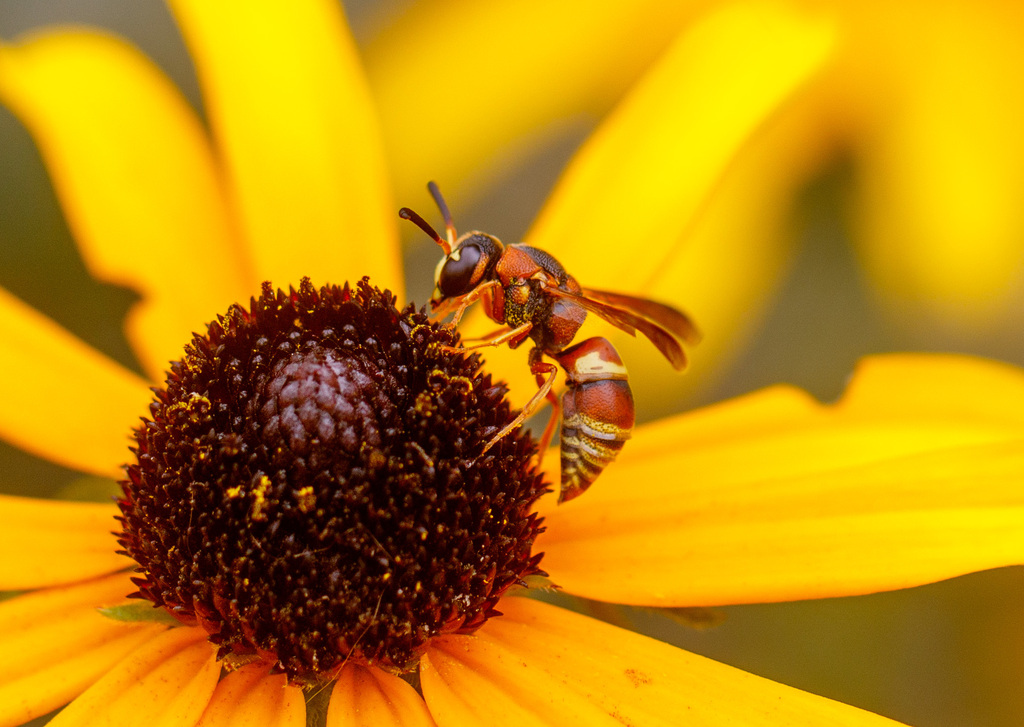
(c) threelark, some rights reserved (CC BY) · licence
Family: Vespidae · Class: Insecta · Order: Hymenoptera
Euodynerus hidalgo (Hidalgo Mason Wasp) is a California animal in the Vespidae family.
The Hidalgo Mason Wasp is a solitary wasp species belonging to the subfamily Eumeninae (Potter and Mason Wasps). Originally described by Saussure in 1857 as Odynerus hidalgo, this species is distinguished by thin, lamellate, reflexed hind margins of the 2nd and 3rd urotergites, which serve as diagnostic features (BugGuide 2025). The amount of black coloration is highly variable in this species, with western populations typically displaying more extensive yellow markings than eastern subspecies. Euodynerus hidalgo exhibits a broad North American distribution, with documented populations ranging from Michigan north to Missouri, west to Kansas, Colorado, and California. The species has been recently reported expanding its range into several eastern states outside its previously known distribution, including Michigan, North Carolina, New York, Tennessee, and Pennsylvania (BugGuide 2025). In California, the species has been recorded in Los Angeles County, with documented observations at Rancho Santa Ana Botanic Garden in Claremont. The species occurs across diverse habitats throughout its range, from sea level to approximately 7,000 feet elevation. In California, specimens have been observed visiting native flowering plants, including Encelia californica (brittlebush), suggesting an association with chaparral and desert scrub communities. The wasp's habitat preferences appear to encompass both arid and mesic environments across its transcontinental range. As a member of the mason wasp group, Euodynerus hidalgo constructs mud nests in cavities or creates free-standing mud structures. Adult wasps are active during warmer months, with California observations documented in June. The species likely provisions its nest cells with caterpillars, following the typical eumenine wasp pattern of paralyzing lepidopteran larvae as food for developing offspring. Adults visit flowers for nectar, serving as pollinators for various native plant species. Two recognized subspecies exist: E. h. hidalgo (the eastern subspecies, also known as boreoorientalis) and E. h. viereckii (the western subspecies occurring from Washington to California and east to Idaho and Colorado). The western subspecies displays more extensive yellow markings compared to the predominantly black eastern form, though both maintain the characteristic membranous, upturned apical lamella of terga 2 and 3. Currently, Euodynerus hidalgo holds no federal or state conservation listing status. The species appears stable across much of its range, with documented range expansion suggesting healthy population dynamics. However, like many native pollinators, the species may face pressures from habitat loss, pesticide use, and climate change. The wasp's apparent adaptability to various elevations and habitat types may provide some resilience against environmental changes. Continued monitoring of population trends and habitat requirements would benefit conservation planning for this and other native mason wasp species. Scientific documentation for this species remains somewhat limited regarding specific ecological requirements and population estimates. Community observations through platforms like BugGuide provide valuable distribution and behavioral data that supplement formal taxonomic studies.
Classification
Class: Insecta · Order: Hymenoptera · Family: Vespidae
Frequently asked questions
How is Euodynerus hidalgo classified?
Euodynerus hidalgo belongs to class Insecta, order Hymenoptera, family Vespidae.
What family does Euodynerus hidalgo belong to?
Euodynerus hidalgo is in the Vespidae family.
What is Euodynerus hidalgo?
The Hidalgo Mason Wasp is a solitary wasp species belonging to the subfamily Eumeninae (Potter and Mason Wasps).
Is Euodynerus hidalgo found in California?
Yes. Euodynerus hidalgo is recorded in California in The California Species Project's catalogue.
Related species
Other California species in the same genus, family, or bioregion.
Data from The California Species Project — 14,000+ California species with verified data from CNPS, CDFW, USFWS, and more.