Eupackardia calleta
Calleta silkmoth
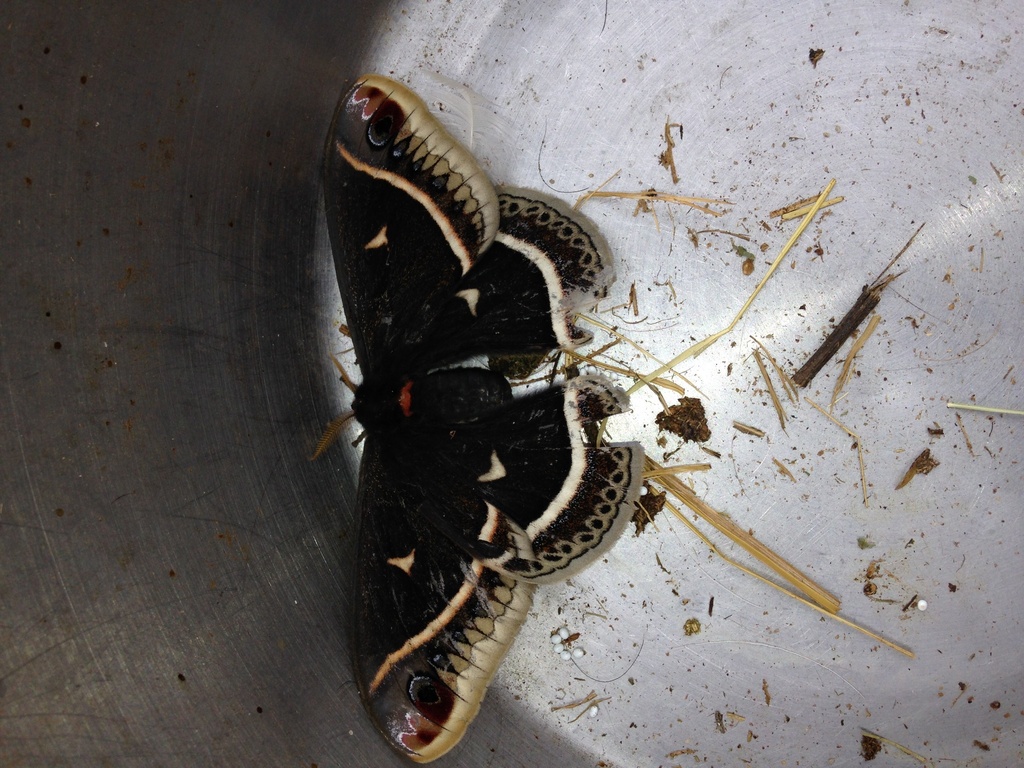
(c) CH Hemphill, some rights reserved (CC BY) · licence
Family: Saturniidae · Class: Insecta · Order: Lepidoptera
Eupackardia calleta (Calleta silkmoth) is a California animal in the Saturniidae family.
The Calleta silkmoth is a large saturniid moth native to the southwestern United States and northwestern Mexico. Adults have a wingspan reaching approximately 90-120 mm (3.5-4.7 inches), with distinctive brown and tan coloration marked by prominent eyespots on each wing. The forewings display a diagonal white stripe, while the hindwings feature large, circular eyespots with dark centers surrounded by concentric rings of brown, tan, and white. Males are typically smaller than females and possess more feathered antennae. The species ranges from the Rio Grande Valley and Big Bend areas of Texas, through southern Arizona and southwestern New Mexico, extending south to Veracruz, Mexico, and Guatemala. In Arizona, populations are documented from Pima and Santa Cruz counties, including areas near Ajo and Sonoita Junction. The moth inhabits xeric regions of the Sonoran and Chihuahuan deserts, where it has adapted to extreme temperature fluctuations and limited water availability. Calleta silkmoths occupy desert scrubland and thornscrub habitats characterized by drought-tolerant vegetation. Larvae feed on several host plants including Sapium biloculare (Chinese tallow tree) and Tecoma stans (yellow bells or esperanza), with feeding documented on these species in Arizona populations (Lepidopterists' Society 1977, 2001). The species shows preference for areas with scattered shrubs and trees that provide both larval food sources and adult roosting sites. The species exhibits a univoltine life cycle with adults emerging primarily in late winter and early spring. Mating typically occurs after 8:00 a.m., distinguishing it from related species like Rothschildia forbesi which mates in late evening (Lepidopterists' Society 2001). Females deposit eggs on host plant foliage, and larvae develop through five instars before pupating in distinctive brown cocoons. These cocoons have cultural significance, being traditionally collected by Yaqui Indians in Arizona and Mexico for use as rattles in ceremonial contexts (Peigler & Maldonado 2005). The Calleta silkmoth lacks federal or state conservation listing status. However, like many desert-adapted species, populations face pressure from habitat loss due to urban development and agricultural conversion within its limited U.S. range. Climate change may pose additional challenges through altered precipitation patterns and increased temperature extremes in desert ecosystems. The species' dependence on specific host plants and its relatively restricted distribution in the United States make it potentially vulnerable to environmental changes. Population trends and detailed ecological studies remain limited, with most biological information derived from lepidopterist observations and breeding records rather than comprehensive surveys.
Classification
Class: Insecta · Order: Lepidoptera · Family: Saturniidae
Frequently asked questions
How is Eupackardia calleta classified?
Eupackardia calleta belongs to class Insecta, order Lepidoptera, family Saturniidae.
What family does Eupackardia calleta belong to?
Eupackardia calleta is in the Saturniidae family.
What is Eupackardia calleta?
The Calleta silkmoth is a large saturniid moth native to the southwestern United States and northwestern Mexico.
Is Eupackardia calleta found in California?
Yes. Eupackardia calleta is recorded in California in The California Species Project's catalogue.
Related species
Other California species in the same genus, family, or bioregion.
Data from The California Species Project — 14,000+ California species with verified data from CNPS, CDFW, USFWS, and more.