Euphagus carolinus
Rusty Blackbird
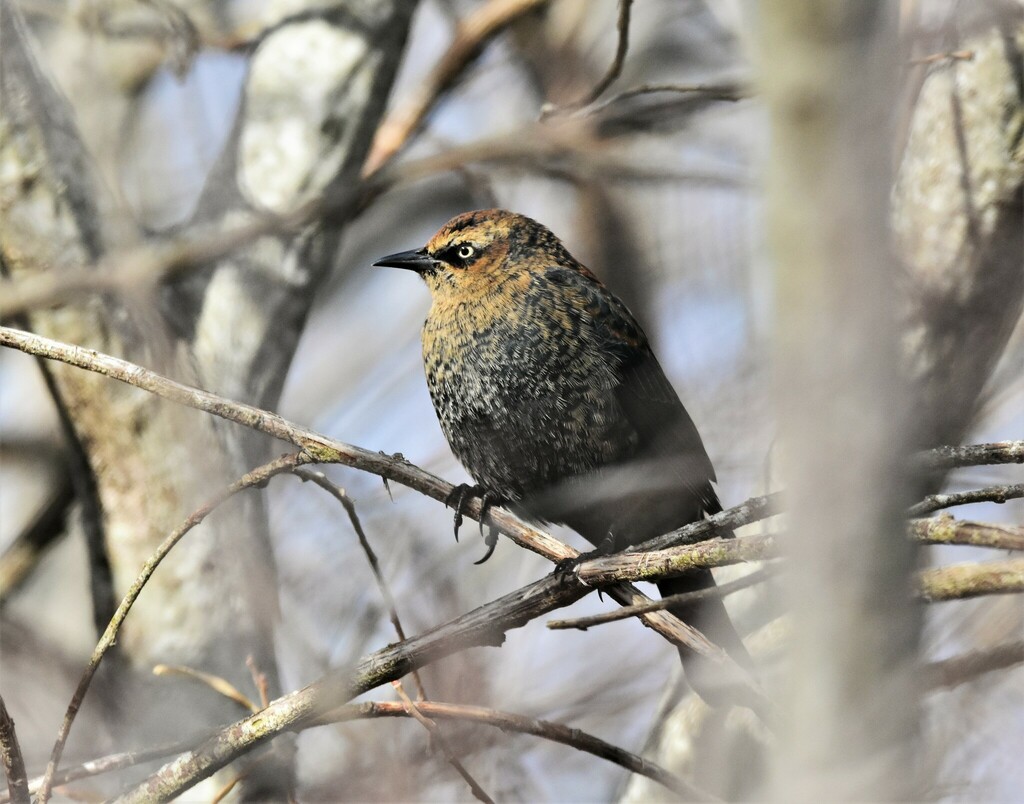
(c) Zac Peterson, some rights reserved (CC BY) · licence
Family: Icteridae · Class: Aves · Order: Passeriformes
Euphagus carolinus (Rusty Blackbird) is a California animal in the Icteridae family.
The Rusty Blackbird is a medium-sized songbird measuring 20-25 cm (8-10 inches) in length with a wingspan of 36 cm (14 inches). Adults weigh 50-70 grams. During breeding season, males display glossy black plumage with a greenish iridescence, while females are slate-gray. In fall and winter, both sexes develop rusty-brown edges on their feathers, giving the species its common name. The bill is straight and pointed, adapted for probing and gleaning prey. Eyes are pale yellow in adults, distinguishing them from similar blackbird species. Historically, Rusty Blackbirds bred across the boreal forests of Alaska and Canada, with their range extending south into the northern United States. In California, the species occurs as a rare migrant and winter visitor, primarily in the northern and central regions. According to eBird data, most California records come from the Central Valley, San Francisco Bay Area, and Sierra Nevada foothills during fall and winter months. The species typically appears between September and March, with peak abundance in October and November. Rusty Blackbirds inhabit wetland edges, wooded swamps, beaver ponds, and riparian forests during breeding season. In California, wintering birds frequent agricultural areas, flooded fields, livestock ponds, and marsh edges. The species shows strong preference for areas with standing or slow-moving water combined with adjacent trees or shrubs for roosting and nesting cover. Elevation range in California extends from sea level to approximately 1,500 meters (4,900 feet). During breeding season, Rusty Blackbirds consume primarily aquatic invertebrates including dragonfly larvae, beetles, and crustaceans, obtained by probing in shallow water and mud. Winter diet shifts to include seeds, waste grain, and terrestrial insects. The species often forages in mixed flocks with other blackbirds and starlings in agricultural settings. Breeding occurs from May through July, with females constructing cup-shaped nests in shrubs or small trees near water. Clutch size ranges from 3-5 pale blue-green eggs marked with brown spots. Incubation lasts 14 days, with fledgling period of 11-14 days. The Rusty Blackbird has experienced one of the steepest population declines of any North American songbird. According to the North American Breeding Bird Survey, populations declined by approximately 95% between 1966 and 2019. The species is listed as Vulnerable by the International Union for Conservation of Nature and is considered a species of high conservation concern by Partners in Flight. Primary threats include habitat loss from wetland drainage, forestry practices that eliminate suitable nesting habitat, and climate change affecting boreal forest ecosystems. Mercury contamination from atmospheric deposition may also impact reproductive success. In California, the species benefits from wetland restoration projects and sustainable agricultural practices that maintain flooded fields during winter months.
Classification
Class: Aves · Order: Passeriformes · Family: Icteridae
Frequently asked questions
How is Euphagus carolinus classified?
Euphagus carolinus belongs to class Aves, order Passeriformes, family Icteridae.
What family does Euphagus carolinus belong to?
Euphagus carolinus is in the Icteridae family.
What is Euphagus carolinus?
The Rusty Blackbird is a medium-sized songbird measuring 20-25 cm (8-10 inches) in length with a wingspan of 36 cm (14 inches).
Is Euphagus carolinus found in California?
Yes. Euphagus carolinus is recorded in California in The California Species Project's catalogue.
Related species
Other California species in the same genus, family, or bioregion.
Data from The California Species Project — 14,000+ California species with verified data from CNPS, CDFW, USFWS, and more.